Poker Quiz! 2-Pair Facing an Overbet, What Do You Do Here?
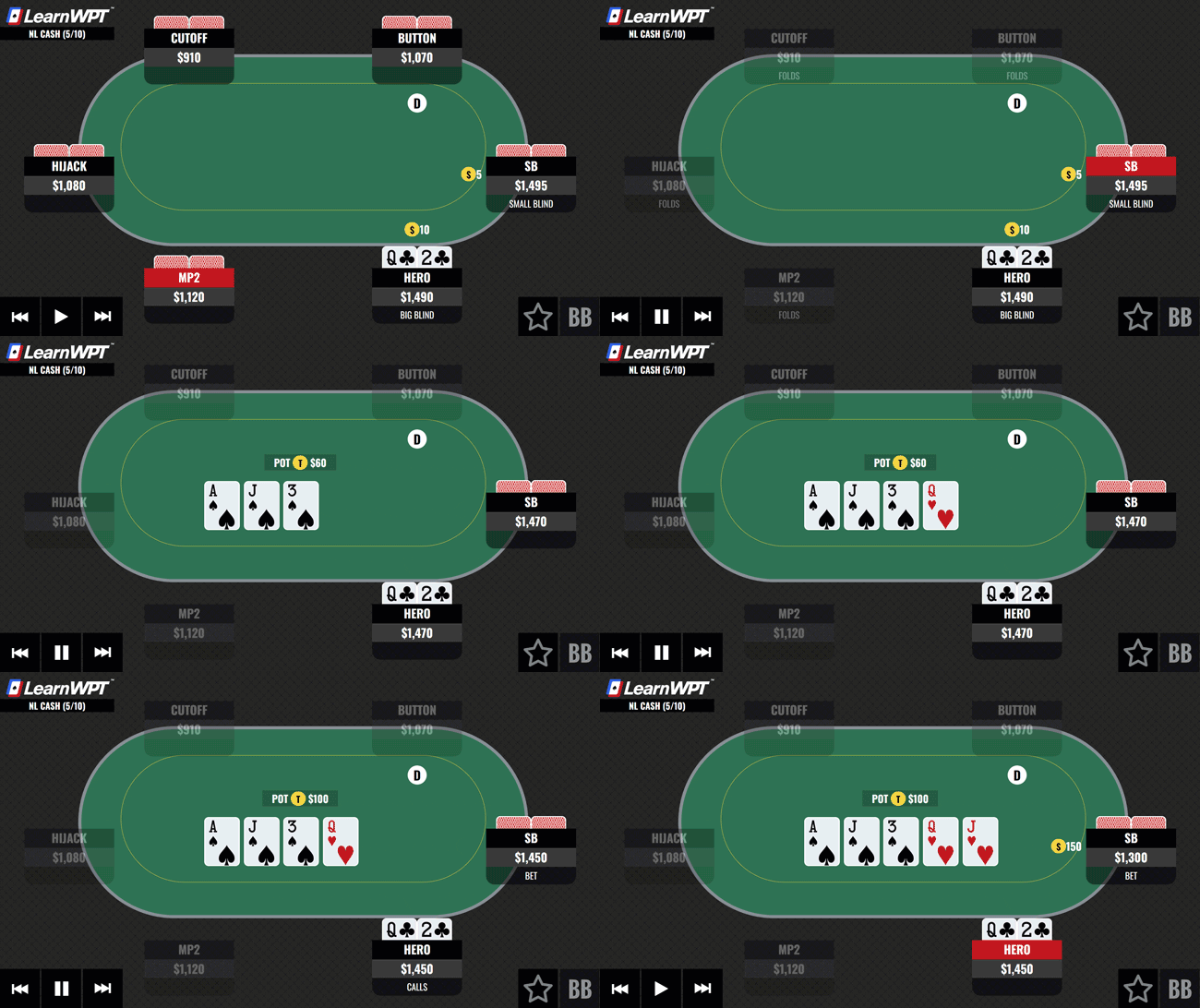
DECISION POINT: You are six-handed in a live $5/$10 cash game with 150BB effective stacks. The action folds to the Small Blind who raises to $30 and you call from the Big Blind with Q♣2♣. The A♠J♠3♠ flop gets checked around. Your opponent bets $20 on the Q♥ turn and you call. The river is J♥ and Villain overbets to $150. Action is on you, what do you do here?
PRO ANSWER: We are playing a six-handed $5/$10 cash game with 150BB effective stacks. We are dealt Q♣2♣ in the Big Blind and everyone folds to the Small Blind who raises to $30. While Q2s isn’t a very strong hand we are in position against a wide range from the Small Blind so we have to defend with a larger frequency than we normally might against other positions.
We call and the flop is A♠J♠3♠. Monotone boards, or boards that contain all of one suit, can be quite tricky to play since there are many equity changing cards that can fall on the turn or river. With this board being ace high it favors the preflop raiser’s range slightly, however our defending range in the Big Blind has a lot of suited hands so they have to navigate carefully. In this spot the Small Blind opts to check the flop, and we have our first real decision.
Our hand has little showdown equity which makes it a prime bluff candidate, but our opponent will also be betting a somewhat polarized range here that consists mostly of complete bluffs and strong Ax hands or better. That means that the Small Blind’s checking range is often capped but it also often has some equity which can make it unlikely for us to win this pot by firing a single barrel.
Continued below...

When we plug this specific spot into a solver, we can see actually just how close this decision is. The output recommends a check 40% of the time and bets a mix of different sizes 60% of the time. In real-time we opt to check and the turn is the Q♥. This is one of the better turn cards for us as we likely have some showdown value. Our opponent bets $20 into the $60 pot.
The Small Blind still has an overall equity advantage as they still have a lot of the weaker Ax hands in their range as well as some KsXx and TsXx hands that are semi-bluffing with good equity. Our hand is too strong to give up with at this point and is also too strong to turn into a bluff by raising.
We call and the river is the J♥. Our opponent bets $150 into the $100 pot. At this point their range is extremely polarized and our hand is just a bluff catcher. Given that we need to call $150 to win $250, the Small Blind would have to be bluffing 37.5% of the time to make calling the river overbet a break even play.
Although the solver input indicates there are several bluffs in the Small Blind’s range, this spot is a very clear fold. While solvers assume our opponent plays perfectly, the player population as a whole doesn’t tend to find these overbet bluffs with the appropriate frequency and from random opponents they often heavily indicate value.
Folding is the best play.
How would you play it?
Share your answer in the comments below!
“Did I play that hand right?”

It’s that fundamental question that, as poker players, we all ask ourselves on a regular basis…
Get clear answers to all of your questions with the popular Fearless River Ask a Pro Feature.
- Members can ask poker questions to get in-depth answers from the Fearless River Pros
- Discuss poker strategy with our Pros and fellow Members
- Submit YOUR poker hands to get expert analysis and feedback by real poker coaches
Find out what’s it like to have a poker coach help you improve your game by trying out your 1st month of membership for just $5.
Have Questions? Email our support team at [email protected].