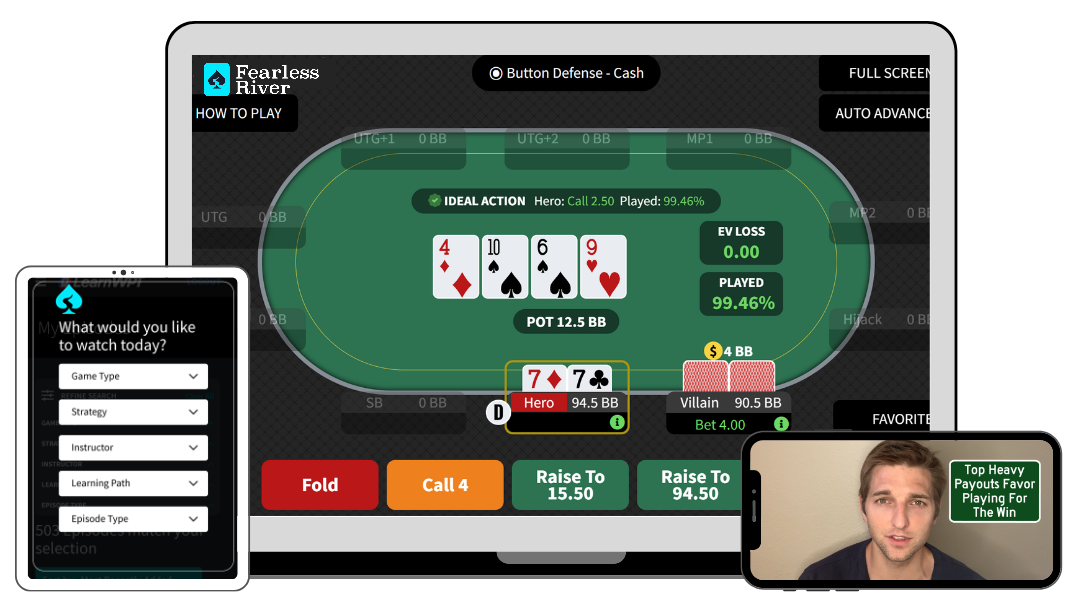
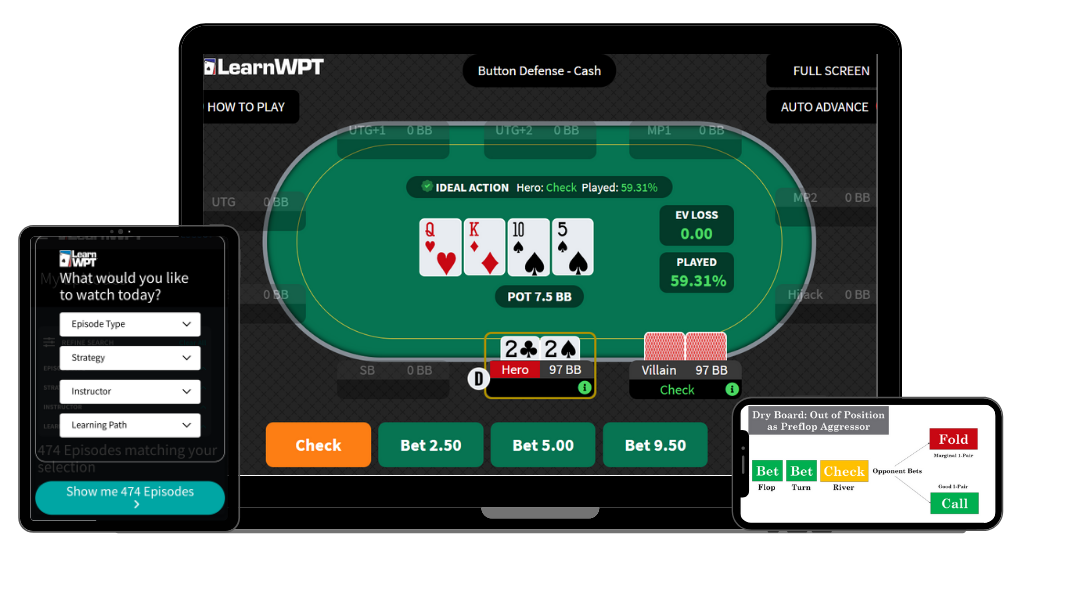
Q♣Q♥ From the Cutoff, what do you do here?

QQ from the Cutoff-optmzd.gif


DECISION POINT:
You are in a 100 BB deep cash game against tough opponents. The action folds to you in the Cutoff with Q♣Q♥ and you raise to 3 big blinds. The Button and Small Blind both fold and the Big Blind calls. Your opponent checks the K♠8♣J♠ flop and action is on you. What do you do here?

PRO ANSWER: This hand comes from the WPT GTO Trainer and involves a cash game scenario where we are 100 BBs deep and it folds to us in the Cutoff with pocket queens. We raise to 3 BBs and it is folds to the Big Blind who flat calls and we’re off to the flop.

The flop is Ks8cJs and the Big Blind checks to us. Since this is a GTO opponent (all opponents in the WPT GTO trainer play game theory optimal ”perfect” poker) we know that they will be appropriately defending against what is a very wide Cutoff opening hand range.

One of the first questions we want to ask when deciding if we should bet the flop with a made hand is “how many streets of value is our hand worth?” In this particular case even with us opening a wide hand range and our opponent defending with a very wide range, if money goes into the pot on all three streets it is very unlikely that second pair to the board is the best hand.

Another question we want to ask is “does our hand benefit from equity denial here?”. While there are some obvious draws on this board, we are unlikely to fold out any flush draws and we block all the straight draws with our queens even if we choose to bet.

Continued below...

We would potentially fold out some ace high hands that could improve on the turn, however in this spot a GTO opponent may continue with even ace high. In this situation our particular holding doesn’t benefit much from equity denial and it is not strong enough to bet, so we really don’t want to start building a huge pot.

This hand is an excellent candidate to balance our checking range and induce some value from hands like Jx or 98s or even induce bluffs from a GTO opponent. Keep in mind that against some “real world” opponents who are either very loose/passive or extremely fit or fold postflop, taking a more exploitative line here by betting the flop may be more profitable than checking.

However, against a GTO tough opponent though who may be capable of check-raising us with a variety of bluffs and backdoor draws, checking here to keep the pot small and get to a controlled showdown versus a wide range is the most profitable play.

Checking is the best play.

How would you play it?
Share your answer in the comments below!


THE WPT GTO TRAINER
The Fastest Way to Learn GTO Strategy

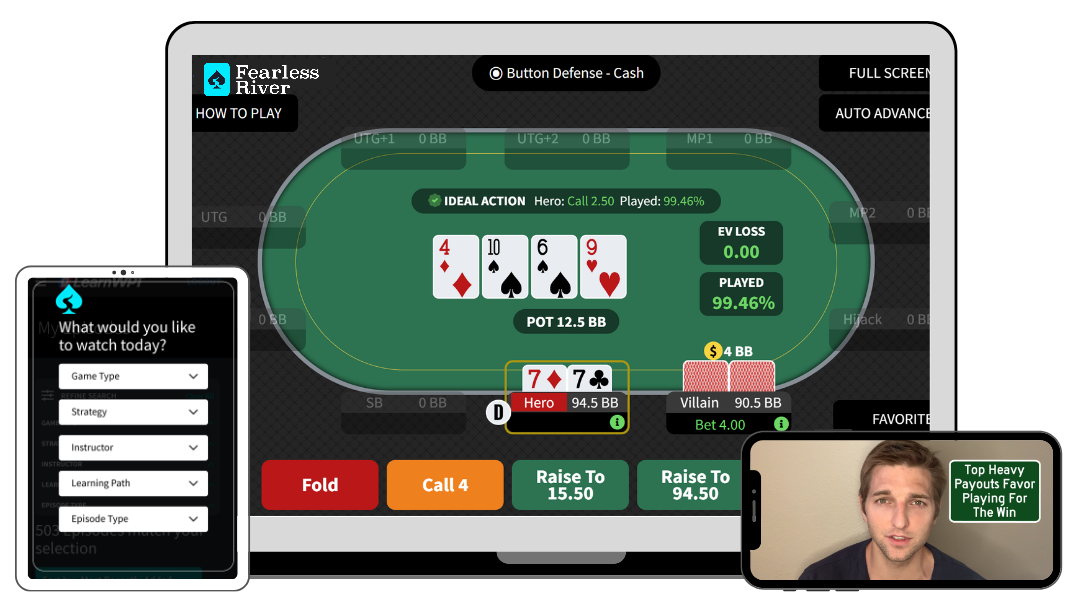
The WPT GTO Trainer allows you to Play and Train against True GTO Opponents and get real-time Feedback and Analysis on Your Actions.

Choose from Cash Game and Tournament scenarios and receive immediate feedback on YOUR play compared to GTO including EV (expected value) Loss, Percentage Played, and the Ideal Action.

Click the button below and play the WPT GTO Trainer for free....


Join Fearless River.com for just $5 your First Month of Membership and play through hundreds of solved hands per hour (anytime, anywhere, and as many hands as you want) on the WPT GTO Trainer!


WPT GTO Trainer: Practice Final Table Play

All of the big prizes and money in a Tournament are at the Final Table. Whether it is your local daily or a WPT Main Event, understanding the unique strategy adjustments for Final Table play is vital to finishing strong.

Tony-Dunst-LearnWPT-Instructor


Are you prepared
to put pressure on a short stack and do you know how to respond when the pressure is on you?

Do you consider ICM (the estimated dollar worth of a stack size) and how to adjust when there are pay jumps?

We are excited to announce the brand-new WPT GTO Final Table Play scenarios to help better prepare you to make the most of your next Final Table!

GTO Trainer - Final Table Pack Select-resized.png


Members can click "What you would like to train today?", select the Final Table Play filter, and choose from the list of available scenarios to start training.

Review the payout structure before you begin by clicking the Payouts link. These numbers represent the percentage of the prize pool for each place.

GTO Trainer - FT Payouts - resized.png


Click START NEW SESSION and begin! Practice these new simulated Final Table situations to gain valuable experience, be better prepared, and have the advantage the next time you are in position to win.

WPT-GTO-Triner-Final-Table-Play.jpg

Play through 5 FREE solved random hands from the WPT GTO Trainer Final Table Scenarios by clicking below and see how close you are to GTO play...

Your goal is to select the action for each individual hand that is as close to 0.00 EV as possible.

LearnWPT Membership Features - Devices


Not a Member?
Join Fearless River.com for just $5 your first month of Membership to play more GTO hands (and as often as you like) to find YOUR leaks and start seeing true stats for YOUR play!


Get real time feedback on trouble Spots and Ask the Fearless River Pros with one click.


A♠A♥ Facing a Flop Check-Raise, what do you do here?

AA Facing a Flop Check-Raise-optmzd.gif

DECISION POINT: In a live $1-3 game with a $6 Under The Gun straddle, the UTG+1 player calls and it folds to you in the Hijack. You raise to $25 with A♠A♥. The Button and UTG call and UTG+1 folds. UTG checks the 3♠3♦5♣ flop and you bet $35. The Button folds and UTG check-raises to $70. Action is on you, what do you do here?

PRO ANSWER: We are dealt pocket aces in the Hijack seat in a $1-3 cash game with a $6 straddle from under the gun. UTG+1 calls the straddle and it is folds to us. In this spot it is standard to make it 3x the straddle amount plus the call amount, or $24.

In most common live games players in the UTG straddler tends to be “stickier” than other players. Making an UTG straddle is a bad play, and people do it to either create action or gamble. Because of those reasons the likelihood of UTG folding goes down significantly. In addition, if we make our raise too small the UTG+1 player is likely to call as well, and taking a multiway pot with pocket aces isn’t what we want to do. This is a spot where we should probably make it $30+ but in the moment we elect to bet $25 instead and get called by both the Button and the UTG straddler.

The flop is 3s3d5c and is one of the better flops for us that doesn’t contain an ace. UTG checks and action is on us. Given the dryness of the board and how our hand performs versus our opponent’s ranges, we don’t need to bet very big here. Something in the neighborhood of 35-40% of the pot is perfectly fine, especially given that the stack to pot ratio (SPR) is around 3. The Button folds and the original straddler min-raises to $70.

Continued below...

Preflop Raise Sizing Ep2 300x250.png

This is a spot where some players often see monsters under the bed. The very small raise does make it less likely that our opponent is bluffing, since they can reasonably expect us to call with most of our range. That being said, their range here is much wider than just 3x/55. Our opponent could easily have other overpairs, or could be setting up a big turn semi-bluff with a hand like A2s/A4s/46s/76s. Villain could also be overvaluing a hand like 77/88 or even A5s in this spot. Sometimes our opponent will have 55/3x and we will be crushed.

When we consider all the hands UTG's range we are way ahead, especially once we factor in that our opponent is straddling UTG preflop. Straddling from UTG is a very negative expectation play typically used by people who are looking for action rather than a tight aggressive strategy.

Given the overall wide range UTG can have in this spot and our position, if we move all-in now it gives our opponent the opportunity to get away from some of their semi-bluffs and even A5s type hands fairly easily. If we proceed by calling we give UTG additional opportunities to pot commit themselves on future streets with bluffs and worse value hands, which is very good for us.

Calling is the best play.

How would you play it?
Share your answer in the comments below!


WHAT IS A LEARNWPT STRATEGY EPISODE?

Animal - HIT resized and optimzd.png

We started Fearless River to make it easy for everyone to improve their game in their spare time.

That’s why we present our Members with poker “lessons” via Strategy Videos so they can elevate their games by watching a short video on a phone, tablet, or personal computer.

Strategy Episodes are presented in short, easy to digest segments (usually 10-15 minutes) that focus on introducing and reinforcing specific aspects of the Fearless River game plan.

Join Fearless River.com for just $5 your first month and start improving your game with our on-demand library of over 450 game-changing strategy videos and access to all of the Fearless River Membership Features!


Have Questions? Contact the support team at [email protected] and we'll be happy to help!

You Look Down at T♣T♥, Now What?

Pocket tens - resized.jpg


For most players the middle pocket pairs (eights through tens) are some of the trickiest hands to play.

When playing middle pairs, your position and the number of opponents in the pot should significantly influence your decision-making.

Accurately putting your opponent on hand ranges is also extremely important for taking down pots with middle pocket pairs.

Put your decision-making skills to the test against our Pros with the following scenarios and be ready to make the best decision possible the next time you look down at a middle pocket pair:

Deliberate application of key concepts at the table and consistent practice of your decision-making skills is essential for success in No-Limit Hold’em.

Remember… Amateurs play, Pros practice!

That’s why we ask that you read these scenarios and keep practicing… even if you don’t always agree with our analysis.

See you online,
-Fearless River

P.S. A Membership with Fearless River is the easiest way to add more levels of complexity and nuance to your game PLUS members have access to 300+ scenarios like this to practice!


How are these Decision Scenarios helping improve your game?
Post your answers in the comments below.

LearnWPT-Poker-Training

Think Like a Pro

K♦8♦ on the River, what do you do here?

K8 on the River-optmzd.gif


DECISION POINT:
In a Tournament where blinds are 500/1,000 it folds to you in the Cutoff. You minraise with K♦8♦ to 2,000 and it folds to Big Blind who calls. Big Blind checks the 2♠K♣7♠ flop, you continuation bet, and Villain calls. The 9♠ turn is checked. The K♥ comes on the river giving you trips and BB check-raises. Action is on you, what do you do here?

PRO ANSWER: In a multi-table tournament at 500/1,000 blinds we are dealt K8s in the Cutoff seat. It folds around to us and we make a standard raise for this point in the tournament to 2,000 and the Big Blind is the only caller. Even though we only raised to the minimum amount preflop, often in the mid/late stages of tournaments this small of a raise size is more than enough to put our opponents to meaningful decisions and skew the risk vs reward heavily in our favor, allowing us to steal more often and play more hands.

The flop is 2sKc7s and the Big Blind checks to us. This is a relatively dry flop and we have a massive range advantage in this spot as the preflop raiser. Given both of these factors we should continuation bet and favor a smaller bet size. We choose to make it 2,000 and our opponent calls.

The turn is the 9s. This is actually a close decision for us. Our opponent could reasonably have called on the flop with a flush draw, but they could also have any pair as well as ace high. Many of those are hands that we beat that will fold if we bet again, making it tough for us to get additional value out of our hand.

On the other hand we don’t want our opponent to get a free card with any of the random hands containing only 1 they could have in their range. If the pot were much bigger in relation to our stacks, we could make a better case that equity denial is more important than extracting some additional value in this spot. We decide to check in order to induce some bluffs from our opponent on the river as well as get some value out of some 2x/7x hands (or hands like 55 or ace high) on the river.

Continued below...

The river is the Kh and our opponent checks to us. Given the action so far it is difficult to put our opponent on a big hand. We have to figure most flushes or Kx hands would bet this river given the action thus far, so we’re really targeting 7x/2x/55/Ax type hands if we decide to bet. Given those target hands are all relatively weak, a smaller bet sizing seems reasonable. We elect to go with 2,000 which may be a little too small as most players who will call 2,000 here will likely call a bet as large as like 3,000-3,500 as well. Our opponent raises to 5,000.

This is one of those spots where game theory would say to call 100% of the time with our hand. We only need to have the best hand 16% of the time and our line in this spot somewhat caps our hand range, making it harder for us to have a strong hand.

If our opponent believes we have a capped range, they should be bluffing some percentage of the time which makes this a fairly trivial call. In the real world we will run into opponents who simply never check-raise bluff the river and we are ahead here very close to 0% of the time.

The price we are getting to make this call is simply too good given the strength of our hand. If we had an opponent specific read then we could perhaps make an exploitative lay-down here. Absent that information we are simply too strong to fold.

Calling is the best play.

How would you play it?
Share your answer in the comments below!


Ready For Better Tournament Results?

Instructors Chewy-Nick-Eric-optmzd.png

Fearless River Tournament Strategy Workshops are for poker players who know the fundamentals of tournament strategy and are ready to take their game from good to great.

Attend a Live Workshop and learn...

  • Strategies to take you from a player who "min-cashes" to one who dominates the final table
  • What it takes to "close the deal" in Tournaments including final tables, short-handed play, heads up play, and deal-making
  • How to thrive in today’s competitive tournaments

Start improving your results with the help of Fearless River's world-class teachers and Pros who boast over 17 Million in combined tournament winnings!


Have a question about Fearless River?
Contact us at [email protected] or (888)600-5593 and we’ll be happy to help!


Tony Dunst's Fold on the River...

Tony Dunst TOC (4).jpg


Fearless River Instructor Tony Dunst recently faced a tough river spot against two time WPT Champion J.C. Tran at a $3500 buy-in event at Thunder Valley Casino.

Check out Tony's blog where he breaks exactly what he was thinking during this heads up battle against a fellow WPT Champion.

Learn more about Tony and how he can help improve your game by clicking here: Meet Fearless River Instructor Tony Dunst

P.S. Join Tony on Tour and put what you've learned into play at the table! Click here to view the World Poker Tour's calendar of events.


Start Improving Your Game!
Join Fearless River and Get:

LearnWPT-Poker-Training

Think Like a Pro


Join (just $5 your first month) to start improving your game!

Have Questions about Fearless River? Email us at [email protected] and we’ll be happy to help!

Fearless River Poker Training's Foundations of No-Limit Texas Hold’em

Watch This Video for the Foundations of No-Limit Texas Hold'em & Get Free Poker Strategy

If you are eager to learn the Foundations of No-Limit Texas Hold'em, one of the most popular and exciting card games in the world, then this beginner's article guide is the perfect place for you.

And if you are new to the game but not sure where to start, don't worry Fearless River is here to help.

In the video above we covered some basic things a new poker player needs to know in order to play the game. Fearless River Lead Instructor Nick Binger shows you the Foundations of No-Limit Texas Hold’em:

  1. Poker hand rankings
  2. Tips for proper betting
  3. Handling cards
  4. Key strategies for selecting which hands to play at the start of each hand


Plus get FREE downloadable tools below!


FIRST-IN HAND RANGE CHARTS
FOUNDATIONS OF NO-LIMIT TEXAS HOLD’EM

First-In Hand Range charts are an amazing poker tool to help you quickly learn the Foundations of No-Limit Texas Hold’em. This tool will tell you what hands to play when you are the first person to put money into the pot at the poker table. They'll keep you on very solid, profitable ground and ensure that you aren't playing bad poker hands!

Download your FREE copy of first-in hand range charts here

Here are some tips for using them at the table:

  • Use the Position Graphic at the beginning to determine your position at the table and reference the appropriate chart for your seat. Always count backwards from the Button ("dealer button") to determine your position
  • You should raise with all hands highlighted in PINK. Do not call the minimum bet amount - RAISE!
  • Your raise sizing should be 3 times the big blind amount. For example if blinds are 100-200 in a tournament and you elect to raise first-in to the pot, your total bet amount should be 600
  • Stay consistent with your raise sizing. If you raise a larger amount with a specific hand and smaller amounts with others, you will be easier to read at the table (IE don't raise to 600 with AA, but 400 with 99)


Remember, these charts are intended for use when you are the first person to put chips in the pot before the flop aside from the blinds (forced bets). If someone else has already voluntarily put chips in the pot before your turn to act, these charts do not apply.


THE 5 KEY 🔑FACTORS
FOUNDATIONS OF NO-LIMIT TEXAS HOLD’EM

When you join Fearless River.com for just $5 your first month we'll teach you the 5 Key Factors every player needs to know to put your opponents on accurate hand ranges!

  • Position
  • Range
  • Stack Depth
  • Board Texture
  • Number of Opponents


When you start playing, no matter if it is a cash game, online poker tournament or the biggest live poker event, understanding the fundamentals of No-Limit Texas Hold’em will help you elevate your skills toward becoming a professional poker player.

Check out this preview of the Episodes you'll receive as part of your $5 First Month Membership introducing the 5 Key Factors...


PRO TIP:
To build mental muscle memory for these tasks in real-time, focus on the 5 Key Factors even when you are NOT in the hand.


TRACK YOUR PLAY TO BUILD A STUDY ROUTINE

If you want to learn No-Limit Texas Hold’em poker strategy and start seeing better results at the table, the first step is to write down the specifics of what happens in hands when you are faced with difficult decisions.

Poker software programs that capture hand histories and allow users to control replays such as Fearless River’s Hand Input Tool, offer an easy way to enter hands with your favorite internet-connected device.

No-Limit-Holdem-Poker-Software-Program


When just beginning to study poker it’s often most beneficial to start tracking your play simply using a pen and paper. It is important to make sure you are tracking the right factors when noting hands for poker strategy study so that you can develop a consistent process and measure your progress.

Here is a simple checklist of 8 questions to use when tracking your play for poker strategy analysis:

  1. What was my seat position at the table?
  2. What were the seat positions of my opponents?
  3. What was my chip stack to start the hand?
  4. What were the chip stacks of my opponents to start the hand?
  5. What were my 2 cards, specific rank and suit?
  6. What were the community cards, specific rank and suit?
  7. What were the specific actions in the hand? Which player opened the betting?
  8. Did my opponents show down their hand, if so what were the specific cards?


Use this checklist to review your play on a regular basis and you will start to see patterns that can be adjusted to increase your win rate. It is very important to remember that the result of any given hand does not matter when studying poker hands to try and improve your game.

Focus your study on trying to determine what actions your opponent would take with all types of hands they could have in a specific spot and avoid trying to pinpoint a single hand.


NEXT STEPS

We created Fearless River to make it as easy as possible for anyone to improve their poker game, on their own time and their own terms. A plan for improvement that includes small, consistent amounts of effort over time is the key factor that most often separates winning pros and students of the game from the average poker player.

Ready to continue learning the Foundations of No-Limit Texas Hold’em Strategy and become a better player?

Enter your email in the box below or visit Fearless River.com and click the green PLAY NOW button to immediately gain access to Free Poker Strategy Content and Tools (including Full Fearless River Strategy Episodes)

PLUS Receive free poker strategy emails to your inbox each week.

No matter how you choose to use Fearless River.com there’s a path for you to learn, improve, and have fun on your own time and your own terms.

I am honored to be your guide on this journey and appreciate your support of Fearless River!

Nick Binger
Lead Instructor, Fearless River


LearnWPT-Poker-Training

TRAIN - PLAY - THINK
LIKE A PRO


Have Questions about Fearless River?
Send an email to our Support Team at [email protected] or click the red CONTACT US button and they will be happy to help!
The Mental Game with Jared Tendler: Setting Goals

Watch This FREE Episode From Fearless River!

Have you set your poker goals?

We want to help get you on the right track and give you a head start on the competition!

Watch this exclusive access to a full Strategy Episode from Fearless River Mental Game coach Jared Tendler to understand how setting goals are necessary to achieving success and growth in poker.

Get started on improving your Mental Game right now and learn:

  • How reflection is essential for measuring improvement
  • What the key methods are for setting process and results goals
  • When setting multiple goals is practical for maintaining motivation
  • And most importantly... discovering your Why!

Why Is The Mental Game Important?

We all make mistakes due to lack of focus, loss of motivation, or because we are simply unprepared. Thousands of hours studying hands and playing in pressure situations should make decisions easier over time, but even the best players in the world make mistakes when it matters most.

The key to improvement and avoiding these mistakes comes from being a student of The Mental Game.

In Strategy Episode 58, Jared introduces us to the concept of The Mental Game and why players of every skill level should add these strategies to their study routine right now!

Gain access to our full library of Mental Game Strategy Episodes from Jared Tendler right now when you join Fearless River.com as part of your $5 First Month Membership!

We'll see you online!
-Team Fearless River


learnwpt logo black-transparent-cropped-resized

Train - Play - Think Like a Pro!

Q♥J♥ Facing a Preflop All-in, what do you do here?

QJ Facing a Preflop All-in-optmzd.gif


DECISION POINT:
In a Tournament where blinds are 800/1,600 it folds to a Middle Position player who limps. The Hijack folds and you raise to 5,200 from the Cutoff with Q♥J♥. The Button folds, the Small Blind goes all-in, and both the Big Blind and MP2 fold. Action is on you, what do you do here?

PRO ANSWER: In a Multi-Table Tournament with 800/1,600 blinds and a 20 chip ante we are dealt QJs in the Cutoff. The MP2 open limps and it folds to us. We could potentially limp behind and play QJs speculatively as a suited connector. Specifically in tournaments, picking up chips is at a premium and a preflop raise here gives us an opportunity to take the pot down preflop or potentially on the flop with a continuation bet. While calling behind is profitable, raising is a better play. We decide to isolate with a raise to 5,200.

It folds to the Small Blind who moves all in for 19,000 chips. All of the other players fold and it is back on us with a decision to make. At this point there is 27,560 in the pot and it is 13,800 more to call. This means we are getting almost exactly 2:1 pot odds. Preflop hand values in No-Limit Hold’em run close enough together that it is extremely rare for a hand to have less than 33% equity versus all but the narrowest of ranges. We also have a reasonably strong hand for this situation, although probably not the best hand at the moment.

Continued below...

Commerce Static 300x250 c.png

Even if our opponent has a fairly narrow range such as 88+, ATs+, KQs, AJo+, KQo we still have over 33% equity here. The final factors to evaluate are specific to this tournament. If calling in this spot would have a significant impact on our stack’s ability to accumulate chips in the rest of the tournament we could consider passing on this edge. For example, if we call and lose and our 25-30 BB stack is reduced to 10 BB stack, we would lose the ability to steal or reshove and must play push/fold poker.

In this situation, if we call and lose this hand our stack will be reduced from around 30 BBs to 20 BBs. While the impact of losing our stack is not insignificant, it is not enough to warrant passing up on a profitable call here.

Calling is the best play.

How would you play it?
Share your answer in the comments below!


THE WPT GTO TRAINER
The Fastest Way to Learn GTO Strategy

The WPT GTO Trainer allows you to Play and Train against True GTO Opponents and get real-time Feedback and Analysis on Your Actions.

Fearless River.com Members can choose from Cash Game and Tournament scenarios and receive immediate feedback on their play compared to GTO including EV (expected value) Loss, Percentage Played, and the Ideal Action.

Click the button below and play the WPT GTO Trainer for free....


Join Fearless River.com for just $5 your First Month of Membership and play through hundreds of solved hands per hour (anytime, anywhere, and as many hands as you want) on the WPT GTO Trainer!


Q♥Q♦ Facing a River All-In, what do you do here?

QQ Facing a River All-In-optmzd.gif

DECISION POINT: In a Tournament a Middle Position player raises and it folds to you in the Big Blind. You 3-Bet with Q♥Q♦ and get a call. On the 8♠A♥J♣ flop you bet and MP2 calls. You check the 4♦ turn, MP2 bets, and you call. The river is 5♠ and you check. Your opponent goes all-in and action is on you. What do you do here?

PRO ANSWER: We are dealt pocket queens in the Big Blind. It is folded to MP2 who raises to 2.5 BBs. It folds to us and we reraise to 10 BBs and our opponent flat calls. The flop is 8sAhJc. With a stack to pot ratio (SPR) of just under 2 here it’s very difficult to get away from our hand. So the question is: how we can extract the most value out of our Pocket Queens?

A pure GTO solution to this situation involves a mixed strategy of checking to induce bluffs as well as betting extremely small (around 5.5 BBs). Both of these strategies keep our opponent’s range extremely wide and allow them to either bluff with much of their range (when we check) or call with worse hands than ours (when we bet small). In this situation we elect to make a small bet of 5.5 BBs and our opponent calls.

The turn is the 4d, which changes very little. Given our small bet on the flop we have encouraged our opponent to float (a float is when someone calls the flop to take the pot away on a later street) with a wide range. This means checking to them makes a lot of sense here to potentially encourage bets from many of the back door flush draws, weaker hands, and pure air that is in our opponent’s range. We check and our opponent bets 8 BBs.

Against tougher opponents who are capable of fighting for pots in this spot it is very important that we call here or else we have set our opponent up to be able to float us VERY profitably in this spot with their entire range. Against very straightforward opponents who are not capable of floating or bluffing with the correct frequencies we could make an exploitative fold here, but against tougher opponents we must call and we do.

Continued below...

The river is the 5s which changes very little given neither of our ranges rarely connect with it. We check and our opponent moves all-in. This is an extremely difficult spot versus a tough opponent. We’re getting nearly 3:1 on our money so before considering any other tournament factors, we need our opponent to be bluffing here around 25% of the time as we should only beat a bluff. If you use a GTO solver on this problem, it actually recommends a mixed strategy of calling and folding.

This is one of the real benefits of GTO solvers. It shows us how to optimally play against the very toughest opponents who are fighting hard for every last chip. Against the absolute toughest opponents who are capable of bluffing in this spot we should absolutely be calling some percentage of the time.

So the question we have to ask ourselves is: Is our opponent capable of floating and bluffing in this spot? In most regular tournaments where the field isn’t as tough and doesn’t play as optimally as the computer does in these spots, most players simply aren’t bluffing in these spots for all their chips often enough to justify calling here against all but the absolute toughest opponents.

Knowing the optimal way to play a situation and then adjusting for opponent tendencies is essential to adapting to the field in a post solver world.

Folding is the best play.

What would you do here?
Share your answer in the comments below!


Start Improving Your Game!
Join Fearless River and Get:

LearnWPT-Poker-Training

Think Like a Pro


To join (just $5 your first month) click the white JOIN NOW button in the top corner of your screen or the JOIN TODAY button below to start improving your game!


Have Questions about Fearless River? Email us at [email protected] and we’ll be happy to help!