Poker Quiz! A♠3♠ in the Big Blind Vs the Button, What Do You Do?
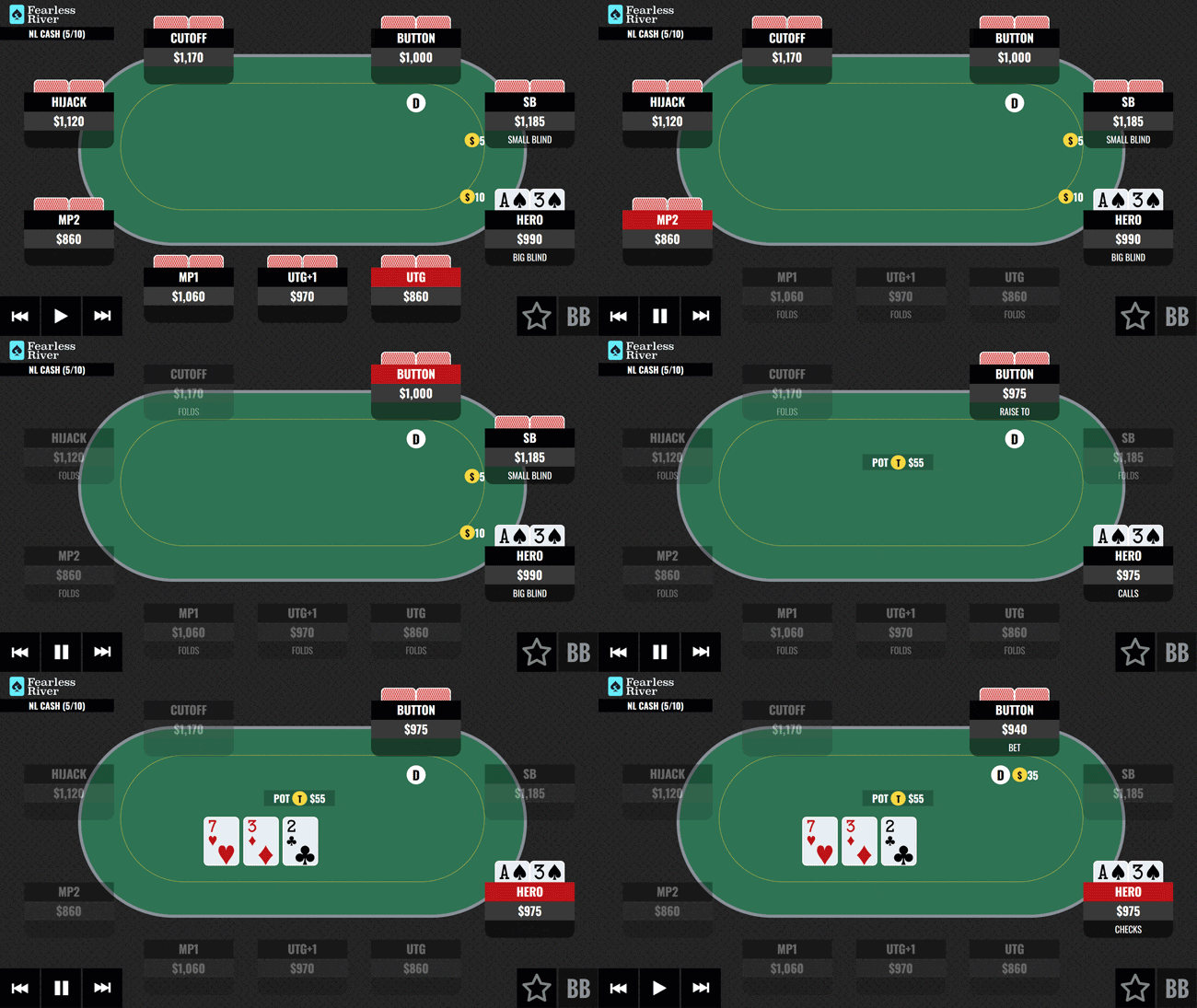
DECISION POINT: You just sat down at a live $5/$10 cash game with $1000 effective stacks and are dealt A♠3♠ in the Big Blind. Everyone folds to the Button who raises to $25, the Small Blind folds, and you call. You check the 7♥3♦2♣ flop and your opponent c-bets $35.
Action is on you, what do you do here?
PRO ANSWER: We are playing a live $5/$10 cash game with $1000 effective stacks and have just recently sat down so we have no relevant reads on the table. Everyone folds to the Button who raises to $25, the Small Blind folds and action is on us with As3s in the Big Blind.
Reraising preflop is certainly valid as a part of a polarized 3-betting strategy, however this hand falls more firmly into the category of a call. The output from a Game Theory Optimal solver prefers to 3-bet A5s, and A4s a portion of the time, leaving A3s and A2s as the suited wheel combinations that prefer calling in this scenario. When analyzing this strategy it’s important to note that 3-betting these hands as a bluff too frequently would imbalance our range.
If we chose to include A3s as part of our overall 3-betting strategy in this instance it could be acceptable, as long as we used some sort of suit or clock randomization technique to maintain appropriate balance. In situations where we have specific reads on an opponent, such as they will call 3-bets frequently but often fold to aggression postflop, we could widen our 3-betting range to include A3s.
In this instance we elect to call and the flop is 7h3d2c. While leading on some low card boards that favor a calling range over the Button’s raising range is a valid play, the default play in this defense calling scenario from the Big Blind is check to the preflop raiser. We do check, and the Button continuation bets $35.
Continued below...

Our pair of 3s is likely to be the best hand on the flop a vast majority of the time and folding to a standard c-bet in spot would be a huge mistake against skilled opponents. Both check-raising and calling have a positive expectation. Right away we can see that check-raising is problematic as our range doesn’t contain many combos that can check-raise for value when we are deep stacked. If a pair of threes is in our check-raising range here, it’s very easy for our range to contain too many weak hands and allow a good opponent to counter by calling or 3-betting more frequently.
We don’t have a backdoor flush draw and our straight draw can only be completed if 4 cards to a straight are showing on the board, so it is not very well disguised. Considering the specific factors in this hand as a whole, calling is the preferred play in this scenario.
Taking this line will likely require some difficult turn decisions where we sometimes may need to call on the turn with 3rd pair, however we show a positive expectation in the long run, especially vs skilled and aggressive opponents.
Calling is the best play.
How would you play it?
Share your answer in the comments below!
Get Ready To Launch Your Poker Game

The Fearless River Launch Tournament Poker Course is a 4-session system built by WSOP Bracelet winners and WPT Champions. You'll get a clear framework for every stage of a tournament and a structured curriculum covering essential concepts and easy-to-learn methods for implementing advanced tactics.
The course includes lifetime access to the recorded sessions, GTO trainer packs, supplemental strategy videos, range charts, and a private strategy Discord.
Have Questions? Email our Support Team at [email protected] or click the CONTACT US button.