Poker Quiz! What’s Your Move With J♥T♥ and Multiple Draws?
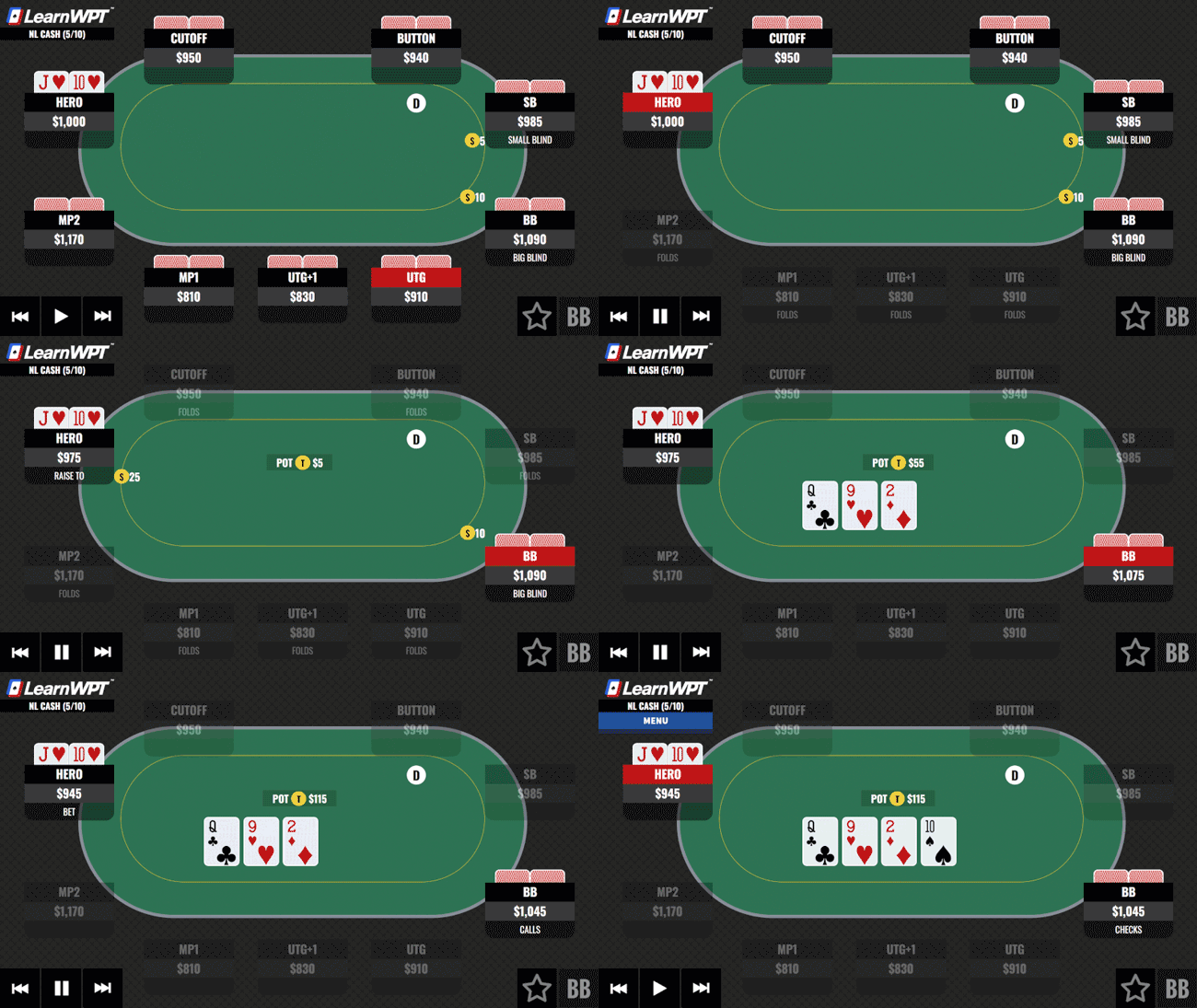
DECISION POINT: It’s early in a live $5/$10 cash game session, but you’ve observed that both players in the Blinds are solid opponents. Action folds to you in the Hijack, and you open to $25 (the standard table raise) holding J♥T♥. The Big Blind makes the call. The Big Blind checks the Q♣9♥2♦ flop. You bet $30 with an open-ended straight draw plus a backdoor flush draw, and they call. The turn is the T♠. Your opponent checks, and action is on you. What do you do here?
PRO ANSWER: We’re playing a live $5/$10 cash game. Most stacks are around $1,000, and the standard table raise has been between $25 and $30. It’s early in the session, but we’ve already picked up some reliable information and observed that both the Small Blind and Big Blind are competent opponents. Action folds to us in the Hijack with J♥T♥, and we make the standard first-in raise to $25. The Cutoff, Button, and Small Blind fold, and the Big Blind flat-calls. The flop comes Q♣9♥2♦.
This is a great board for our hand, giving us an open-ended straight draw plus a backdoor flush draw. Our opponent is a solid player, and they continue with the appropriate line of checking the flop when first to act after defending the Big Blind.
As the initial raiser, we have a significant range advantage on this board. The Big Blind is very likely to 3-bet preflop with most big overpairs and Qx broadway hands, while we still have all of these combinations in our range. We’re also uncapped here and hold a slight nut advantage due to having more combinations of QQ. However, it’s important to note that the Big Blind will have pocket 22 more often than we do, and both ranges contain 99/Q9s combos.
Given the substantial range advantage, we should be c-betting this spot at a high frequency, but just how often?
Continued below...

Using a GTO solver, we find that c-betting is preferred with nearly 80% of the Hijack’s range on this flop. The solver output supports our instinct to bet, and our specific hand, J♥T♥, has considerable equity along with strong semi-bluff potential. We bet slightly more than half-pot ($30), and the Big Blind calls.
The turn is the T♠, giving us second pair but also weakening our draws. Any straight we make now will put four-to-a-straight on the board, meaning it won’t be the absolute nuts. While our hand has improved in absolute strength, this turn is actually better for our opponent’s range than for ours. The Big Blind checks, and the action is back on us.
Many players make the mistake of thinking that just because they bet the flop and their hand improved, a bet on the turn is now mandatory. This turn card, even though we now have a pair of tens to go only with the straight draw, is a clear sign to slow down. Our hand no longer wants to play a big pot when it improves to a straight, and this card is better for the Big Blind’s range. We would prefer to try and fully realize our equity rather than continuing to put money in on the turn, which could mean we have to make some tough river decisions with a bluff catcher if the Big Blind leads the river.
Even accounting for possible difficult river decisions, slowing down and checking here is still preferred. Our opponent has an equity edge, and our hand lacks the absolute strength needed to play for stacks in most scenarios where we complete our draw.
Checking is the best play.
How would you play it?
Share your answer in the comments below!
Improve Your Game Today!
Join Fearless River and Get:
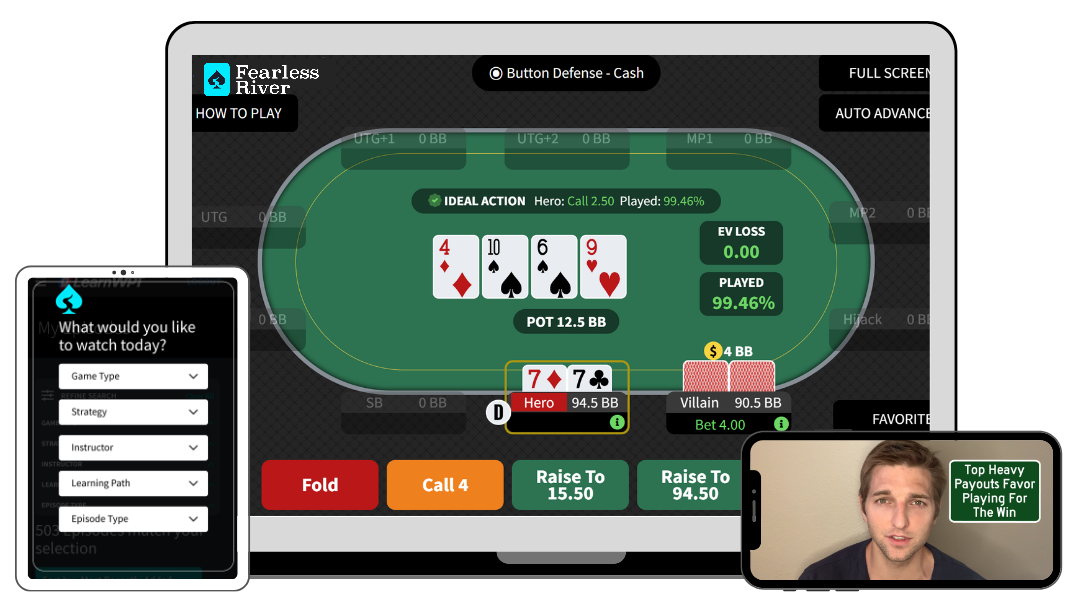
- The GTO Trainer to play real solved hands and get instant feedback on YOUR leaks (over 4 BILLION solved spots!)
- On-demand access to our full library of 550+ (and growing) in-depth Strategy Episodes from world-class players
- All of your poker questions answered with the Ask a Pro Feature
- Analysis from Fearless River Pros using The Hand Input Tool
- Downloadable Tools you can use at and away from the tables
- Learn from a Team of world-class Professional Players
To join (just $5 your 1st month) click the JOIN NOW button and start improving your game!
Have Questions? Email us at [email protected].