Poker Quiz! Turned a Straight on a Highly Coordinated Board ...
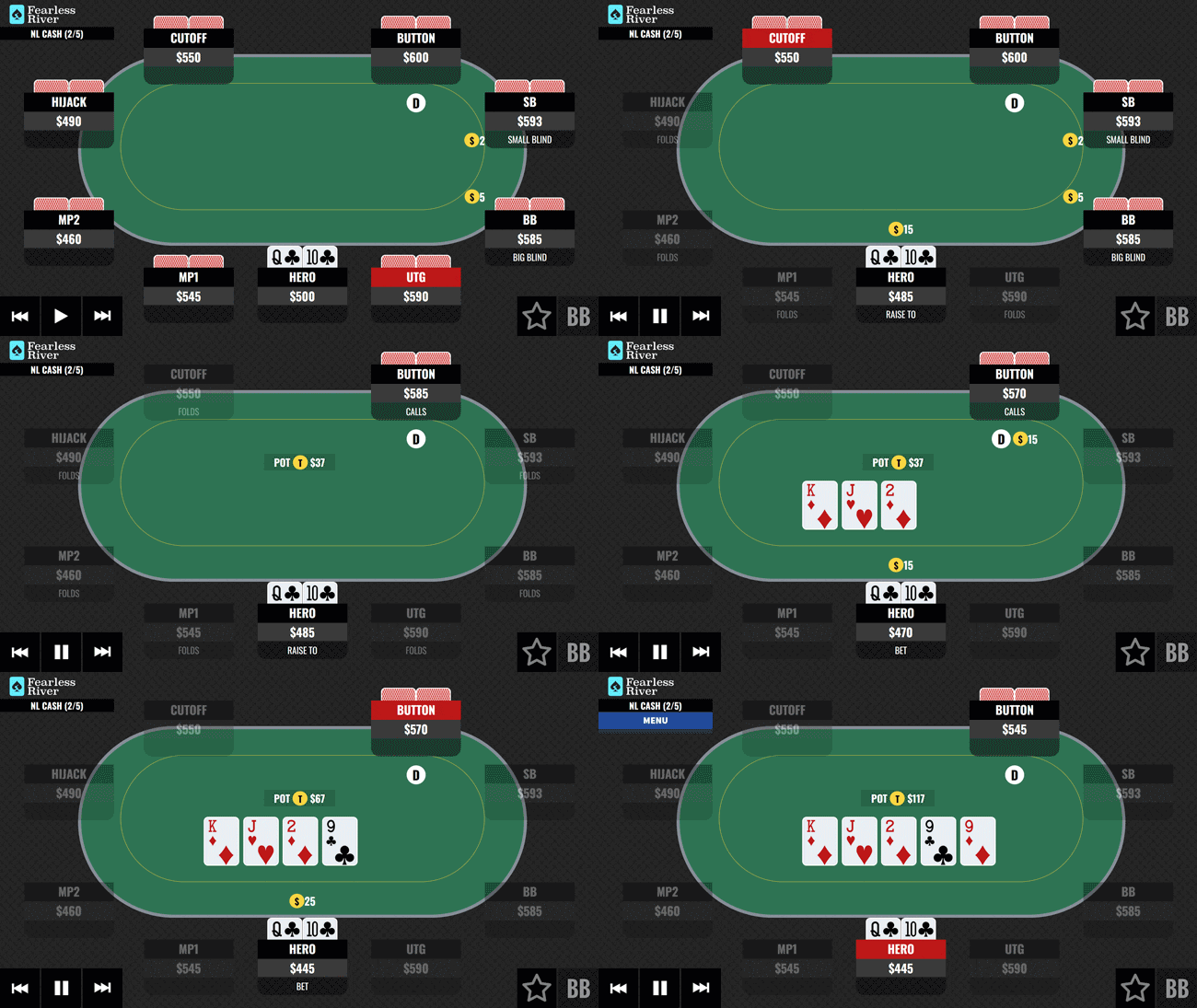
DECISION POINT: You’re in a live $2/$5 cash game that recently started. In early position you raise to $15 with Q♣T♣ and only the Button calls. You continuation bet $15 on the K♦J♥2♦ flop and get called. On the 9♣ turn you bet $25 and your opponent calls. The river is 9♦ and action is on you. What do you do here?
Vote and see how your answer compares to other players 👇
PRO ANSWER: We are playing in a $2/$5 game at our local casino. The game has recently started, and we don’t have any significant reads on our opponents. We are dealt Q♣T♣ UTG+1 and the UTG player folds. QTs is well within our first-in hand range in early position, so we make a standard open to $15. Everyone folds to the Button who flat calls, and both Blinds fold.
The flop is K♦J♥2♦ and we have an open-ended straight draw. On this flop the early position raiser has a significant range advantage and wants to bet frequently. Since we want to continuation bet our entire range, a smaller size is preferred. We bet $15 and the Button calls.
The turn is the 9♣ and we hit our straight draw. Our opponent called an early position raise preflop from the Button, which should represent a fairly condensed range consisting mostly of middle pairs, some suited broadway hands, and some suited Ax hands. We can assume that hands that continued on the flop connected with the board in some way, so the Button’s likely range on the turn is composed of flush draws, Kx/Jx/TT/T9s and QTs.
One big mistake many players make is becoming fixated on pricing out draws whenever they have a strong hand with draws present on the board. While that is a factor, we also need to be concerned about maximizing value against our opponent’s most likely range. Hands like KTs or QJs are unlikely to call a really big bet but are likely to continue against a half pot sized bet while drawing extremely thin. We elect to bet $25 and the Button calls.
The river is the 9♦. This completes the flush draw that was on the flop, and there are some hands like J9s that made a full house. Often players make the error of instantly going into check and call mode fearing the worst. By taking a check/call line we would still lose to all our opponent’s flushes, however we would also miss out on value from many Kx and 9x hands that would likely call a half-pot bet but will check behind if we check.
Missing value spots, especially out of position on the river, is one of the more common cash game leaks. Attempting to extract $60 more value in this spot by betting rather than checking and calling a similar sized bet, even though we will need to fold to a raise with some frequency, is a big way to increase your hourly rate. There are times where we may have opponent specific information that may make checking to induce bluffs in this situation more profitable, but against an unknown opponent, this is a great spot to go for a thin value bet.
Betting around half the pot ($60) is the best play.
How would you play it?
Share your answer in the comments below!
Your Opponents Are Making Mistakes.
Are You Capitalizing?

Join the Fearless River Exploit the Field Live Workshop on Saturday, May 23rd. In one full day of live, interactive training you'll get a complete framework for identifying the most common errors your opponents make and exactly how to exploit them.
Seating is limited. Registration Closes May 22nd.
Have questions about this event? Email us a [email protected].