What is a PKO Tournament?

  • PKO (Progressive Knockout) tournaments are fun, unique events where a dynamic bounty is placed on each player
  • As you knock out other players, typically you are paid 50% of their bounty and the other 50% is added to your total bounty
  • Unlike regular knockout tournaments the value of the bounties can grow
  • If you are the victor in a PKO Tourney you win in multiple ways:
    • Win the amount in the general prize pool for 1st place
    • Win the bounties you earned over the course of the event
    • Keep the full amount of the bounty that is on your head

SHOULD I PLAY A PKO DIFFERENTLY?

Yes! The strategy for playing PKOs is very different from regular bounty tournament strategy.

Click below to view an in-depth Strategy Episode from Fearless River Instructor Nick Binger to learn valuable math shortcuts and strategy tips to improve your play in PKO events.


Remembers these tips when playing in a PKO Tournament:

  • Because bounty values change based on each player's number of knockouts, some players are worth much more than others to knock out
  • Players are incentivized to widen their ranges and go after opponents when they have a high bounty value
  • Starting PKO Tournaments on time and avoiding late registration is critical to maximize your chances of winning the most bounties
  • It's often profitable to call with any 2 cards in PKO Tournaments when your opponent's bounty value is high
  • This style of tournament has become extremely popular over the last year because it encourages so much action!
  • Download the PKO Equity Reduction Reference Guide for an easy and quick way to determine your equity in PKO Tournaments

Have Questions about Fearless River? Send an email to our Support Team at [email protected] or click the CONTACT US button and they will be happy to help!



Fearless River-Logo-Stacked-Light-300x250

Find Your Flow. Train Smarter. Play Fearless.

Fearless River Poker Training Pros Winning Big!

July has been a very successful month for Fearless River Pros!

We had TWO Instructors each take home their 2nd illustrious Gold Bracelet and a 3rd place finish in the WSOP Main Event! 🏆🙌

Take a look at how Nick, Tony, and LuckyChewy fared….


Lead Instructor for Fearless River and the World Poker Tour Nick Binger outlasted a massive 2,408 entry field to win his 2nd WSOP bracelet and took home an impressive $133K first prize at the World Series of Poker Event# 24 8-Hand No-Limit Hold'em Tournament.

Nick Binger.jpg


If you’ve ever watched one of his Strategy Episodes, attended a Live Workshop and heard his lecture, or had the pleasure of sitting at one of his Lab Day tables, you know how dedicated Fearless River Lead Instructor Nick Binger is to teaching his students.

Nick has dedicated over 12 years perfecting his poker instruction skills with the WPT and enjoys teaching as much as he enjoys playing.

Nick has helped many students reach their goals and achieve success in the game they love. Click below to learn more about Nick...


Fearless River Instructor Tony Dunst took home his 2nd bracelet when he outlasted a massive 1,361 entry field and scored a huge $168K 1st prize during the World Series of Poker Event#21 $777 buy-in 6-Hand No-Limit Hold'em Tournament.

Tony Dunst smile.jpg

As a high-stakes pro and co-commentator for the World Poker Tour, Tony who has spent over eight seasons analyzing some of the most pivotal hands from World Poker Tour events.

Away from the bright lights of the WPT set, Tony is a force to be reckoned with both at the live and online felt. Tony has been putting in the work and getting great results.

Tony's experience grinding the Tournament and Cash Game scene make him a huge resource and asset for Fearless River Members and Students. Click below to learn more about Tony...


Fearless River Instructor Andrew "LuckyChewy" Lichtenberger took 3rd place and scored $140K in the huge 2,126 entry field World Series of Poker Event#31 $1,000 buy-in Championship Main Event!

LuckyChewy Aria 2019.jpg


LuckyChewy is one of the best all-around players in the game today and had 8 cashes in major live tournaments in 2019 alone.

Chewy has been tearing up the virtual felt and continues to evolve and improve his game dominating both online tournament and cash games.

LuckyChewy's experience, positive mentality, and success make him a powerful resource and asset for Fearless River Members and Students. Click below to learn more about Chewy...


Fearless-River-Poker-Training-logo

Think Like a Pro

Fearless River Student Bryant Morrison Getting Results...

Fearless River Member and Live Workshop Student Bryant Morrison has been putting in the work and seeing big results at the poker tables!

Bryant recently conquered a field of 322 players to win his first WSOP Circuit Ring in the Seniors Event at the Choctaw Durant stop.

The $250 buy-in tournament generated a $64,400 prize-pool and as victor, Bryant was awarded $13,948 and a coveted World Series of Poker Gold Ring.

We asked Bryant about his recent win, how Fearless River has helped his game, and more…

Bryant Morrison - WSOP Ring win - optmizd.jpg

Fearless River: Do you play many live tournaments? Why did you pick this specific event to play?

Bryant: I only play live tournaments but I practice at FearlessRiver.com using the GTO trainer more and more now. I do not play cash games to speak of unless I am waiting for a tournament to start.

I chose the Choctaw event because it fit my schedule during the Christmas break. I play WSOP in the summer, again on break, and this circuit event was close enough to drive to.

Fearless River: You’ve attended two Fearless River Live Workshops. How would you say these live events have helped your game?

Bryant: Both workshops added to my understanding of the game on a theoretical level. I constantly refer to handouts even now as I develop a playing strategy for different situations. Being able to ask questions and listen to other player's questions greatly increased my knowledge of the game. The best time for learning at the second workshop was the laboratory work where we all played our hands openly with the instructors advising and critiquing our play. That one day is worth all the money in [my] opinion.

Bellagio - Chewy - Bryant.jpg


The greatest take away from both workshops was the fact that they made me reconsider what my game was doing. Then, after working at home to unscramble my brain, my game would improve to a better understanding of certain aspects of the game that I was repeatedly seeing at the tables.

Fearless River: How often do you use Fearless River to improve your game? What specific features do you like about the online training site?

Bryant: About 6 weeks before I go to a tournament setting I begin to use FearlessRiver.com extensively, every day if possible. I am not a professional so I have to plan when I can play and that includes when I can practice as well. Right now I only play at 2 times a year: WSOP summer and any circuit events during Christmas break. I might add Spring Break this year to that schedule since there are now more WSOP circuit events planned.

I have created my own constantly updated index of all the episodes so that I can drill into any specific element of poker. Using this index I can review cbetting, 3rd bullets, stack to pot ratios, speculative calling, exceptions to these rules, and many other situations that might confuse me at the table. Having these episodes available 24/7 at my beck and call has proved tremendously useful to keeping my play sharp. If I had to learn this at the tables through actual play I would never be where I am now.

Bryant quote blue 2.png


This most useful element of the website has been the addition of the GTO trainer. I did not enjoy it at first, constantly being graded down with losing points for errors, until I understood the tool’s usefulness. I am not supposed to win; I am supposed to develop a pattern of play that minimizes my losses in each different scenario.

Then, later at the tables, when I recognize the same situation, I will know the proper move based on stack size, position, stack to pot ratio, and the other factors taught at the workshops. Then it is up to me to decide whether it is the proper moment to DEVIATE from perfect play to maximize my exploitation of the situation. It is at that moment in the tournament that the training pays off: you realize your opponent is just not that good after all. Viola! The chips slide your way. Next hand please!

The GTO trainer never makes a mistake so you know you are learning the proper action EVERY TIME. Build knowledge off of that and table play becomes much more readable.

Fearless River: Can you name a few specific skills or techniques from the Fearless River game plan that helped you win this WSOP ring? Can you talk about how or why they helped?

Bryant: One of the basic skills reinforced at FearlessRiver.com and the workshops is thinking of stack size as BBs and adjusting your play accordingly. Knowing where you are in the tournament helps make decisions so much easier. If it is time to shove all in with A2o (my winning hand) then make the play.

In my specific winning hand my opponent had 8 bbs left... I knew he had to be pushing ALL IN with wide open ranges so when I had the A and was only risking a few more bbs to end the tourney my second card was less relevant to me. A in the window and the ring was mine.

Listen to what Bryant had to say back in 2018 during his first Fearless River Live Workshop...

I would never have thought like that before Fearless River. My cards would have been the most important item in my equation. Instead, looking at the stack sizes, position, time, stack to pot ratio, reads, and the reward my call with a weak A was practically automatic. Move the clock back and his stack is larger proportionately so the call would be less likely but with only those few bbs left it was an opportunity I could not pass up. I doubt I would ever have thought about poker like this without training at FearlessRiver.com.

Fearless River: $13,948 for a $250 buy-in is an impressive return on investment. Do you have any plans for future tournaments? Where will we see you next?

Bryant: Future tournaments will be WSOP summer events that fit my schedule. The money is not the motivation; the competition is. $1000 buy-in at WSOP returns hundreds of thousands and the higher events, with higher skill levels, return more. The math is the same for ROI but the “life changing” amounts are not going to appear for me. I am already settled into the retirement life style, just not completely yet.

Look for me at WSOP in the summer events but hopefully you won’t recognize me and future I am just an old timer, the OMC type, who is just playing his cards as he gets them. ABC with a little luck, that’s what I want you to see when you see me. Meanwhile, back at FearlessRiver.com I will have put in multiple hour days on the trainer, updated my index, reviewed and drilled certain elements, attended another workshop (probably, based on schedule), and hopefully added a few more tools to my war chest.

Fearless River: Do you have any advice for players trying to learn and improve their No-Limit Hold’em game?

Bryant: The key to improving is to actually use the tools you have. Playing is one way but it is slow, expensive, and time consuming. The GTO trainer is on all the time and is free with unlimited use when you buy into the monthly program. You can even but in, practice, play, resign and come back later when you plan on playing your next tournament with no penalty. Thus, you can plan your own time instead of having the tournament schedules run your life. Your wife and family will appreciate your presence in the “off” seasons.

While I also suggest a workshop they are expensive and will “break your game” until you recollect your thoughts and adjust to what the new information gives you. Well worth the time and money but be prepared to have at least a week off after the workshop to work the material into your game before you play. Now I may be slow and perhaps you can adjust faster than this poor old man but you do need some time to change your game.

Fearless River: Aside from poker, what else do you do for fun?

Bryant: Ahhh… the back-story, personal part of this interview. As a window into my life let me summarize by saying that in my long life I have not been idle. I have practiced law, taught history (still doing this one), piloted my own aircrafts with a multi-engine instrument commercial license, instructed accelerated freefall skydiving with over 1,000 jumps, scuba dived to a depth of 350 feet on a salvage attempt, sailed the Caribbean as a bareboat charter captain, raced downhill slalom (very briefly), written 6 books (4 published), traded commodities, played golf down to a 12 handicap, raised 2 children to be better than me, kept a wife 12 years younger than me happy for the past 30 years, and besides just playing poker I now find pleasure in studying and practicing the game. And I’m not done yet!


As an educator, Bryant understands the importance of study, the effort needed to improve your game, and mental fortitude to be successful in poker and life.

Bryant is a true student of the game and we couldn’t be more proud of his accomplishment. We can't wait to see what is in store next for Bryant.

Have a success you’d like to share? Let us know by emailing the Fearless River Team at [email protected].


Fearless River-Logo-Stacked-Light-300x250

www.fearlessriver.com
Find Your Flow. Train Smarter. Play Fearless.

Fearless River Student Susan Faber Wins WSOP Gold!

Thousands of poker players descended on the Rio in Las Vegas for 6 weeks of action during the 50th World Series of Poker looking to win a prestigious WSOP Bracelet (and some cash too).

Fearless River Member Susan Faber was one of those players there to win her first WSOP bracelet.

And guess what? SHE DID!

Sue emerged as the victor in the $500 buy-in Salute to Warriors No-Limit Hold’em event* defeating the field of 1,723 entries and earning $121,161 in the process.

Sue, a 71-year-old tax accountant and recreational poker player, was only woman to win an “open” No-Limit Hold'em event this series.

We recently asked Sue about her WSOP experience, her love of the game, and more…

Sue Faber - WSOP Bracelet cropped - optmzd.jpg

Fearless River: What do you enjoy most about playing poker? How did you get started playing No-Limit Texas Hold’em?

Sue: I started playing poker when my son got me involved in playing on line poker about 10 years ago. I realized I was far behind the other players on the net and started looking for classes I could take to get better. I found that WPT was teaching classes in Las Vegas and traveled there to participate. I took the beginners class and the advance class.

The thing I enjoy the most about playing poker is of course winning but also the social aspect. I have met so many nice people both dealers and people playing the game and have made many good friends.

Fearless River: Is poker a hobby or do you have more lofty goals for your poker career?

Sue: Poker is a hobby. I would love to play more in live events and plan to do that in 2020.

Fearless River: Do you play many live tournaments? Why did you pick this specific WSOP event to Play?

Sue: I only play live events now. I picked this event because it was a salute to warriors and I have so much respect and thanks to give to the men and women that serve. My husband also served in the Army.

*According to a report from the WSOP, the funds raised will support the roughly 100,000 U.S. troops and their families. A portion of each buy-in went to the USO. The event raised $43,075 for the charity, which will be used to fund USO projects throughout Southern Nevada.

Fearless River: How did it make you feel to be playing on the big stage under the lights and on live stream? Were you nervous? How did it feel to have your family and friends there to watch?

Sue: It was definitely an experience of a lifetime it seemed unreal. I was not nervous because I was so concentrated on the game.

I loved having family and friends there to watch and it was an experience of a lifetime for my husband also he was so proud of me.

Sue Faber Pull Quote.png

Fearless River: How often do you use FearlessRiver.com to improve you game? What specific Member Features do you like about the online training site?

Sue: I use Fearless River weekly to review past episodes or the new ones that are sent to me.

I love the on-line training site because I can go back and review any aspect of the game I want to at any time. The episodes are so timely and involve so many things that I can add to my game.

Fearless River: Can you name 3 specific skills or techniques from the FearlessRiver.com game plan that helped you win this WSOP bracelet? Can you talk about how or why they helped?

Sue: Learning and memorizing the opening hand ranges helps me to know what cards to play in the position I am in and narrowing what cards my opponents have in their positions.

Knowing when a flop is dry or coordinated and continuation betting after the flop. Short Stack play really helped at the final table. The mental game with Jared Tendler helped me come back from large losses.

Fearless River: $121,000 for a $500 investment is a pretty amazing payday. Any big plans for the money?

Sue: $10,000 of it will be saved for the main event next year. I would like to go on a cruise and do some remodeling to my home.

Fearless River: Aside from poker, what else do you do for fun?

Sue: I love to spend time with my two grandchildren.

Fearless River: Anything else you’d like to add about your experience?

Sue: I am so glad I joined FearlessRiver.com which gave me the skills and confidence to win the bracelet at the WSOP this year.

Sue dominated the Final Table and we couldn’t be more proud of her and her accomplishment! Hearing member success stories like Sue's makes US successful!

Have a success you’d like to share? Let us know by emailing the Fearless River Team at [email protected].


Fearless River-Logo-Stacked-Light-300x250

www.fearlessriver.com
Find Your Flow. Train Smarter. Play Fearless.

Poker Quiz! Out of Position on the Turn With A♠T♥...

Facing-a-Turn-Decision-With-AT-optimized

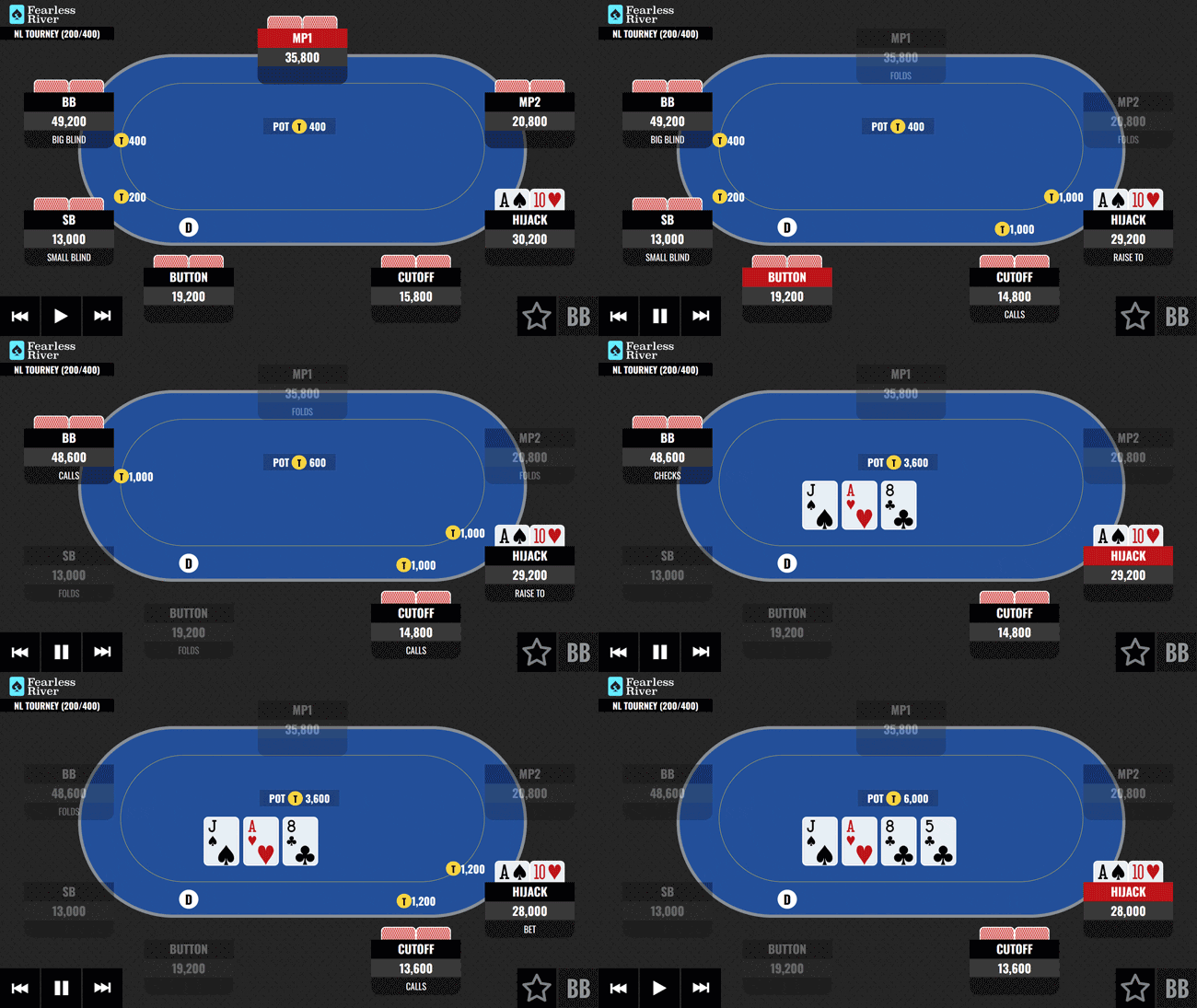
DECISION POINT: You're in the early stages of a live daily tournament with blinds at 200/400 and a 400 big blind ante. Action folds to you in the Hijack with A♠T♥. You raise the standard open to 1,000 and get called by the Cutoff and Big Blind. On the J♠A♥8♣ flop the Big Blind checks, you bet 1,200, and only the Cutoff calls. The turn is 5♣ and action is on you. What do you do here?

PRO ANSWER: We are playing a live daily tournament. It is still early on with 200/400 blinds with a 400 big blind ante and most of the field still remaining. We are dealt A♠T♥ in the Hijack seat and everyone folds to us. We make a standard open to 1,000 chips and both the Cutoff and the Big Blind call. The flop is J♠A♥8♣ and the Big Blind checks.

This is a tricky spot as we likely have the best hand and strongest range, however this is the type of coordinated flop that also connects quite well with our opponents’ ranges. If we decide to bet, a larger sizing will likely fold out a lot of the hands we have dominated and only get called by hands that are either ahead of us or have significant equity against our AT offsuit. If we bet too small we keep a lot of dominated hands in but are also giving our opponents a tremendous price to hit any potential draws.

Having the Ten in our hand does help as it blocks some of the QT/T9 combinations that make up some of our opponent’s highest equity draws. Since we are early in the tournament and the effective stack in the hand is over 70BBs, it makes a lot of sense to keep the pot small for now and keep our opponent’s weaker hands in. We can then determine how to proceed based on the flop action and the specific turn card.

We elect to bet 1,200 and the Cutoff calls and the Big Blind folds. The turn is the 5♣. This is one of the more innocuous turn cards that could have appeared and is unlikely to have significantly impacted the equity of our hand versus our opponent’s range.

Continued Below ...

Ad-Study-Session-Equity-Dynamics-Oct-2026

Often players are inclined to continue betting in this spot to try and deny equity to the opponent’s draws. We are essentially facing the same dilemma on the turn that we just encountered on the flop. If we bet large enough to deny equity to our opponent's draws, we are likely to only get action from hands that are ahead of us.

If we choose to fire a turn second bullet we are basically at the bottom of the range we are trying to represent. Additionally, we have to play the rest of the hand out of position, which likely creates some tough decisions on a majority of river cards. Checking keeps all of our opponent’s weaker hands in their range that won’t call a turn bet, but we still can potentially get value from on the river, and we may induce bluffs from weaker hands as well.

Reviewing this spot in a solver, the output confirms we are on the cusp of hands that could potentially bet. When holding AQ or AK, the solver would choose to purely bet for value. With AT however, checking to keep the opponent’s range wide to induce bluffs and/or betting for thin river value against weaker made hands is favored against a looser opponent capable of calling down with weaker Ax hands or Jx hands.

We could continue betting for value exploitatively, however against all other opponents we should check.

Checking is the best play.

How would you play it?
Share your answer in the comments below!


Your Opponents Are Making Mistakes.
Are You Capitalizing?

Exploit the Field Course

In almost every hand of tournament poker you play, someone is making a critical error. The Exploit the Field training teaches you the adjustments you need to turn their mistakes into your profit.

Originally taught live in the lead-up to the 2026 World Series of Poker, this training gives you the same strategy attendees learned in real time, on your own schedule.

Includes lifetime access to the recorded sessions, supplemental strategy videos, downloadable tools, and a private strategy Discord.

Have questions? Email us a [email protected].

Poker Quiz! Pocket Eights in the Cutoff Vs a Tough Button...

88 Vs a Tough Button-FR

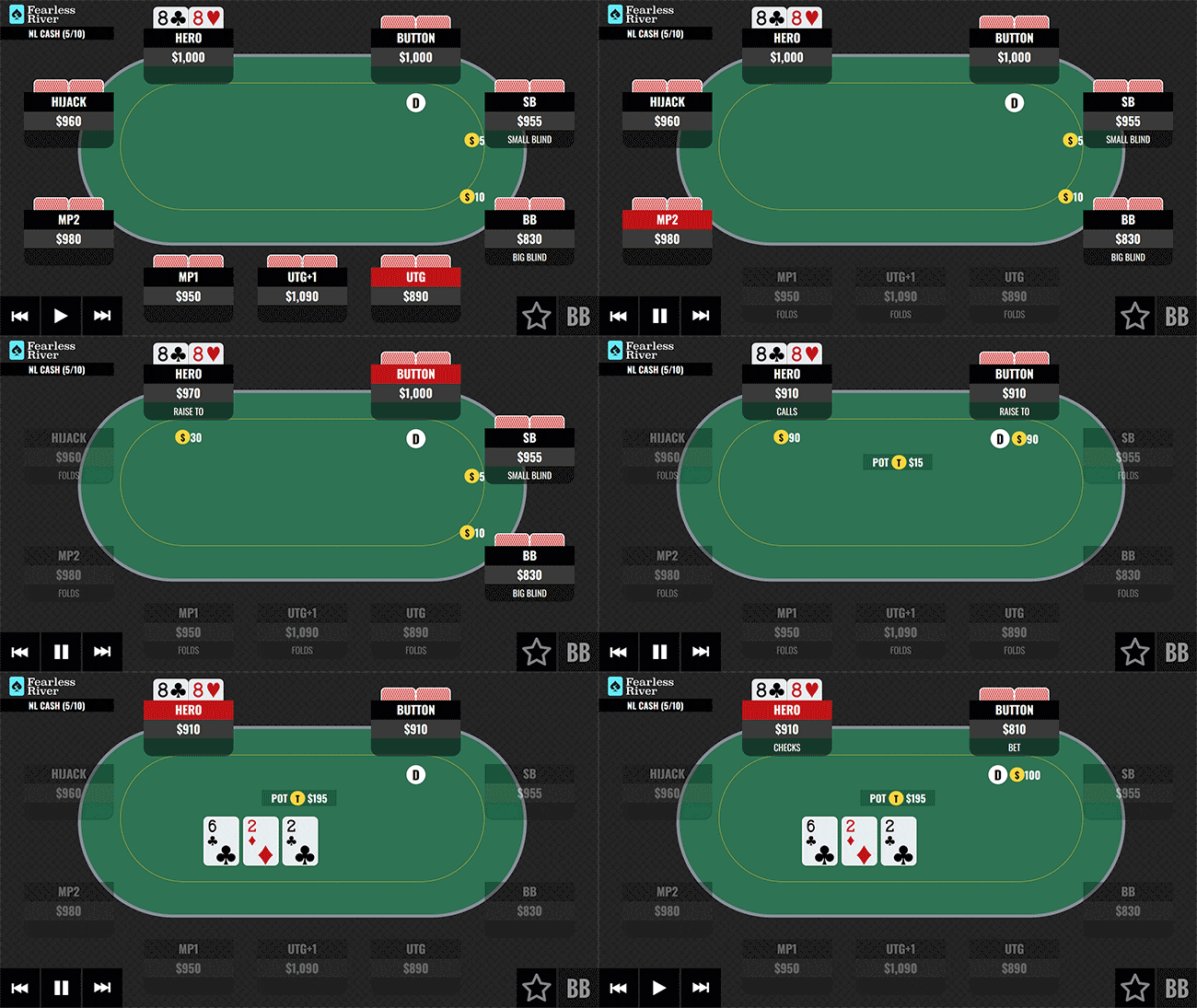
DECISION POINT: You're in a live $5/$10 cash game with most stacks at around $1,000 (100BBs). It folds to you in the Cutoff with 8♣8♥ and you make the table standard raise to $30. The Button, who is a very tough player, raises to $90 and you call. You check the 6♣2♦2♣ flop, your opponent bets $100 and action is back on you. What do you do?

PRO ANSWER: We are playing a live $5/$10 cash game with a very tough player seated to our immediate left. Most of the stacks are around $1,000 so we’re playing with 100 big blind effective stacks.

Action folds around to us in the Cutoff with pocket eights, we make a standard open to $30 and the Button to our immediate left reraises to $90. A good, aggressive Button player should be reraising us with around 14% of hands versus a Cutoff open. This range includes hands we are way behind preflop such as the large over pairs, but also includes a lot of overcards, Axs, and some suited connectors.

If we choose to reraise in this spot, all the hands we have significant equity against would likely fold and force the Button to only continue with the hands that dominate our range. Given those considerations, this is a good spot for us to call to keep our opponent’s range wide and try and navigate profitably postflop.

The flop is 6♣2♦2♣ and is one of the better flops for us that doesn’t contain an 8. Even though the flop is great for our specific hand, the best approach is to check with our entire range. The Button still has a range advantage over us and will likely continuation bet their entire range, therefore checking should allow us to get the most value in the long run. We check and the Button bets $100, or around half the pot.

Continued below ...

300x250 Ad -Fearless-River-Join

Our opponent is a very tough player, so they likely recognize this as an appropriate spot to continue with nearly their entire range. In fact, when we analyze this spot in a solver, the Button is supposed to bet 81% of their combinations on this flop. We are still well ahead of their overall range and although our hand does benefit from protection against a skilled and aggressive player, we benefit more from keeping our opponent’s range wide.

Note that if the Button were much tighter and only raised premium hands as many low stakes players do, we would look to play speculatively and flop a set. In this scenario we are against a good, aggressive player, and we need to construct a range that can continue facing aggression on this flop. Pocket eights fall firmly into that category.

Calling is the best play.

How would you play it?
Share your answer in the comments below!


Improve Your Game Today!
Join Fearless River and Get:

Site Features - Multiple Devices Mockup

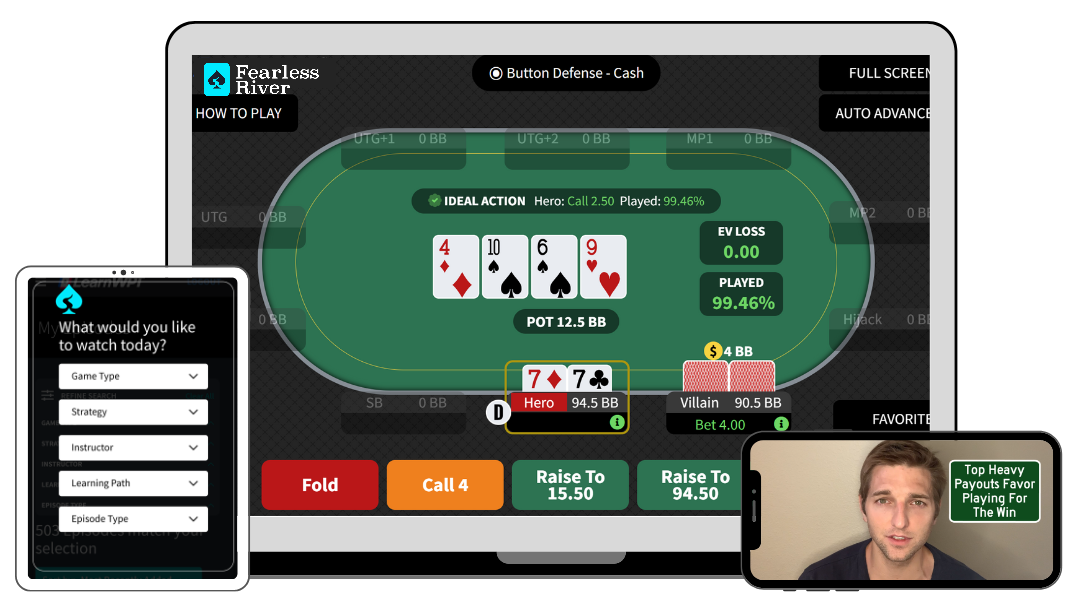
  • The GTO Trainer to play real solved hands and get instant feedback on YOUR leaks (over 4 BILLION solved spots!)
  • On-demand access to our full library of 550+ (and growing) in-depth Strategy Episodes from world-class players
  • All of your poker questions answered with the Ask a Pro Feature
  • Analysis from Fearless River Pros using The Hand Input Tool
  • Downloadable Tools you can use at and away from the tables
  • Learn from a Team of world-class Professional Players


To join (just $5 your 1st month) click the JOIN NOW button and start improving your game!


Have Questions?
Email us at [email protected].


Poker Quiz! Short Stacked in the Big Blind With 7♥7♦, Your Move?

Short-Stacked-Big-Blind-77

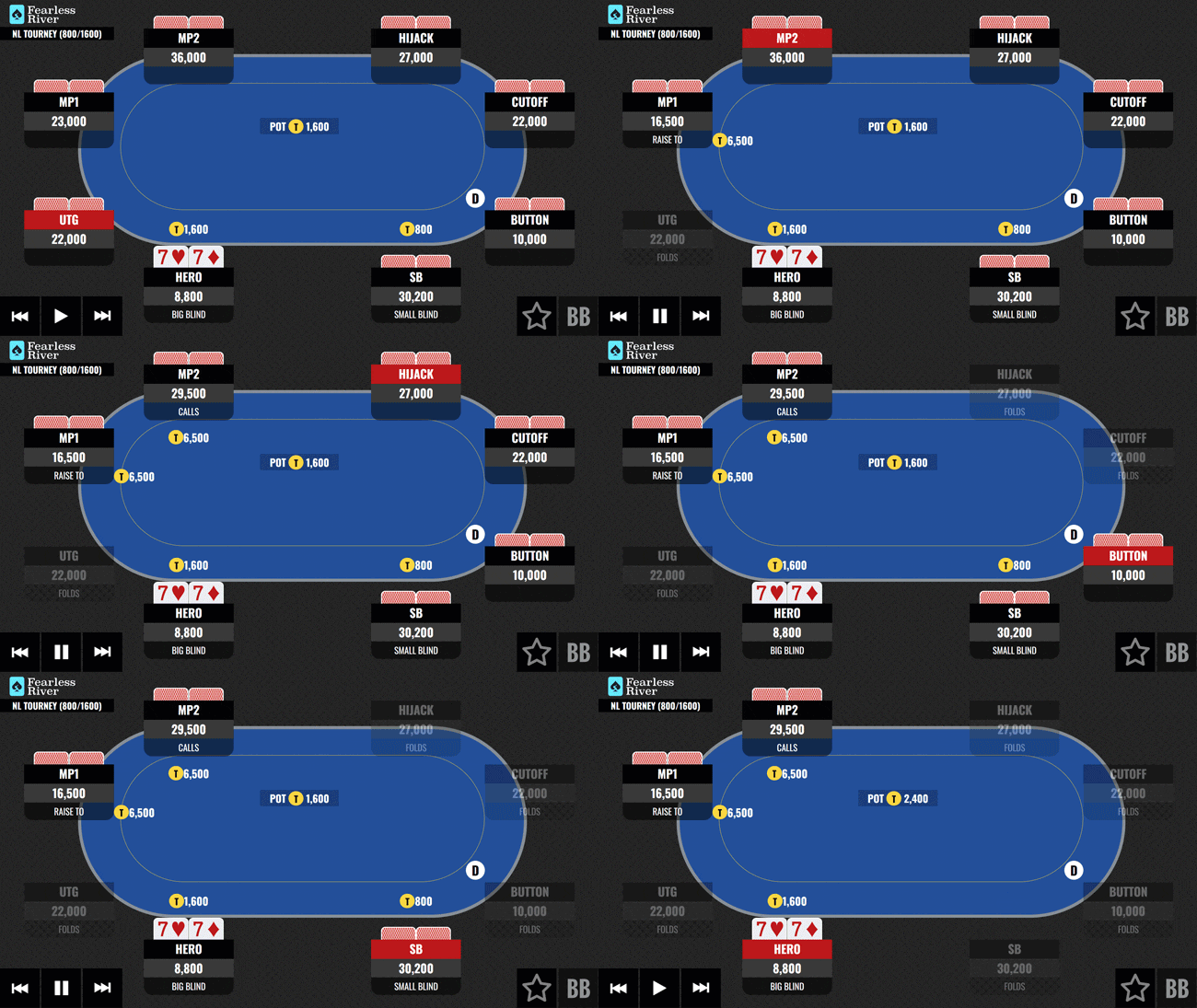
DECISION POINT: You’re in a one-day, fast-structured daily tournament. 12 places get paid and there are 40 players remaining. The table is 8-handed and the blinds are 800/1,600 with a 1,600 big blind ante. You are in the Big Blind with 7♥7♦ and an 8,800 stack after posting your blind and ante. The MP1 player raises to 6,500, MP2 calls, and action folds to you. What do you do here?

Vote and see how your answer compares to other players 👇

PRO ANSWER: We are playing a fast-structured one-day local tournament. Nearly 40 players remain with the top 12 being in the money. The blinds are 800/1,600 with a 1,600 big blind ante. We are in the Big Blind with 7h7d and have 8,800 chips after posting our big blind and the big blind ante, and the table is currently 8-handed.

The UTG player folds, and MP1 makes it 6,500. This raise is over 4 big blinds and represents over a quarter of their remaining stack. MP2 flat calls and everyone else folds over to us in the Big Blind.

Playing with a short stack is often an exercise in patience and picking your spots. Ideally, we would have found a spot to move all-in before we got this short. However, in these very fast structured daily tournaments the blinds can catch up to us quickly. That means we are likely to often find ourselves in situations such as these, so navigating them well adds meaningfully to our overall win rate.

If we continue with this hand, we are basically all-in. This situation really becomes a math problem where we estimate our opponents' ranges, estimate our equity against those ranges, factor in any perceived risk premium we have, and then decide how to proceed.

There aren't really range charts for opening more than 4 big blinds with an awkward stack, but intuitively we can guess that MP1 likely has a hand they are willing to risk their stack with. This range might look like 99+/AJs+/AQo+. Assuming that MP2 recognizes the situation, they are probably calling with a very narrow range of hands as well. Calling would normally cap someone's range but given the abundance of short stacks at this table and the unusually large opening raise size, our opponent could easily call with big hands as a trap. Given that potential, we would estimate MP2’s range to be something like TT+/AQs+/AQo+.

Using an equity calculator after the fact, we can see that against these two ranges we have just over 25% equity with 77. This means we need to be getting over 3:1 pot odds to break even. If we move all-in and assume both players call, we will be risking 8,800 chips to win 24,800 chips (2.8:1). This is very close, but not quite enough to continue, especially once we factor in any ICM/risk premium that our stack has.

In real-time, without an equity calculator, we can take a simple shortcut in these situations where continuing is likely close. The first question we want to ask is "Do we dominate any hands in our opponent's range?”. In this case, in order to continue, we would want our opponent’s likely ranges in this spot to include some hands such as 66 or A7s. If we are able to dominate even a small portion of our opponent's range, our overall equity increases significantly.

If we have observed our opponents enough to think it is likely that by shoving we may induce an all-in from the original raiser which causes the caller to fold a reasonable percentage of the time, then moving all-in becomes a compelling play. We would likely have over 35% equity all-in against the original opener's range in a heads-up situation.

Without very opponent specific information however, our hand just isn't quite good enough to continue with. In fact, against the ranges we estimated, pocket tens is the minimum we would need to continue.

Folding is the best play.

How would you play it?
Share your answer in the comments below!


Get Ready To Launch Your Poker Game

Fearless-River-Launch-Course (1)

The Fearless River Launch Tournament Poker Course is a 4-session system built by WSOP Bracelet winners and WPT Champions. You'll get a clear framework for every stage of a tournament and a structured curriculum covering essential concepts and easy-to-learn methods for implementing advanced tactics.

The course includes lifetime access to the recorded sessions, GTO trainer packs, supplemental strategy videos, range charts, and a private strategy Discord.

Have Questions? Email our Support Team at [email protected] or click the CONTACT US button.

Poker Quiz! Turned a Straight With 9♦8♦, What's Your Move?

turned-straight-98-suited


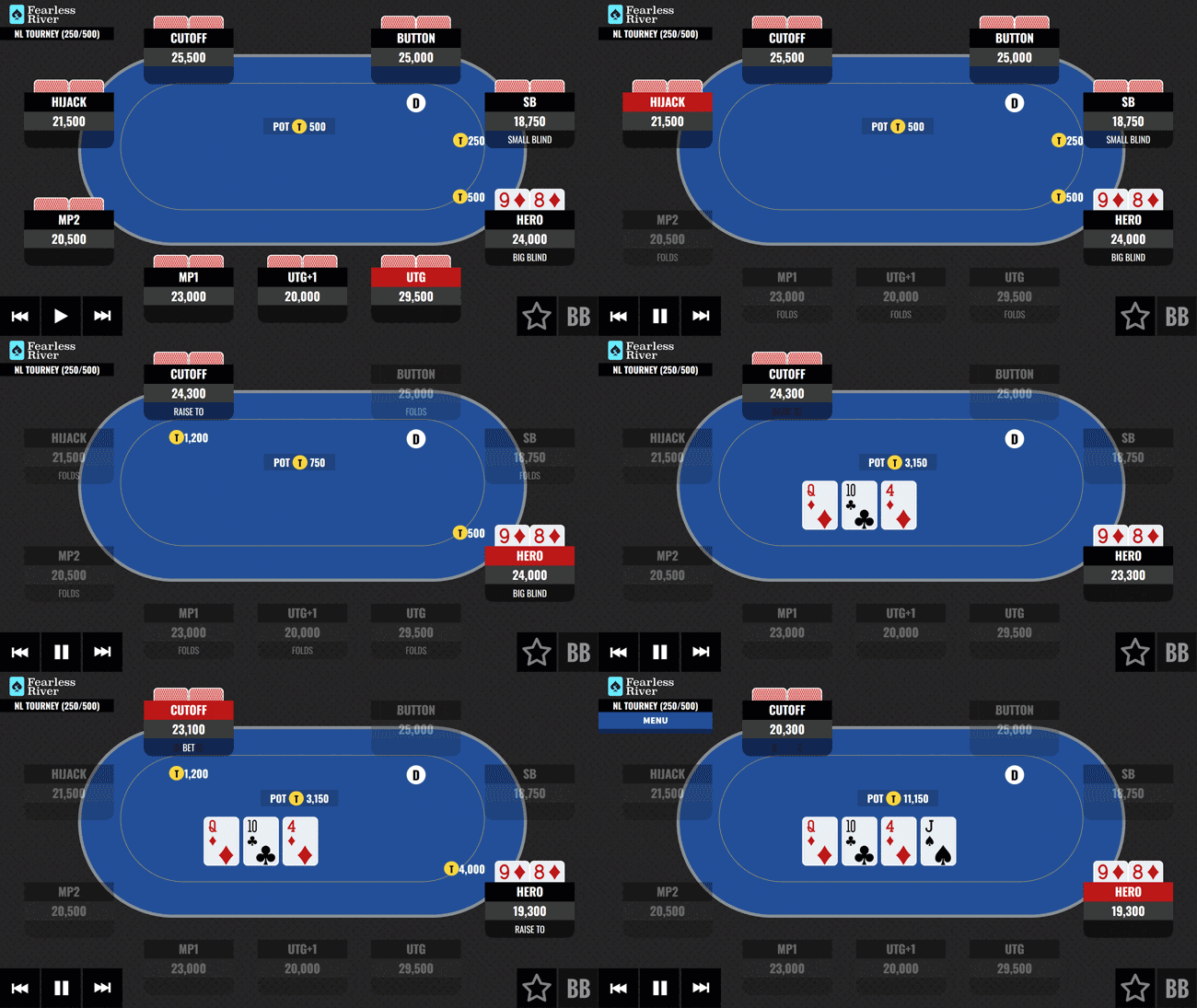
DECISION POINT: You’ve just late registered a local daily tournament with a fast structure. This is the last level of reentry and blinds are 250/500 with a 500 big blind ante. The Cutoff opens to 1,200. It folds to you in the Big Blind with 9♦8♦ and you call. You check the Q♦T♣4♦ flop. Your opponent bets 1,200, you check-raise to 4,000 and get called. The straight comes in on the J♠ turn and action is on you. What's your move here?

Vote and see how your answer compares to other players 👇

PRO ANSWER: We're playing a local daily tournament with a relatively fast structure. This is the last level of reentry before late registration closes. The blinds are 250/500 with a 500 big blind ante. We have 25,000 chips, having just registered and have no reads on the table.

We are dealt 9d8d in the Big Blind. Action folds around to the Cutoff who opens to 1,200 chips, and everyone else folds to us. We can mix in some preflop reraises with suited and connected hands, but the more standard play is to call, which we do here.

The flop is QdTc4d and we flop a flush draw along with the bottom end of an inside straight draw. This is a board that we connect fairly well with as the Big Blind, but still heavily favors the preflop raiser. We check and they bet 1,200 chips, or just over one third pot. We will have a lot of hands we can easily continue with here, such as pairs, flush draws, and some straight draws.

We also flop some strong hands that would love to check-raise now such as T4s/QTs/44. In order to get max value when we check-raise our stronger hands, some bluffs must be included as well for balance. The most logical bluffs come from some of our highest equity draws. Examples of those are ace and king high flush draws where the flush and our over card are often outs, as well as combo draws such as ours.

Taking those factors into consideration we decide to check-raise to 4,000 chips and the Cutoff just calls. The turn is the Js which completes our straight. Many players first instinct is to bet the turn when they hit their hand after check-raising, and often that is the correct approach. If we really step back and think about what each player’s range looks like in this situation, this Js is actually a much better card for our opponent than it is for us.

Much of their continuing range improves on this card, so it’s a card that we will want to be checking quite frequently. One way to protect our checking range so our opponent can’t just bet and take down the pot every time we check the turn, is to mix some strong hands into our checking range. Our particular hand makes a perfect candidate as it doesn’t fear giving away a free card since we have the flush draw, and we can induce bets from the Cutoff when they have hands such as AT that are likely to fold to continued aggression.

If we're up against a passive player who is unlikely to bluff appropriately when we check, then we could exploitatively continue betting. Against opponents who are finding the appropriate amount of bluffs by attacking perceived weakness, it’s very important to have some strong hands that we can check with.

Checking is the best play.

How would you play it?
Share your answer in the comments!


Gags Finishes 4th at the WSOP Main Event!

Fearless River instructor Michael "Gags30" Gagliano's incredible WSOP Main Event run has come to an end in 4th place, earning $2,750,000.

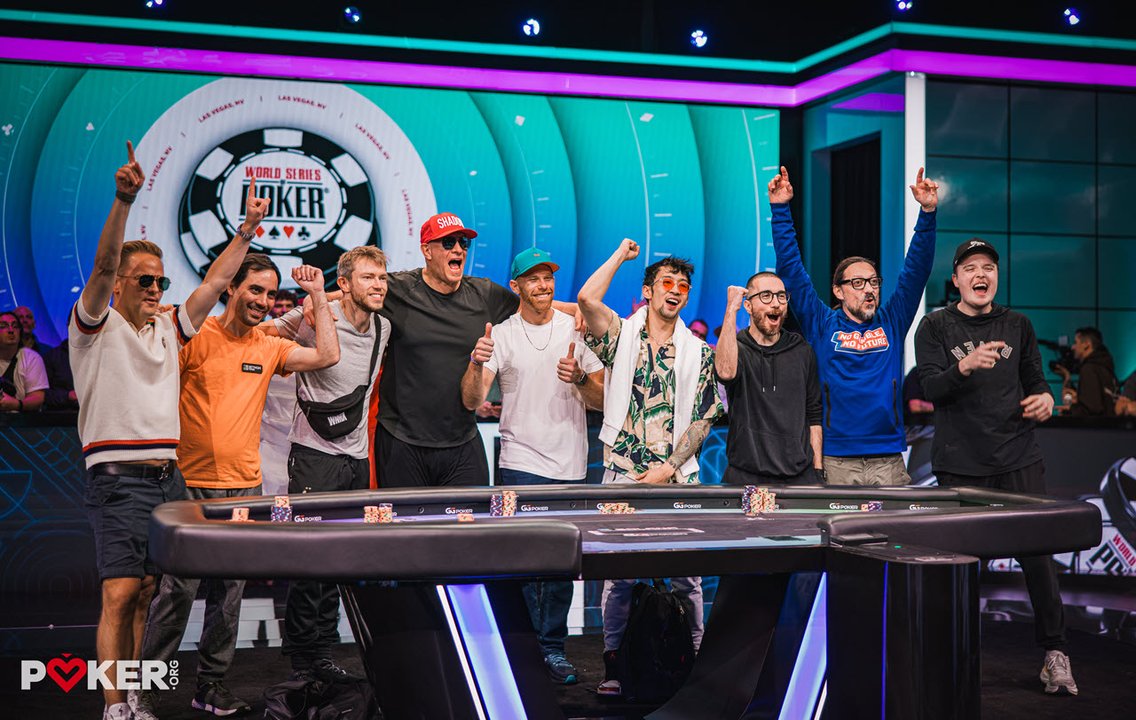
Michael Gagliano celebrates with the 2026 WSOP Main Event final table after play concludes on Day 8

Out of a field of 9,208 entrants, the 4th largest Main Event ever held, Gags outlasted all but three players. We couldn't be prouder, and we wanted to celebrate it with everyone who's learned from him.

We put together a full look at his run this summer including a free strategy episode where Gags breaks down hands from his 2023 WSOP bracelet win. Thanks for the run, Gags.

Poker Quiz! Flopped a Gutshot at the WSOP, What’s Your Move?

Flopped-Gutshot-WSOP

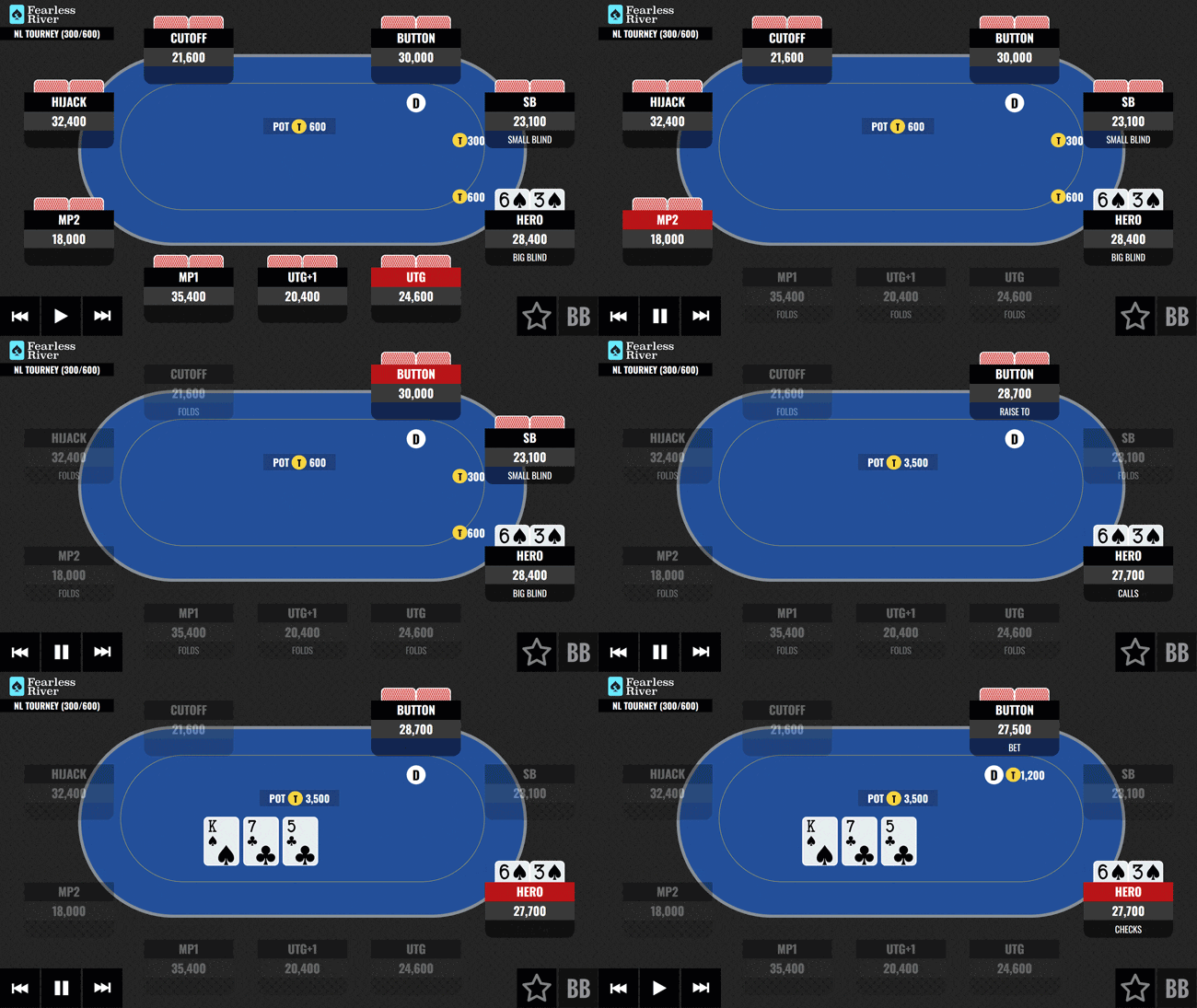
DECISION POINT: You're in the early stages of a $500 WSOP bracelet event with blinds at 300/600 and a 600 big blind ante. Most stacks are in the 50BB range, and you have no reads on your tablemates. Action folds to the Button who raises to 1,300, the Small Blind folds, and you defend in the Big Blind with 6♠3♠. You check the K♠7♣5♣ flop, the Button c-bets 1,200, and action is back on you. What's your move?

PRO ANSWER: We are playing a $500 buy-in multi-day bracelet event at the World Series of Poker. The tournament is still in the early levels, and we just moved tables a few hands ago, so we have no significant reads on our opponents. Most of the stacks are in the 50 big blind range. The blinds are 300/600 with a 600 big blind ante and we are dealt 6♠3♠ in the Big Blind. Everyone folds to the Button who opens to 1,300, the Small Blind folds, and action is on us.

With the big blind ante in play we are getting very favorable pot odds to continue from the Big Blind. While some of our weakest hands should definitely be folds, the defending range must be very wide when getting this price and calling with any two suited cards is a must. If we’re folding more than 20% of all total hands against this raise size when closing the action in the Big Blind, that means we are folding way too frequently in general.

We do elect to call, and the flop is K♠7♣5♣ bringing a backdoor flush draw and an inside straight draw. This is a flop that favors the preflop raiser’s range, so we will be checking 100% of hands by default in this situation. We check and the Button bets 1,200 into a 3,500 pot. While our hand might not seem like much with a gutshot straight draw and backdoor flush draw, we are getting nearly 4:1 on a call and the Button should have a very wide hand range in this situation.

With three cards to a straight and three to a flush in a Big Blind defense situation facing a small bet against a wide range such as this one, we should be alert that this scenario is potentially a good spot to check-raise. Our opponent is likely betting a super wide range on this board. That means that even when the Button does call our check-raise we still can potentially improve our hand to a likely winner and will pick up additional equity on some turn cards that will allow us to continue semi-bluffing.

Continued below...

StaticAd-Episodes-300x250-FR


Looking at this spot in a solver after the hand, the output indicates a split between calling (around 60% of the time) and raising (around 40% of the time). While our play shouldn’t always mimic a solver, understanding what the “optimal” play is based on pure theory is a good starting point. Deciding which option is best will often come down to tendencies for each player in your game.

If we had opponent specific information that the Button played tighter ranges, calling would often be the preferred option since the implied odds of hitting a straight would be higher and our check-raise would induce folds less frequently. Facing opponents who open more than they should from the Button, or continuation bet with a higher frequency than the solver suggests (which is 65% in this situation), we can adjust by check-raising.

The one clear mistake in this spot would be to fold. If we are considering a fold in this situation, we likely are proceeding too conservatively postflop when defending the Big Blind and would benefit greatly from tools such as the Fearless GTO Trainer to improve play in these postflop spots.

Calling or raising are both correct plays.

How would you play it?
Share your answer in the comments below!


Get Ready To Launch Your Poker Game

Fearless-River-Launch-Course (1)

The Fearless River Launch Tournament Poker Course is a 4-session system built by WSOP Bracelet winners and WPT Champions. You'll get a clear framework for every stage of a tournament and a structured curriculum covering essential concepts and easy-to-learn methods for implementing advanced tactics.

The course includes lifetime access to the recorded sessions, GTO trainer packs, supplemental strategy videos, range charts, and a private strategy Discord.

Have Questions? Email our Support Team at [email protected] or click the CONTACT US button.

Poker Quiz! Facing a Squeeze Play With Pocket Jacks ...

Pocket-Jacks-Facing-a-Squeeze-Play

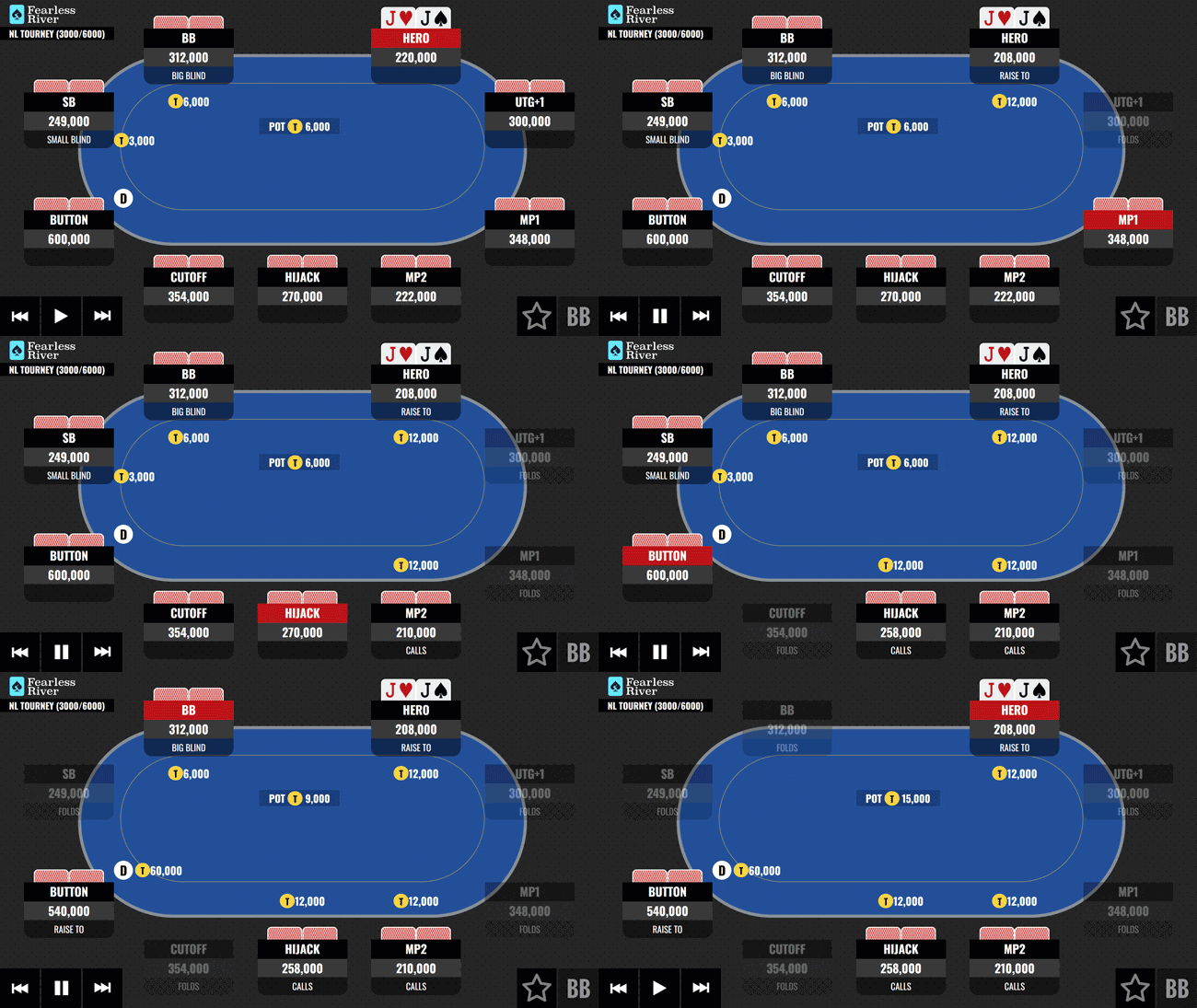
DECISION POINT: You are playing Day 2 of a $5K WSOP Bracelet event and blinds are 3,000/6,000 with a 6,000 big blind ante. It's early in the day and there is still approximately 50% of the field remaining. The average stack at your table is around 40BBs except for the Button who has 100BBs. You raise to 12,000 from UTG with J♥J♠. A Middle Position player calls, the Hijack calls, the Button reraises to 60,000, and action is back on you. What do you do here?

Vote and see how your answer compares to other players 👇

PRO ANSWER: We are playing early on Day 2 of a $5K buy-in WSOP Bracelet event. Around 50% of the field is remaining, and the blinds are 3,000/6,000 with a 6,000 big blind ante. We have just under 40 big blinds, as does most of the table except the Button who has 100 big blinds. We are dealt pocket jacks Under the Gun and make a standard open for this level to 12,000 chips (2BBs). Two players call the open and action folds to the Button who reraises to 60,000. Everyone else folds and the action is on us.

Much of the decision in this spot comes down to our assessment of the Button and whether they are capable of making a move with a wider range. If we assume that they are a skilled and studied opponent, then they definitely should be showing up with some A5s/KTs type of squeeze semi-bluffs in this situation in addition to stronger hands. Based on the Button’s assumed range, this is a slam dunk shove with jacks. Taking a closer look at this hand using a solver, the result shows it's a pretty clear +EV move to shove here against a GTO opponent.

During situations at the table like this in real-time it’s useful to ask ourselves, "Does our opponent ever have a hand here that we dominate?", such as TT or AJ in this instance.

If the answer is yes, we have a very compelling reason to continue with all the likely dead money in the pot since the middle position stacks are unlikely to have hands they can continue with here. If the answer is no and we believe the Button is raising a tighter range to include only premium pairs such as AA-JJ plus AK and AQ, then we could consider exploitatively folding.

In a $5K buy-in WSOP Bracelet event, most of our opponents are likely to be more than capable of including some semi-bluffs in their 3-bet squeezing range here, making our hand a fairly trivial all-in. Using the framework of asking ourselves the question “Does my opponent ever have hands I dominate?” will help us exploitatively adjust in the event that we do run into an opponent who has an extremely narrow range in this situation.

Moving all-in is the best play.

How would you play it?
Share your answer in the comments below!


Improve Your Game Today!
Join Fearless River and Get:

Site Features - Multiple Devices Mockup

  • The GTO Trainer to play real solved hands and get instant feedback on YOUR leaks (over 4 BILLION solved spots!)
  • On-demand access to our full library of 550+ (and growing) in-depth Strategy Episodes from world-class players
  • All of your poker questions answered with the Ask a Pro Feature
  • Analysis from Fearless River Pros using The Hand Input Tool
  • Downloadable Tools you can use at and away from the tables
  • Learn from a Team of world-class Professional Players


To join (just $5 your 1st month) click the JOIN NOW button and start improving your game!


Have Questions?
Email us at [email protected].