How to Play No-Limit Texas Hold'em: A Beginner's Guide
If you have never played a hand of poker, start here.
No-Limit Texas Hold'em is the most widely played form of poker in the world. You see it on TV, at the World Series of Poker, on the World Poker Tour, and in most cardrooms and home games.
It is also a game you can learn the rules of in about twenty minutes.
That is what this page is for.
Below is a free video that walks you through the basics from start to finish, plus a written reference you can come back to any time. You’ll learn how a hand plays out, what beats what, your options when the action is on you, and a few simple rules to guide your play. No experience required. No account required.
If you already know the basics, unlock The 5 Keys Of Poker here. Free.
Start Here: The Quick Start Video
In this video, Fearless River instructor and 2x WSOP Bracelet winner Nick Binger covers everything you need to sit down and play:
- Poker hand rankings so you always know what beats what
- How the betting works, including proper technique so you do not give away information
- Handling your cards and chips at a live table
- Which cards to play at the start of each hand
Watch it before you play, then use the sections below as a reference.
🤔 What Does That Term Mean?
Run into a word you don't recognize? Poker has a lot of unique vocabulary, and nobody expects you to know every term right away. Click the magnifying glass 🔍 in the menu at the top of any page and type in the term.
You will get the plain-language definition, plus links to Fearless River strategy videos and tools that cover it. Here is what a sample search looks like for Big Blind. Try it with position, button, or any other term as you read on.
How a Hand of No-Limit Hold'em Is Played
Every hand follows the same rhythm. Once you have seen it a few times, it becomes automatic.
- The blinds are posted. A dealer button marks one player at the table and moves one seat clockwise after every hand. The two players to the direct left of the button are required to put chips in the pot before the cards are dealt; these are called the small blind and big blind. The small blind is normally half the amount of the big blind. The amount is based on the blind level in tournaments or betting limit in cash games. The blinds are used to entice play.
- You get two cards. Every player is dealt two cards face down. These are your hole cards. Only you see them and you need to protect them from other players' view. Never show your cards unless instructed by the dealer.
- Preflop betting. Action always starts to the left of the big blind and moves clockwise. Each player folds, calls, or raises.
- The flop. Three community cards are dealt face up in the middle of the table. All players still in the hand share community cards to make their best five-card hand. Another round of betting follows.
- The turn. A fourth community card is dealt. Another round of betting follows.
- The river. A fifth and final community card is dealt. One last round of betting.
- Showdown: When two or more players are still in the hand after the final round of betting, the winner is determined by shown cards. The best five-card hand, using any combination of your two hole cards and the five community cards, takes the pot, and the dealer pushes it to that player. The last player who bet or raised turns their cards over first, then the rest follow in clockwise order.
There are two ways to take down a pot. Either you have the best hand at showdown or you bet and everyone else folds. You do not need the best hand to take the pot if everyone else folds.
Pro Tip: You are never required to show a losing hand. If you know you are beaten, you can muck, which means handing your cards to the dealer face down and giving up your claim to the pot.
Poker Hand Rankings: What Beats What
This is the one thing worth memorizing before you play. Hand rankings apply to every decision you make, and they never change.
| Rank | Hand | Example | What it is |
|---|---|---|---|
| 1 | Royal Flush | 10♠J♠Q♠K♠A♠ | Ace-King-Queen-Jack-Ten all of the same suit. The best possible hand. |
| 2 | Straight Flush | 7♠8♠9♠10♠J♠ | Five cards in sequence, all the same suit. |
| 3 | Four of a Kind | 9♥9♠9♦9♣J♠ | All four cards of the same rank. |
| 4 | Full House | 9♥9♠9♦J♣J♠ | Three cards of the same rank + two cards of the same rank. |
| 5 | Flush | Q♥3♥6♥8♥A♥ | Five cards of the same suit, not in sequence. |
| 6 | Straight | 7♦8♠9♦10♠J♣ | Five cards in sequential order, not of the same suit. |
| 7 | Three of a Kind | 7♠7♦7♥10♠J♠ | Three cards of the same rank. |
| 8 | Two Pair | 7♠7♦10♦10♠J♠ | Two cards of the same rank + two cards of another rank. |
| 9 | One Pair | Q♠Q♣6♥10♠3♣ | Two cards of the same rank. |
| 10 | High Card | A♥Q♣6♥10♠3♣ | One card ranking higher than all others. No pairs, straights, flushes. |
A few things that trip up new players:
- Suits do not rank against each other. A flush in spades does not beat a flush in hearts. The highest-ranking card in the flush decides it.
- You make your best five-card hand out of seven. Your two hole cards plus the five community cards give you seven to choose from, and only the best five count. That can mean using both of your cards, one of them, or neither. When your best five-card hand consists solely of the five community cards on the board, you are said to be "playing the board". If no player has a hand that can beat the board, the pot is split among the players involved.
- An Ace can be high or low. A-K-Q-J-10 is the highest straight. A-2-3-4-5 is the lowest (known as a wheel).
Your Options When the Action Is on You
Every decision in poker comes down to one of these actions:
- Check: To defer your action to the next player in the hand. Only possible if nobody has bet ahead of you on that street.
- Bet: To voluntarily place money in the pot.
- Call: To match the amount of someone else's bet, rather than choosing to raise or fold.
- Raise: To increase the current bet. The amount of your raise must be at least the size of the last bet or raise. Example: If it is 100 to you, the smallest raise is to 200. If someone has already raised from 100 to 300, the smallest reraise is to 500, not 600. Multiple raises can occur in a given betting round.
- Fold: The action of surrendering your cards. Players who fold at any point before showdown are not eligible to win any portion of the pot and cannot re-enter the hand.
- All-in: A bet that commits your entire chip stack to the pot. This action can take place during any betting round. If you go all-in and no one calls your bet, you win the pot without needing to reveal your hand. However, if someone does call, you must win the hand at showdown to claim the pot. It is important to note that once you declare an all-in bet, you cannot retract it.
Two habits worth building from day one:
➧ Announce your action before you touch your chips. Verbal declarations are binding, so saying "raise" or "call" out loud protects you from misconstrued hand action.
➧ Put your chips out in one clean motion. Reaching back to your stack for a second handful after your chips have crossed the line can be ruled a call instead of a raise. Also known as a string bet.
Where You Sit Changes Everything
This is the first real strategy concept, and it is the one that separates new players from everyone else faster than any other.
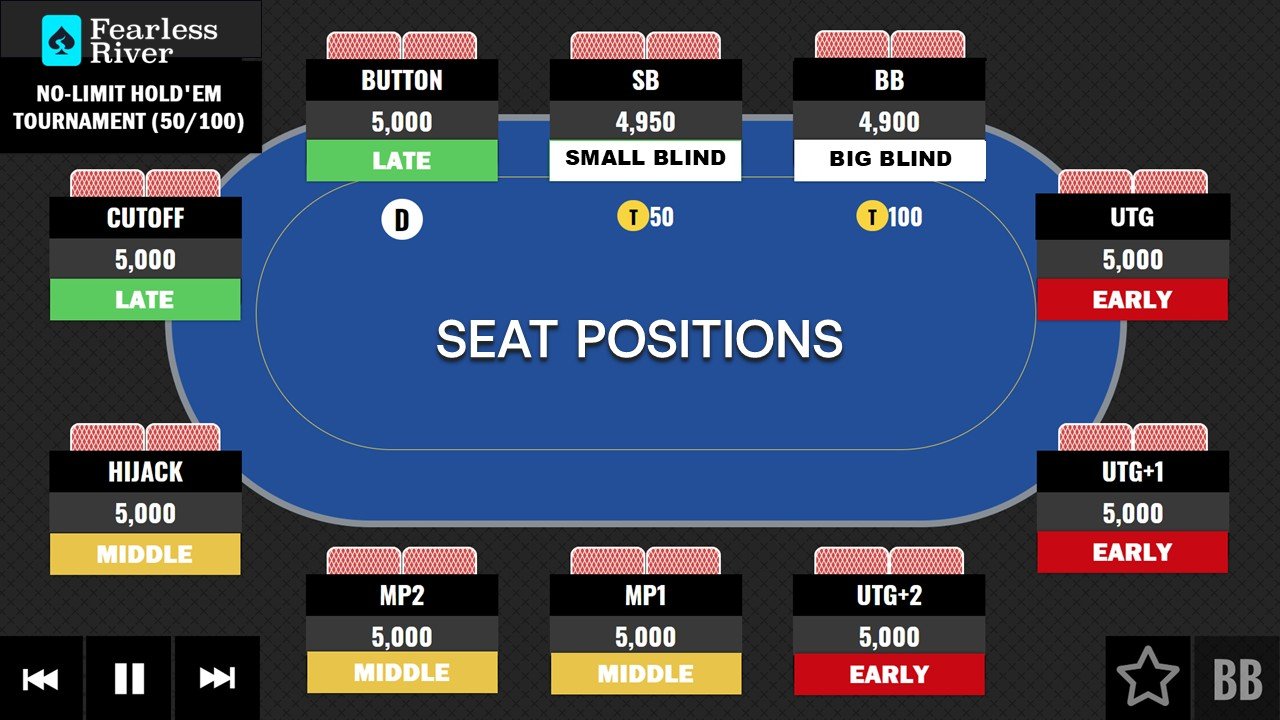
Position in poker means where you sit relative to the dealer button. The later you act in a hand, the more information you have when it is your turn. The player on the button acts last on every betting round after the flop, which makes it the best seat at the table.
Quick tips to remember:
- Early Position = play fewer hands
- Middle Position = play more hands
- Late Position = play even more hands
Always count backwards from the button to figure out where you are sitting. Later into your study we'll show you which hands you should enter the pot with depending on your seat position.
What Comes Next: The 5 Keys of Poker
Once you know the rules and basic game flow, poker stops being a memory test and starts being a decision-making game. Most new players get overwhelmed with what to do next because they think every hand feels like a brand-new problem with no obvious answer.
That's not the case. Experienced players are not memorizing thousands of situations. They are filtering every decision through a small set of core factors. We call them the 5 Keys:
- Position: Why acting last is the single biggest advantage in poker.
- First-In Hand Ranges: Which hands to raise with from each seat and how to adjust.
- Board Texture: How different types of flops, turns, and rivers affect your next move.
- Number of Opponents: Why multiway pots (pots with more than 1 opponent) require completely different thinking.
- Effective Stack Size: When stack depth calls for aggression and when it calls for control.
Get these five concepts right and you have a repeatable process for almost every decision you will face, from your first hand preflop to a river bet.
The 5 Keys training is free. You get five strategy videos, the First-In Hand Range charts download, poker quizzes, and training hands. No credit card, and you can unsubscribe any time.
Pro Tip: To build mental muscle memory for these concepts in real time, focus on the 5 Keys even when you are not in the hand. Watch what gets shown down, and you will start seeing patterns immediately.
Five Mistakes Almost Every New Player Makes
- Playing too many hands. Most starting hands are not worth playing. Folding is not passive; it is a decision.
- Calling first-in instead of raising. If a hand is good enough to put chips in with, it is usually good enough to raise with. Calling gives your opponents cheap chances to outdraw you.
- Changing bet sizes based on hand strength. Raising to 600 with aces and 400 with nines makes you easy to read. Stay consistent.
- Chasing every draw. Not every flush or straight draw is worth paying for. The rank of your flush cards, the size of the pot and the size of the bet decide that, not hope.
- Judging decisions by results. A good decision can lose the pot, and a bad one can take it down. Results in a single hand tell you almost nothing. Focus on the process.
Build a Study Routine from Day One
Improving at poker is not about playing more hands. It is about reviewing the hands you already played. The simplest version costs nothing: when you face a tough decision, write it down. Pen and paper is fine to start. What matters is capturing the same details every time so you can spot patterns later.
Here is a simple checklist of 8 questions for tracking a hand:
- ☐ What was my seat position at the table?
- ☐ What were the seat positions of my opponents?
- ☐ What was my chip stack to start the hand?
- ☐ What were the chip stacks of my opponents to start the hand?
- ☐ What were my 2 cards, specific rank and suit?
- ☐ What were the community cards, specific rank and suit?
- ☐ What were the specific actions in the hand? Which player opened the betting?
- ☐ Did my opponents show down their hand, and if so, what were the specific cards?
When you are ready to move past pen and paper, the Fearless River Hand Input Tool (HIT) lets you enter hands from your phone, replay them, and share them with our pros for feedback.
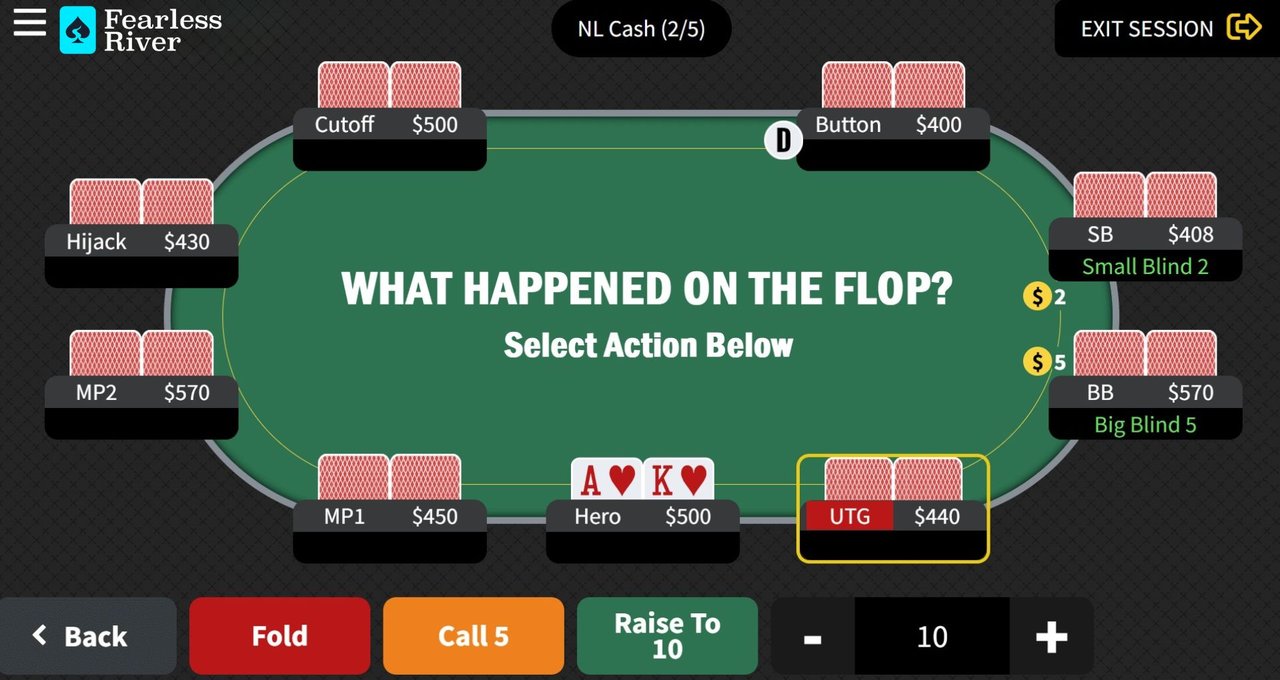
One rule when you review: focus on the range of hands your opponent could have had instead of putting them on a specific hand (like pocket jacks). Use the first-in hand range charts from the 5 Keys to guide you. Trying to put your opponent on a single hand is the fastest way to talk yourself into a bad decision.
Common Questions from New Players
Q: Do I need to memorize hand rankings before I play?
A: Yes, and it takes less time than you think. Hand rankings are the one thing that never change and you need instantly at the table. Download the free chart above and give it ten minutes.
Q: How much money do I need to start?
A: Start at the smallest stakes you can find, or play free games online while the rules sink in. There is no reason to risk money you care about while you are still learning the mechanics. Home games with your friends are also a great way to get started.
Q: Is poker mostly luck?
A: Over a single hand, luck decides a lot. Over the course of hundreds of hands, the quality of your decisions ultimately determines the outcome. That is the entire reason studying works and why you see the best players in the world constantly at the final table.
Q: Is Fearless River for beginners or experienced players?
A: Both. Our content is filterable by skill level: Foundation, Intermediate, and Advanced. You can train at the level that matches your game and skill level.
Q: Where should I start after this page?
A: The free 5 Keys training. It picks up exactly where this guide ends.
Ready to Keep Going?

We built Fearless River to make improving at poker as simple as possible, on your time and your terms. Small, consistent effort over time is the thing that separates students of the game from everyone else. Not talent.
➧ Start free. The 5 Keys training gives you five strategy videos, First-In Hand Range charts, and poker quizzes to test what you have learned.
➧ Ready for the full library? A Fearless River membership gets you 550+ strategy videos from WSOP Bracelet winners and WPT Champions, the GTO Trainer, live monthly study sessions, and the Ask a Pro Discord where you get your hands reviewed directly from our pros.
Your first month is $5. No contracts. Cancel anytime.
No matter how you choose to use Fearless River, there is a path for you to learn, improve, and have fun on your own time and your own terms.
Good luck and good playing,
– Team Fearless River

Find Your Flow. Train Smarter. Play Fearless.
Have questions? Email our support team at [email protected] or click the 'Contact Us' button and they will be happy to help.