Poker Quiz! J♠J♣ on the Button Facing a Raise and Reraise ...
JJ Button Facing Raise and Reraise-optimzd

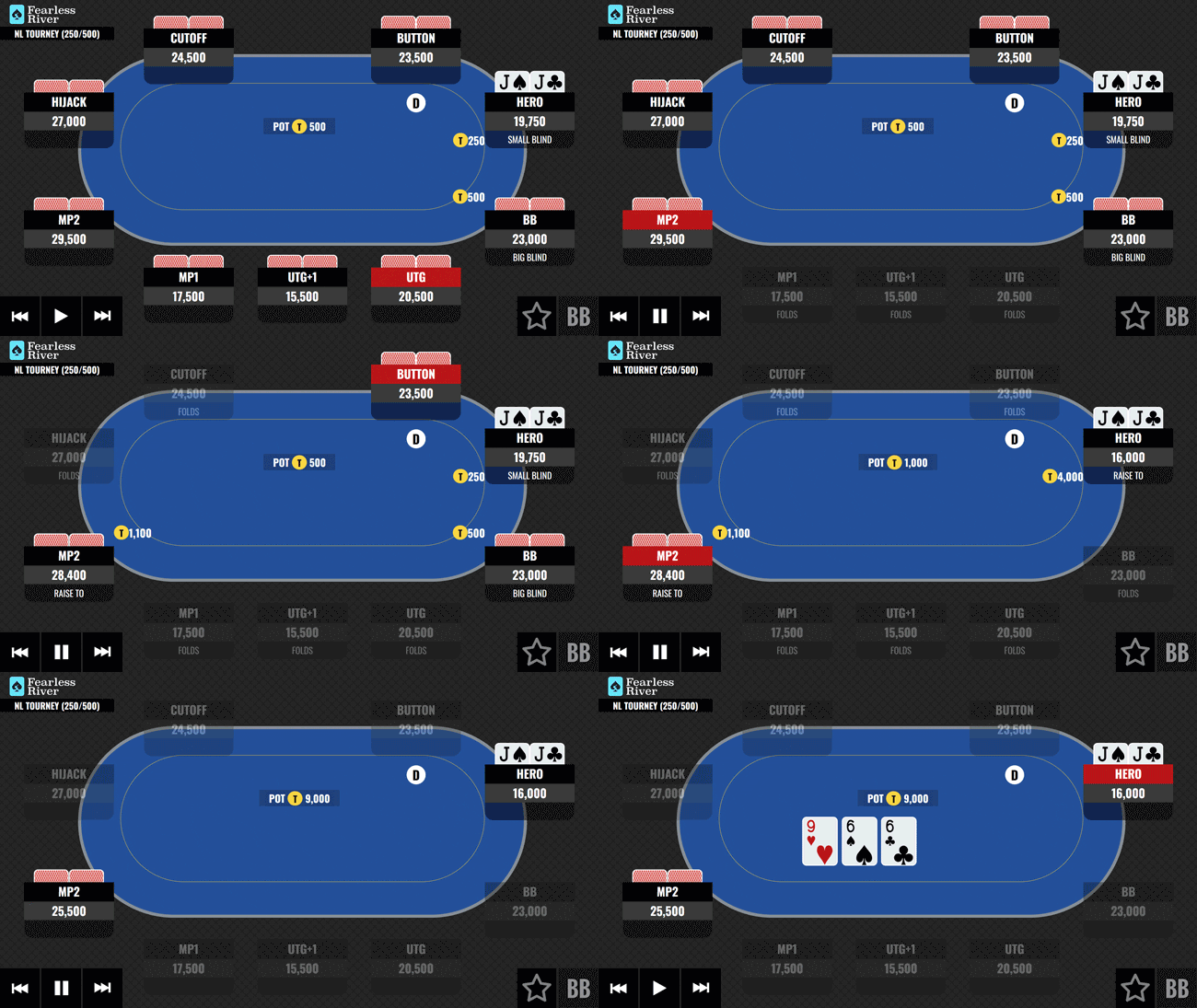
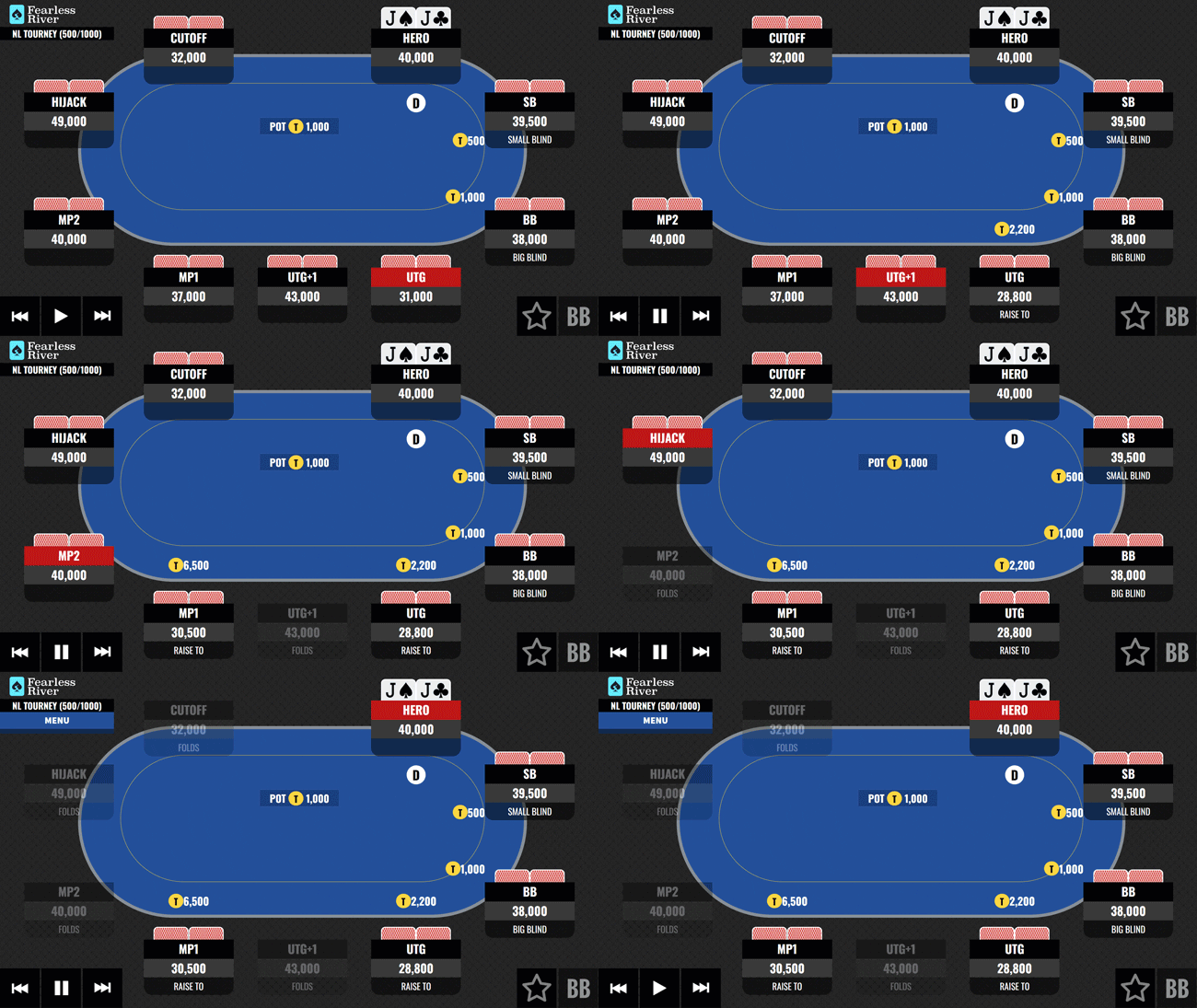
DECISION POINT: You’re playing in a two-day regional tournament and have noticed your tablemates are using appropriate ranges based on hands seen at showdown. The blinds are 500/1,000 with a 1,000 big blind ante. The UTG player raises to 2,200 and MP1 reraises to 6,500. Action folds to you on the Button with J♠J♣. What do you do here?

PRO ANSWER: We are playing in a two-day regional event with a reasonable structure. The blinds are 500/1,000 with a 1,000 big blind ante. So far, we’ve seen solid hands at showdown from every player at the table and can assume we are up against competent opponents.

We are dealt J♠J♣ on the Button and the UTG player raises to 2,200 chips. Following a fold from UTG+1, the player in the MP1 seat reraises to 6,500 chips and everyone else folds to us. This is a spot where many players make the mistake of thinking about their hand’s absolute value instead of their hand’s relative value in the specific situation. Pocket jacks is one of the top 5 starting hands in poker, and we are going to want to continue in some fashion preflop in the majority of situations.

In this scenario, however, the initial raise came from an early position player followed by a reraise from MP1 with 40 big blind effective stacks. In this spot, MP1 should be raising fewer than 5% of total hands. To give an idea of what this looks like, MP1’s reraising range should only include hands such as TT+/AKs/AQo+ along with a few bluffs for balance. A true GTO 3-betting range for MP1 versus UTG open would include 88-QQ all mixing with some frequency, where pocket pairs 88-JJ are doing more calling than raising. Combine MP1’s narrow range with the fact that any action preflop will very quickly become pot committing for us, and our hand doesn’t look near as nice.

If we had some sort of information that our opponents were on the more aggressive side with their preflop ranges, we might be able to continue exploitatively. In longer events that are well-structured, players will often be even more passive than optimal ranges would suggest, which would make continuing here with pocket jacks even more problematic.

It can be incredibly frustrating to be dealt a top 5 starting hand in No-Limit Hold’em and have to fold preflop facing multiple raises. When the action suggests that one of your opponents is likely holding something that is stronger, finding folds and preserving your stack for more favorable situations is a huge edge.

Folding is the best play.

How would you play it?
Share your answer in the comments below!


Will YOU Be Our Next Bracelet Winner?

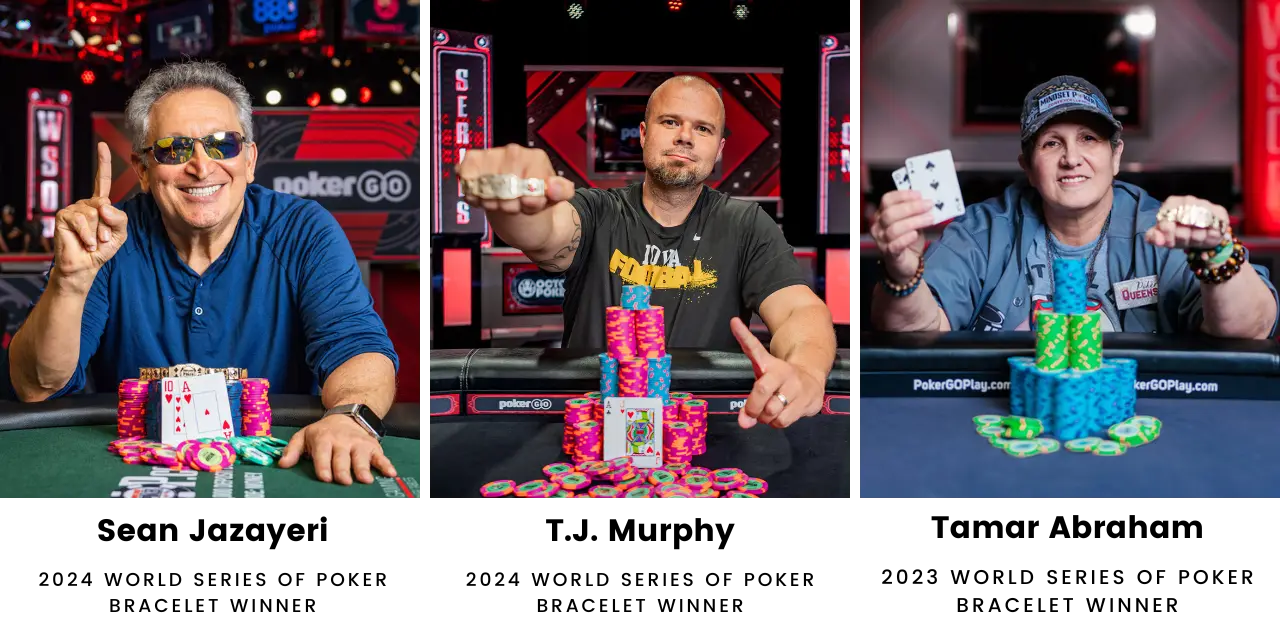
Our students consistently crush the summer poker season, bringing home massive scores and achieving their poker dreams.
WSOP Success 2023 and 2024 - Sean-TJ-Tammy

In fact, in just the past few years alone during the summer in Vegas Fearless River Students have achieved:

🥇 4 WSOP BRACELETS
🏆 6 WSOP Final Tables
💪 1 Around Town Win
👏 9 Around Town Final Tables
💰 Over $1.7 Million in Cashes

Ready to be our next success story?

Become a FearlessRiver.com Member now for just $5 your 1st month and start preparing for your best summer yet.

Have Questions about Fearless River? Send an email to our Support Team at [email protected] or click the CONTACT US button.
Poker Quiz! Pocket Sevens in Late Position Vs the Big Blind...

Pocket-Sevens-LP-Vs-Big-Blind-optimzd

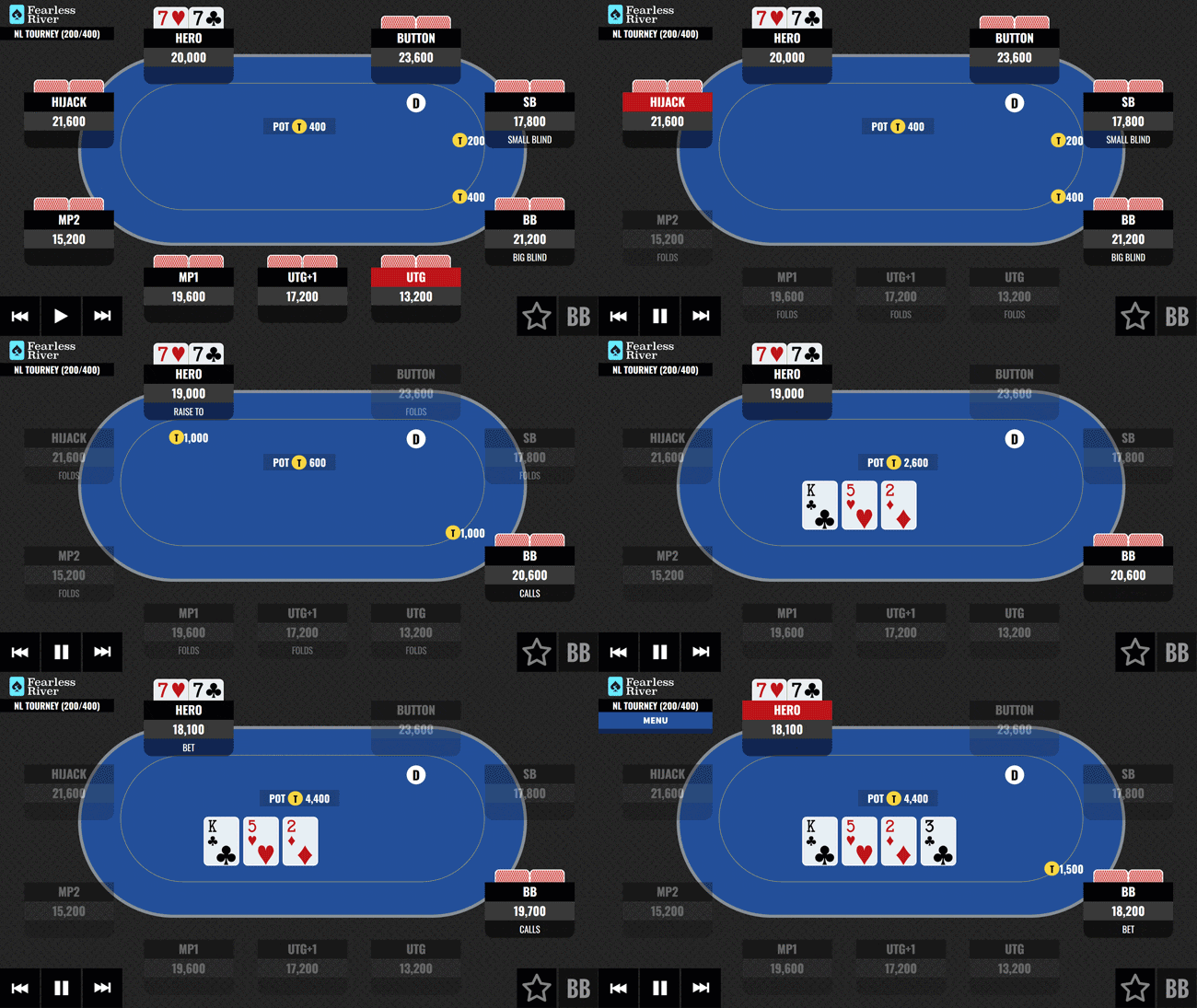
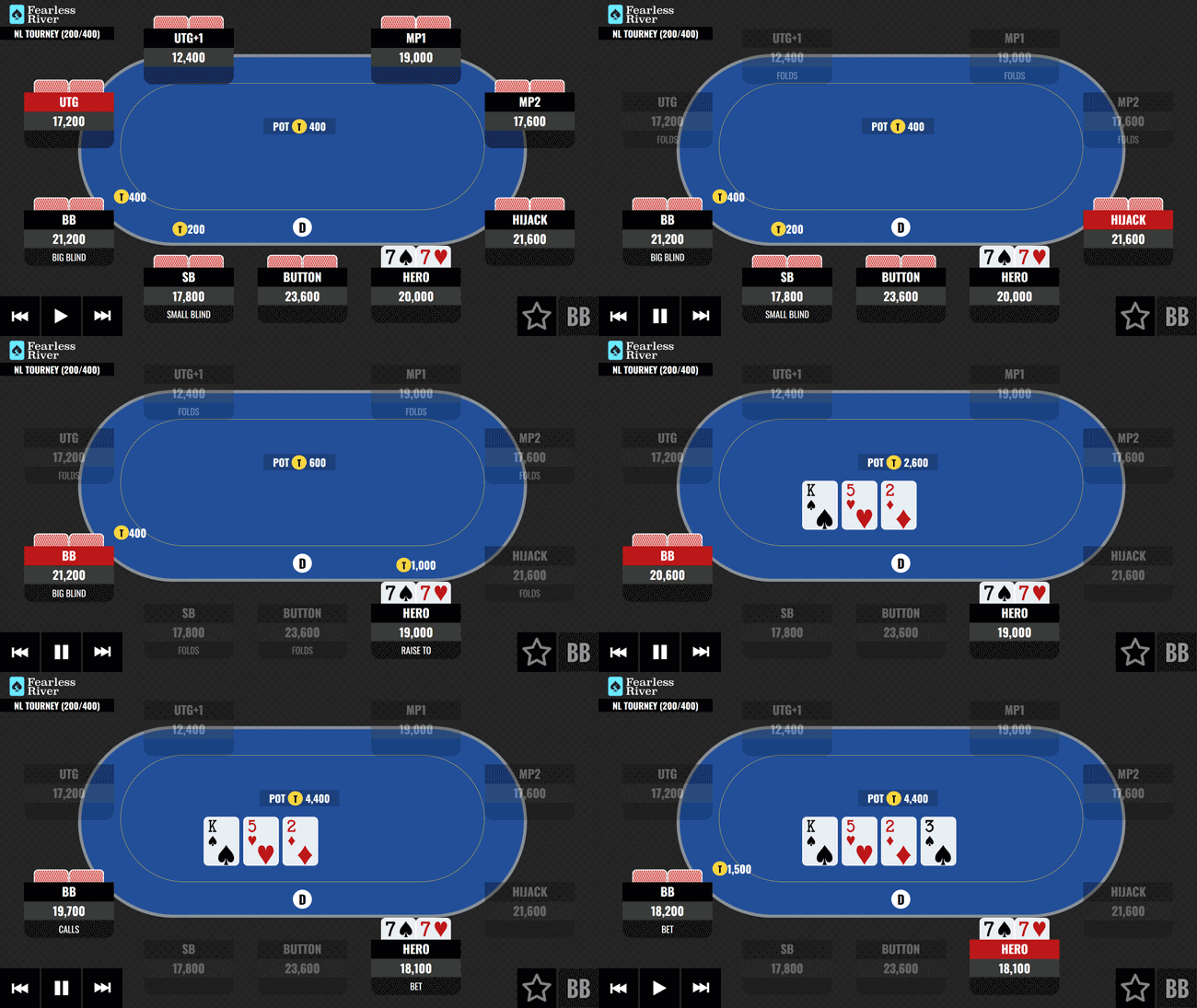
DECISION POINT: You're in the early stages of a daily tournament with no significant reads on your tablemates, with the exception that they mostly have been showing down reasonable hands. The blinds are 200/400 with a 400 big blind ante and you have 20,000 chips to start the hand. The action folds to you in the Cutoff with 7♠7♥, you open to 1,000, and only the Big Blind calls. The flop comes K♠5♥2♦. Your opponent checks, you c-bet 900, and they call. On the 3♠ turn the Big Blind leads out for 1,500 and action is on you. What do you do here?

PRO ANSWER: We are in the earlier stages of a daily tournament with blinds of 200/400 and a 400 big blind ante. Most of the players have been showing down reasonable hands when we’ve had the opportunity to see them, and we otherwise haven’t developed any significant reads to this point in the session.

With 20,000 chips to start the hand in the Cutoff and holding 7♠7♥ we make a standard raise to 1,000 chips, and everyone folds to the Big Blind who just calls. The flop is K♠5♥2♦ and the Big Blind checks to us. This is a board where the preflop raiser from the Cutoff will have a significant range advantage and we will frequently continuation bet with our entire range. In game we make the preferred choice and bet 900 into the 2,600 pot, and the Big Blind just calls.

The turn is the 3♠ and surprisingly, our opponent leads for 1,500. When an opponent takes a line where they lead into the aggressor on the turn, there is often one of several factors at play.

First, the Big Blind will often lead the turn when picking up additional equity, which in this case would mostly be flush draws but does include some Ax, 6x, and 4x hands.

Second, they could have turned two-pair or better with hands including A4, K3, 33, 53, and 32s, and are trying to build a pot fearing we may not fire again on this board texture. Lastly, this turn lead may be intended to deny equity since we are betting such a wide range on the flop. Many of the 5x combos in the Big Blind’s range benefit greatly from generating folds from some of our random overcards, such QJo, that still have significant equity.

Given these assumptions, the Big Blind’s leading range likely consists of some draws, some bigger hands, and some medium-strength hands looking to clear out equity. Our pocket sevens are doing fairly well against that range. However, there is little reason to raise as our opponent is likely to fold medium-strength hands we dominate, continue with the hands that dominate us, and proceed with draws only if getting the correct price.

Calling is the best play.

How would you play it?
Share your answer in the comments!


Will YOU Be Our Next Bracelet Winner?

Our students consistently crush the summer poker season, bringing home massive scores and achieving their poker dreams.

WSOP Success 2023 and 2024 - Sean-TJ-Tammy

In fact, in just the past few years alone during the summer in Vegas Fearless River Students have achieved:

🥇 4 WSOP BRACELETS
🏆 6 WSOP Final Tables
💪 1 Around Town Win
👏 9 Around Town Final Tables
💰 Over $1.7 Million in Cashes

Ready to be our next success story?

Become a FearlessRiver.com Member now for just $5 your 1st month and start preparing for your best summer yet.

Have Questions about Fearless River? Send an email to our Support Team at [email protected] or click the CONTACT US button.
The Fearless GTO Trainer: Interactive Learning Explained

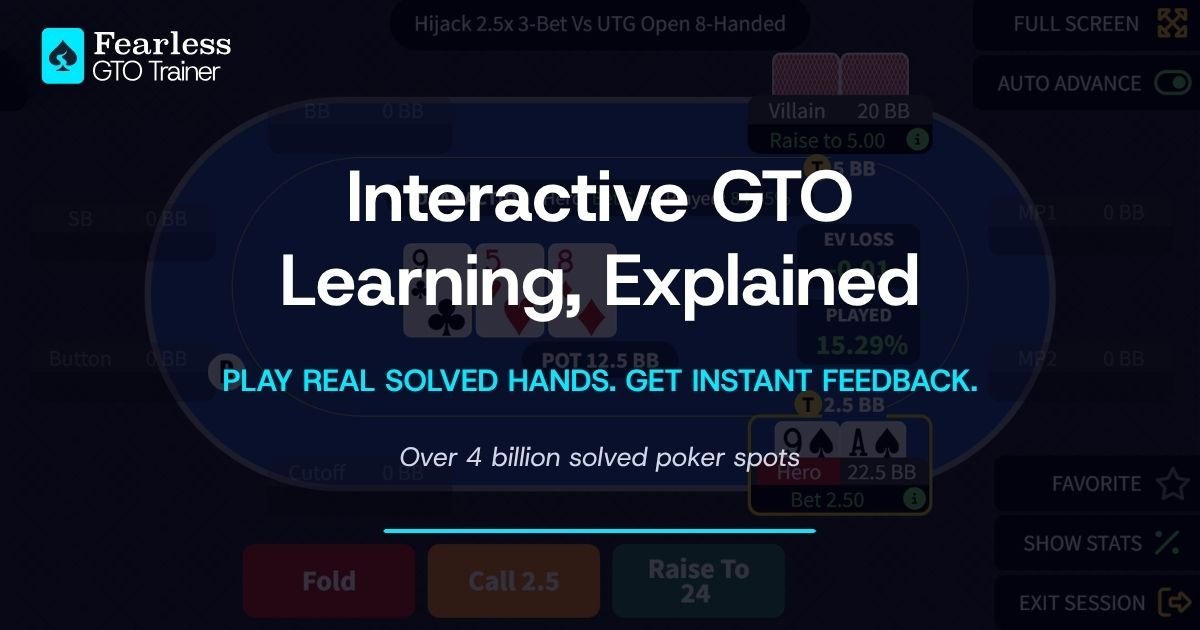
Fearless GTO Trainer interactive learning explained

Why Use the Fearless GTO Trainer vs. Other GTO Poker Strategy Trainers?

There have been many poker “trainers” in the past that allow you to play poker hands for practice. However, these have been powered by opinions of what is good play and are often based on a specific player’s experience. The poker strategy offered might not consider every factor that influences a poker hand when giving advice.

Unfortunately, human beings have only so much brainpower. These key strategic factors are often difficult to see without the help of cutting-edge technology, and they can make a big difference between a profitable and losing poker session. It’s practically impossible for one person to quickly and accurately tell you what will be the most profitable decision for your poker game in the long run.

Human poker players simply cannot give instant feedback on the correct strategy for every poker decision and show you how to correct mistakes instantly, without doing some serious in-depth analysis first (even poker legend Phil Ivey!).

It’s very unlikely that a human poker player will be able to make the correct decision for a high percentage of hands they play without some real work studying poker strategy off the table. In addition, most humans are not capable of providing poker strategy advice without favoring their own strengths and protecting their weaknesses.

GTO Trainer vs. Poker Solver Software: What’s the Difference?

A poker solver is software that calculates Game Theory Optimal strategy for a specific spot. You enter the starting hand ranges for both players, the board, stack sizes and bet sizes, and the solver adjusts both players’ strategies until neither can be exploited.

Solvers are powerful, but they’re built for experienced players. Setting them up takes a strong understanding of GTO strategy, running each spot takes time, and professional versions can be expensive.

A GTO trainer takes those solved results and turns them into hands you can play. Instead of studying charts or running simulations, you make decisions in real hands and get instant feedback on how close each one was to the GTO play.

That’s what makes the Fearless GTO Trainer such a practical form of poker training software: you learn by doing.

Fearless GTO Trainer ideal action feedback

How Does the Fearless GTO Trainer Make It Easy for Anyone to Learn GTO Poker Strategy?

The Fearless GTO Trainer allows you to study and learn true Nash equilibrium solutions solved for GTO poker strategy by simply playing poker hands in a user-friendly interface. Game Theory Optimal poker strategy is used by the best players in the world to dominate tournaments and cash games and now you can learn these cutting-edge strategies without doing all of the time-consuming research. You don’t need to test your poker strategy theory by trial and error. You just need to train poker GTO strategy with the Fearless GTO Trainer.

This cutting-edge poker training tool looks just like a standard online poker game and makes learning GTO strategy simple. Choose a poker situation from your favorites including cash games, tournaments, small stakes cash games, 6-max poker, final table play including ICM adjusted ranges, and heads up play.

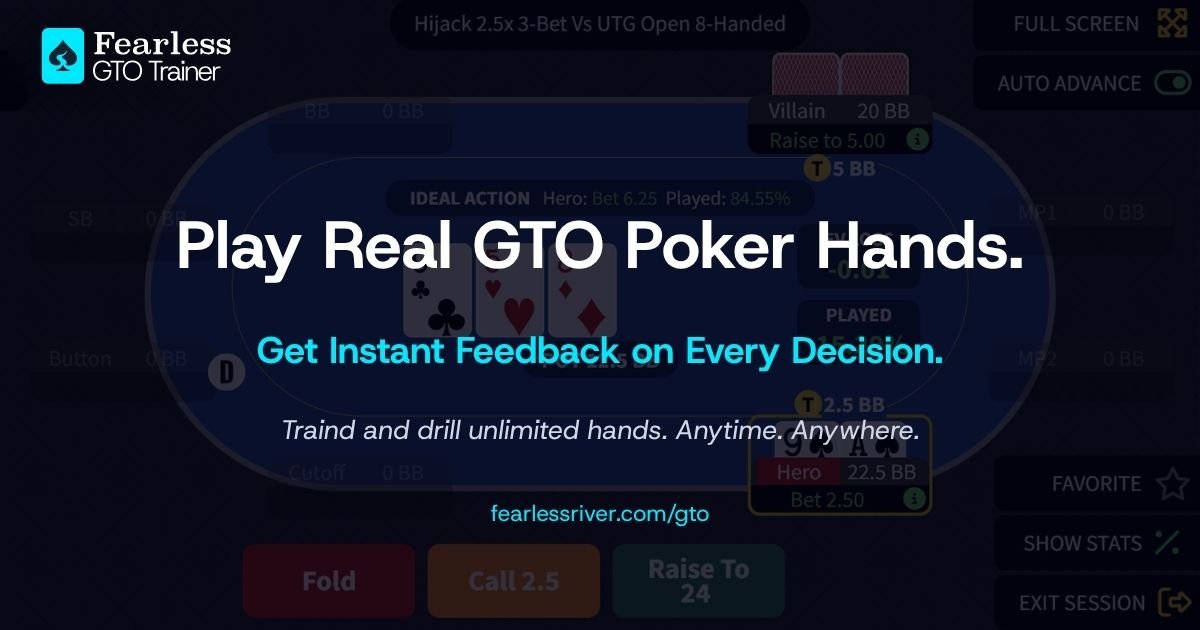
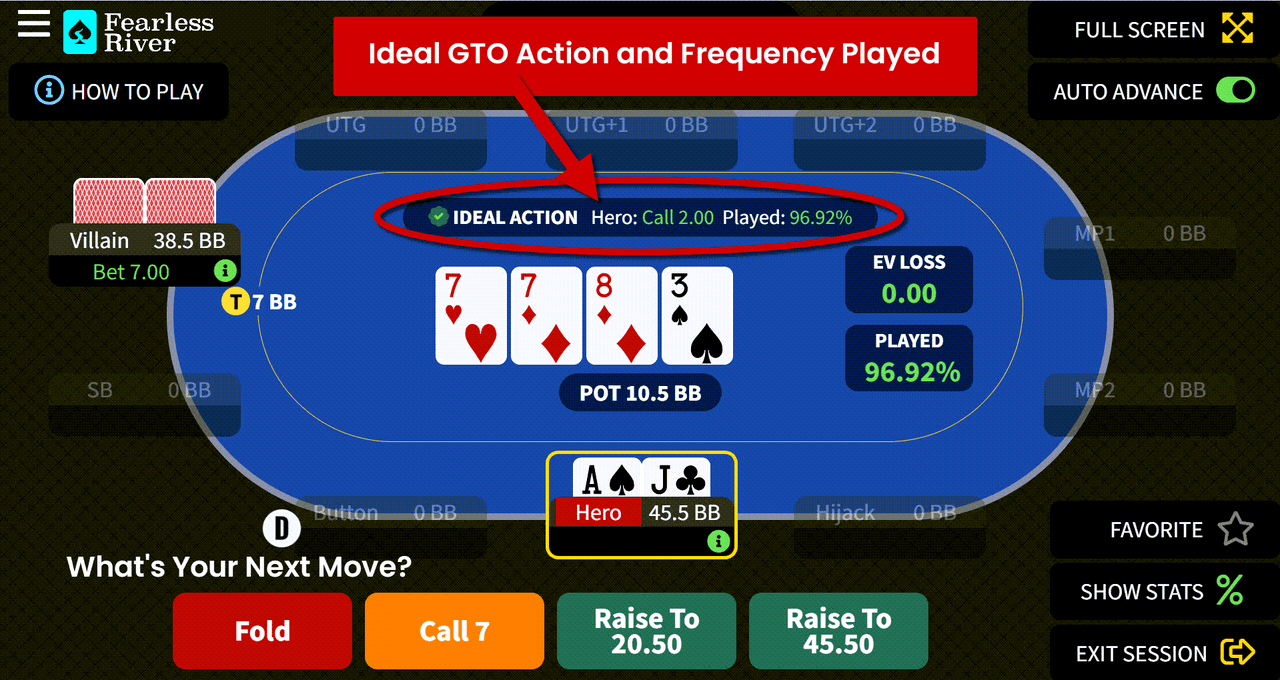
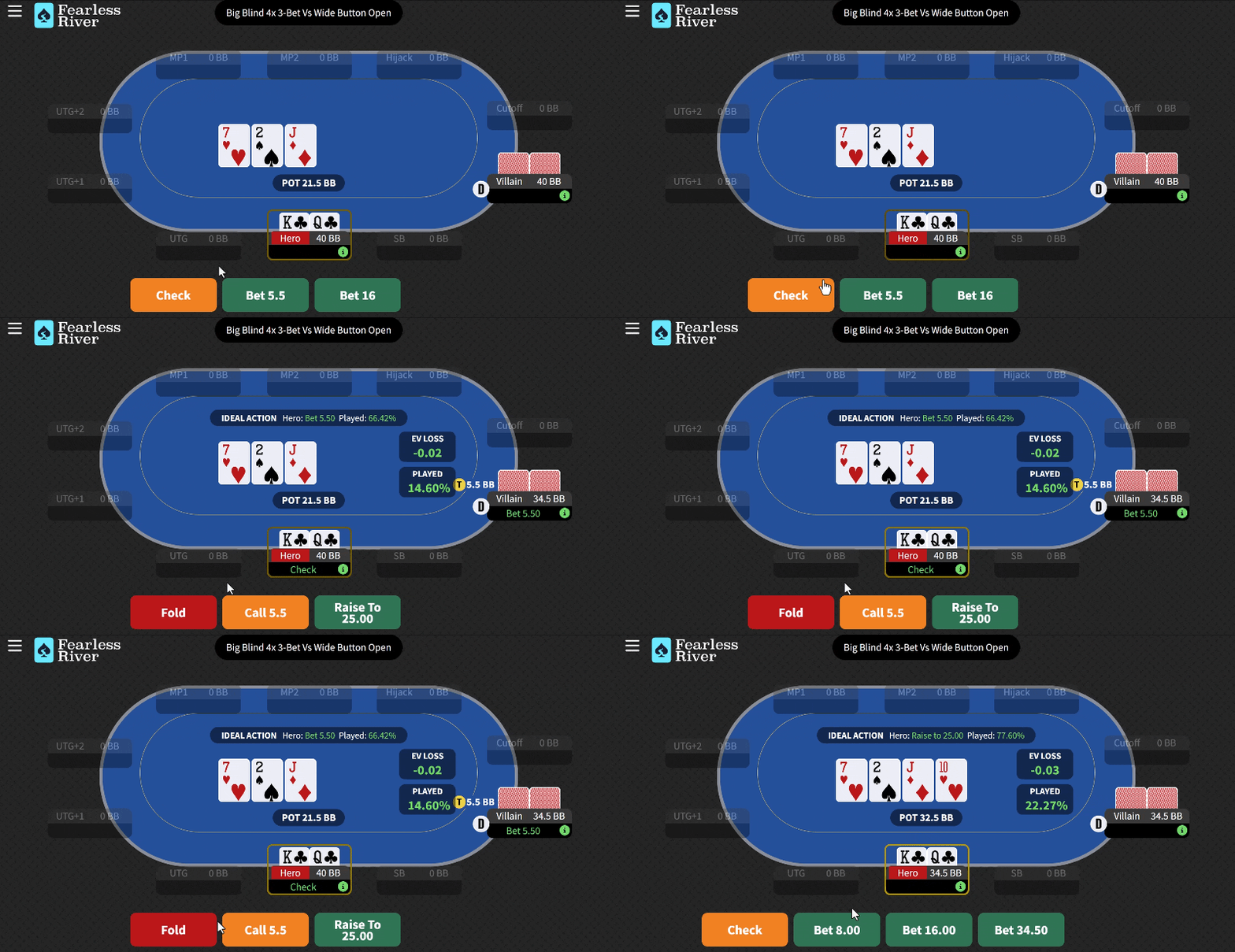
Train vital poker skills including continuation betting, big blind defense, button defense, 3-betting, 3-betting defense, and more. For each decision you make, get instant feedback on the precise EV (Expected Value) Loss of each play and see the Ideal Action as recommended by the GTO poker solver right on the screen.

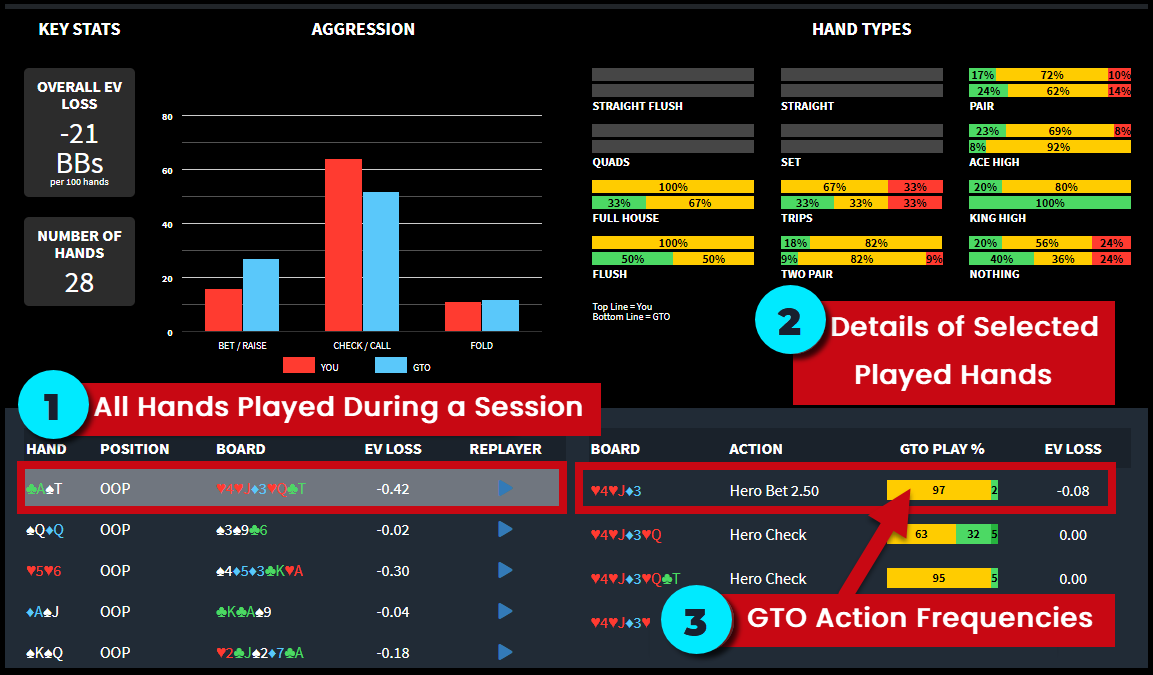
As you play real poker hands solved using real poker GTO strategy your game will quickly be guided closer and closer to GTO play. Quickly review your play at a glance with the Session Summary and see where your leaks are immediately.

Compare your play to correct GTO poker strategy including 1-pair hands, flushes, straights, full houses, and even ace high showdowns. Get in-depth feedback and share hands from the Session Summary directly to the Ask A Pro feature. With the click of a button, share the replay of the hand that gives you trouble directly to the Fearless River pros for expert GTO strategy guidance.

How Many Flops Does the Fearless GTO Trainer Solve For?

When evaluating whether a poker GTO strategy solution is accurate it’s essential to know how many flops the solution solves for. The most experienced GTO poker strategy teachers will solve for 1,755 strategically significant flops, which ultimately represent all of the 22,100 possible flop combinations in No-Limit Hold’em. Focusing on 1,755 strategically significant flops allows for efficient solving of GTO poker strategy solutions and ensures the output will be highly useful in studying situations based on poker GTO strategy.

The most common poker scenarios you’ll face at the tables are solved for poker GTO strategy using exclusive cloud-distributed server technology and transformed into playable online poker hands in the Fearless GTO Trainer. The GTO poker strategy solutions utilized by the Fearless GTO Trainer are true Nash Equilibrium solutions, not guesstimates.

For every poker scenario, each of the 1,755 strategically significant flops in no-limit hold’em is playable. Every spot has been solved to an exploitability of between 0.1% and 0.6% of the pot giving assurance the GTO poker strategy shown by the Fearless GTO Trainer is highly accurate. In total, there are over 4 billion poker GTO strategy hands available to play in our database and counting.

Want to see what's included? Browse the full GTO Trainer pack library, with over 140 cash game, tournament, final table, and heads up packs available to members.

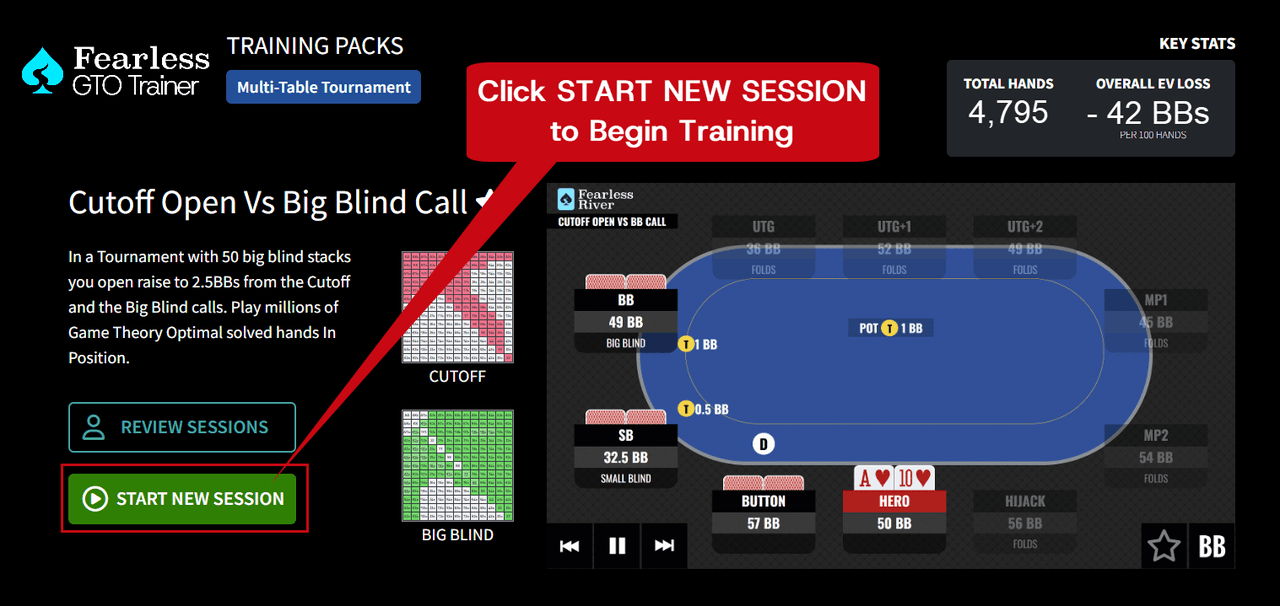
Playing a hand in the Fearless GTO Trainer

How Many Bet Sizes Does the Fearless GTO Trainer Use?

The Fearless GTO Trainer utilizes a maximum of 3 different bet size options for you to choose from for any decision you are presented with. While GTO poker solvers have the ability to determine the correct strategies using several additional bet sizes, trying to build a GTO poker strategy using too many options is almost impossible in real life.

Using a maximum of 3 bet sizes for GTO poker strategy solutions allows you to train only the most relevant poker situations that you are likely to encounter in most games you play. By sticking to a maximum of 3 bet sizes the Fearless GTO Trainer lets you practice key spots with the most realistic simulated responses from your opponent.

Each time you are presented with a decision in the Fearless GTO Trainer you’ll learn to choose the correct bet sizing faster based on the real-time feedback you get from each decision. Soon your bet sizing decisions will trend closer and closer to real GTO strategy by simply playing poker hands. You won’t need to worry about setting up poker GTO solvers or having a game plan that is too complex.

Just make the best decision at the moment based on the poker situation you are presented with and learn as you play.

Starting a new session in the Fearless GTO Trainer

How Easy Is It to Use the Fearless GTO Trainer?

If you’ve never worked with a GTO poker solver before, it can be really difficult to create the hand ranges for each player and know how each player's hand range interacts using GTO poker strategy. Solvers can be very intimidating to operate and require advanced GTO poker strategy expertise in order to make the correct assumptions.

Building correct hand ranges based on position, preflop action, and how opponents are likely to proceed involves a high level of experience and in-depth understanding of GTO poker strategy. In order for a GTO poker strategy solver to help your game, it’s essential you have the knowledge to determine the correct actions and incorporate them as part of a balanced game plan.

The Fearless GTO Trainer removes this time-consuming and potentially error-filled step and gets you to the correct answer by recreating a GTO poker strategy simulation in a virtual gameplay environment. Simply choose a training spot from the huge selection and start playing hands to learn and practice the GTO poker strategy.

The Fearless GTO Trainer is laser-focused on plugging your leaks and training you for peak performance. Learn GTO poker strategy fast by choosing the specific situations that give you the most trouble at the table. Whether you need to practice continuation betting from in position vs out of position, brush up on postflop play after defending your big blind, or you want to drill 3-bet defense from a middle position facing raises from virtually any seat at the table, it’s just one click away.

Simply filter for the poker GTO strategy scenario you want to train today, click the PLAY NOW button and you will automatically be presented with a flop and hole cards. Choose your action and bet amount for each street and get real-time feedback on your EV Loss, Played Percentage, and Ideal Action right on the screen after you make a decision.

Fearless GTO Trainer hand breakdown

At the end of each GTO poker strategy training session view your Session Summary dashboard to see your data displayed graphically for quick leak identification. Share the hands that generated the biggest EV Loss from your dashboard directly to Ask a Pro for expert feedback (hint, the results will be bright red).

Review your previous session before each day’s training to stay aware of your previous trouble spots and adjust your decisions closer to GTO strategy in real-time during your current training session. Use this cutting-edge poker training tool to practice anytime and anywhere from your favorite internet-connected device.

Check out how powerful this advanced GTO poker strategy training tool is and train with one of the best players in the game.

Play along with WPT Commentator, WPT Champion, 3x WSOP Bracelet Winner, and Fearless River Instructor Tony Dunst and learn GTO poker strategy in this free Strategy Episode.


Learn by Your Own Actions

Range charts, strategy tip sheets, and apps can be useful at the table; however, they also can be difficult to memorize and can often make the process of understanding GTO strategy more difficult.

GTO poker strategy involves many adjustments based on board texture and opponent actions, and trying to visualize these adjustments based on percentages listed in a chart can be almost impossible. Learning GTO poker strategy involves adjustments based on board texture and opponent response, including randomizing decisions in certain spots.

There aren’t many players who are skilled enough to memorize all of the possible hand range charts and how they change based on GTO poker strategy in each situation, not to mention take that information to the table and use it in real-time.

The Fearless GTO Trainer takes the classwork out of studying GTO poker strategy and forces you to learn by doing. You will develop the mental muscle memory for common No-Limit Hold’em poker scenarios and direct your study time toward the areas you need help with the most, by simply playing solved GTO poker strategy hands.

The Fearless GTO Trainer is accessible from all your favorite internet-connected devices from the road or the comfort of home. It’s never been easier to train real GTO poker hands and learn GTO poker strategy with Fearless River.


The Fearless GTO Trainer:
The Fastest Way to Learn GTO Strategy

Fearless GTO Trainer play real GTO poker hands with instant feedback

The Fearless GTO Trainer allows you to play and train against true GTO opponents and get instant feedback on your actions.

Choose from cash game and tournament scenarios (including small stakes cash games, final table ICM, and heads up play) and receive immediate feedback on your play compared to GTO including EV (expected value) Loss, Percentage Played, and the Ideal Action.

Join below and unlock 50+ different GTO training spots to train.

Become a Fearless River member for just $5 for your first month and play through hundreds of solved hands per hour (anytime, anywhere, and as many hands as you want).

Have questions? Email us at [email protected].

Poker Quiz! 9♥9♣ Facing a Flop Donk Bet, What's Your Move?

99-Facing-a-Flop-Donk-Bet

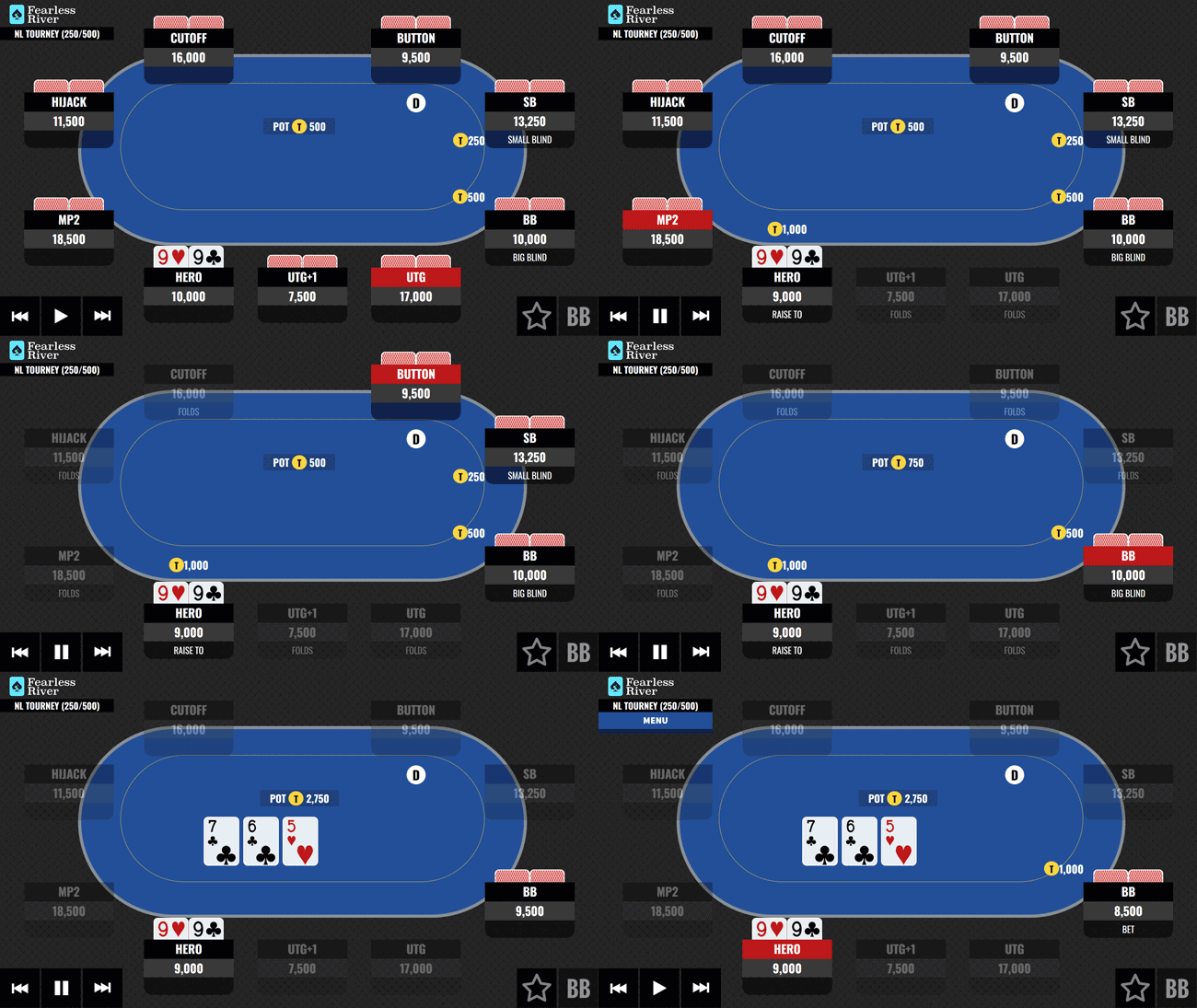
DECISION POINT: You have late registered for a daily tournament with a fast structure. The blinds are 250/500 with a 500 big blind ante. It folds to you in MP1 with 9♥9♣ and you raise first-in to 1,000. Action folds to the Big Blind who just calls. The flop comes 7♣6♣5♥ and your opponent bets 1,000. Action is on you. What do you do here?

PRO ANSWER: We have just entered a daily tournament with a fast structure and are jumping in a few levels after the start. The blinds are 250/500 with a 500 big blind ante. We are dealt 9♥9♣ in MP1 with our 10,000 starting stack. Everyone folds to us, and since pocket nines are a part of our first-in hand range from this position, we open to 1,000 chips. Everyone folds except the Big Blind, who just calls.

The flop is 7♣6♣5♥ and our opponent leads for 1,000 chips. Unlike our recent decision from a cash game session, this is a spot where a good opponent should be doing some leading based on theory. This board does connect well with a Big Blind defense calling range, but they have many hands that benefit from protection, and this is a board we won’t be expected to continuation bet often.

The Big Blind’s range should include a lot of 1-pair hands, especially those that have some sort of straight and/or flush draw to provide some backup equity. They will also lead with some overcard combinations that include flush draws, both backdoor and direct, as well as some 2-pair hands for balance. When we look at this situation closely, the Big Blind should be leading with around 50% of their range on this board.

From our perspective, we have an overpair with an inside straight draw and a stack to pot ratio (SPR) of around 3. This is not a spot we would ever be looking to fold our hand, so the main question we have to ask is if we should just call or raise. When considering the potential leading range for the Big Blind as discussed above, we can assume:

  • We are well ahead of most of their 1-pair hands
  • We still have significant equity against many of their 2-pair hands
  • Many of their overcards have significant equity against us


It is important to consider that if we were to raise now, many of their hands that we are well ahead of will call, while many of the overcard combos that have significant equity against us will fold (with the exception of direct flush draws using both hole cards). When our opponent will continue against aggression with hands such as 74s but folds hands such as JhTh or KcTh, that is a huge win for us.

Raising is the best play.

How would you play it?
Share your answer in the comments!

Play Better Poker With Fearless River!

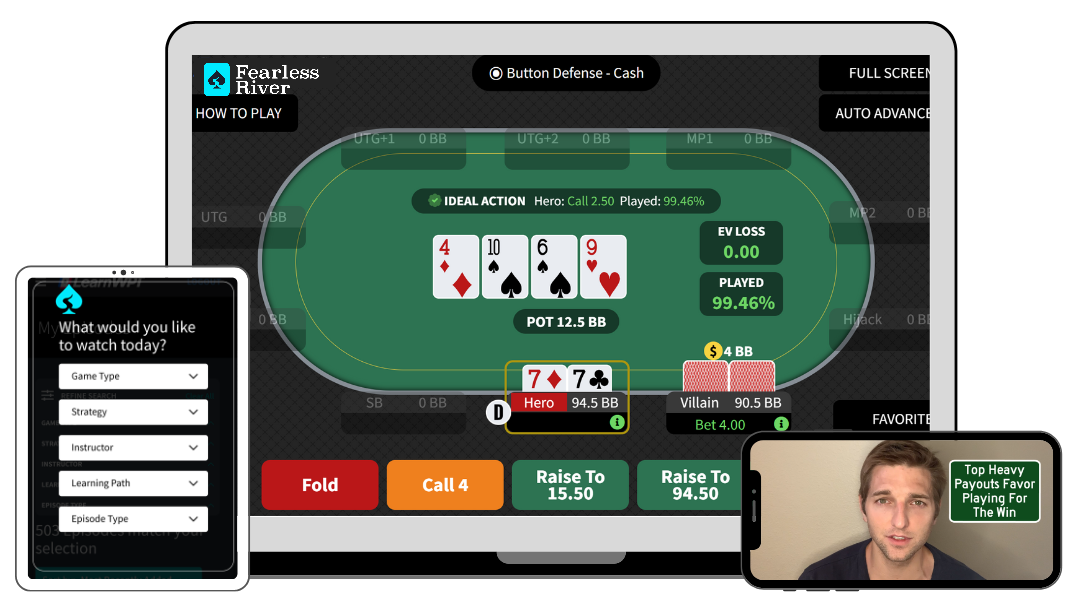
Whether you’re brand-new to poker training or are an experienced student, a membership to FearlessRiver.com is your chance to learn from world-class professional poker players in a friendly community using state-of-the-art tools.

Site Features - Multiple Devices Mockup

Join now to get started, and you'll immediately gain access to the Fearless River training features, including GTO Trainer packs, 550+ strategy videos, downloadable tools, Ask a Pro Discord, and more!

Have Questions about Fearless River? Send an email to our Support Team at [email protected] or click the CONTACT US button.
How to Play No-Limit Texas Hold'em: A Beginner's Guide

If you have never played a hand of poker, start here.

No-Limit Texas Hold'em is the most widely played form of poker in the world. You see it on TV, at the World Series of Poker, on the World Poker Tour, and in most cardrooms and home games.

It is also a game you can learn the rules of in about twenty minutes.

That is what this page is for.

Below is a free video that walks you through the basics from start to finish, plus a written reference you can come back to any time. You’ll learn how a hand plays out, what beats what, your options when the action is on you, and a few simple rules to guide your play. No experience required. No account required.

If you already know the basics, unlock The 5 Keys Of Poker here. Free.


Start Here: The Quick Start Video

In this video, Fearless River instructor and 2x WSOP Bracelet winner Nick Binger covers everything you need to sit down and play:

  • Poker hand rankings so you always know what beats what
  • How the betting works, including proper technique so you do not give away information
  • Handling your cards and chips at a live table
  • Which cards to play at the start of each hand

Watch it before you play, then use the sections below as a reference.


🤔 What Does That Term Mean?

Run into a word you don't recognize? Poker has a lot of unique vocabulary, and nobody expects you to know every term right away. Click the magnifying glass 🔍 in the menu at the top of any page and type in the term.

You will get the plain-language definition, plus links to Fearless River strategy videos and tools that cover it. Here is what a sample search looks like for Big Blind. Try it with position, button, or any other term as you read on.

How a Hand of No-Limit Hold'em Is Played

Every hand follows the same rhythm. Once you have seen it a few times, it becomes automatic.

  1. The blinds are posted. A dealer button marks one player at the table and moves one seat clockwise after every hand. The two players to the direct left of the button are required to put chips in the pot before the cards are dealt; these are called the small blind and big blind. The small blind is normally half the amount of the big blind. The amount is based on the blind level in tournaments or betting limit in cash games. The blinds are used to entice play.
  2. You get two cards. Every player is dealt two cards face down. These are your hole cards. Only you see them and you need to protect them from other players' view. Never show your cards unless instructed by the dealer.
  3. Preflop betting. Action always starts to the left of the big blind and moves clockwise. Each player folds, calls, or raises.
  4. The flop. Three community cards are dealt face up in the middle of the table. All players still in the hand share community cards to make their best five-card hand. Another round of betting follows.
  5. The turn. A fourth community card is dealt. Another round of betting follows.
  6. The river. A fifth and final community card is dealt. One last round of betting.
  7. Showdown: When two or more players are still in the hand after the final round of betting, the winner is determined by shown cards. The best five-card hand, using any combination of your two hole cards and the five community cards, takes the pot, and the dealer pushes it to that player. The last player who bet or raised turns their cards over first, then the rest follow in clockwise order.


There are two ways to take down a pot.
Either you have the best hand at showdown or you bet and everyone else folds. You do not need the best hand to take the pot if everyone else folds.

Pro Tip: You are never required to show a losing hand. If you know you are beaten, you can muck, which means handing your cards to the dealer face down and giving up your claim to the pot.


Poker Hand Rankings: What Beats What

This is the one thing worth memorizing before you play. Hand rankings apply to every decision you make, and they never change.

Rank Hand Example What it is
1 Royal Flush 10♠J♠Q♠K♠A♠ Ace-King-Queen-Jack-Ten all of the same suit. The best possible hand.
2 Straight Flush 7♠8♠9♠10♠J♠ Five cards in sequence, all the same suit.
3 Four of a Kind 9♥9♠9♦9♣J♠ All four cards of the same rank.
4 Full House 9♥9♠9♦J♣J♠ Three cards of the same rank + two cards of the same rank.
5 Flush Q♥3♥6♥8♥A♥ Five cards of the same suit, not in sequence.
6 Straight 7♦8♠9♦10♠J♣ Five cards in sequential order, not of the same suit.
7 Three of a Kind 7♠7♦7♥10♠J♠ Three cards of the same rank.
8 Two Pair 7♠7♦10♦10♠J♠ Two cards of the same rank + two cards of another rank.
9 One Pair Q♠Q♣6♥10♠3♣ Two cards of the same rank.
10 High Card A♥Q♣6♥10♠3♣ One card ranking higher than all others. No pairs, straights, flushes.
Download The Free Hand Rankings Chart ➧


A few things that trip up new players:

  • Suits do not rank against each other. A flush in spades does not beat a flush in hearts. The highest-ranking card in the flush decides it.
  • You make your best five-card hand out of seven. Your two hole cards plus the five community cards give you seven to choose from, and only the best five count. That can mean using both of your cards, one of them, or neither. When your best five-card hand consists solely of the five community cards on the board, you are said to be "playing the board". If no player has a hand that can beat the board, the pot is split among the players involved.
  • An Ace can be high or low. A-K-Q-J-10 is the highest straight. A-2-3-4-5 is the lowest (known as a wheel).


Your Options When the Action Is on You

Every decision in poker comes down to one of these actions:

  • Check: To defer your action to the next player in the hand. Only possible if nobody has bet ahead of you on that street.
  • Bet: To voluntarily place money in the pot.
  • Call: To match the amount of someone else's bet, rather than choosing to raise or fold.
  • Raise: To increase the current bet. The amount of your raise must be at least the size of the last bet or raise. Example: If it is 100 to you, the smallest raise is to 200. If someone has already raised from 100 to 300, the smallest reraise is to 500, not 600. Multiple raises can occur in a given betting round.
  • Fold: The action of surrendering your cards. Players who fold at any point before showdown are not eligible to win any portion of the pot and cannot re-enter the hand.
  • All-in: A bet that commits your entire chip stack to the pot. This action can take place during any betting round. If you go all-in and no one calls your bet, you win the pot without needing to reveal your hand. However, if someone does call, you must win the hand at showdown to claim the pot. It is important to note that once you declare an all-in bet, you cannot retract it.

Two habits worth building from day one:

➧ Announce your action before you touch your chips. Verbal declarations are binding, so saying "raise" or "call" out loud protects you from misconstrued hand action.

➧ Put your chips out in one clean motion. Reaching back to your stack for a second handful after your chips have crossed the line can be ruled a call instead of a raise. Also known as a string bet.


Where You Sit Changes Everything

This is the first real strategy concept, and it is the one that separates new players from everyone else faster than any other.

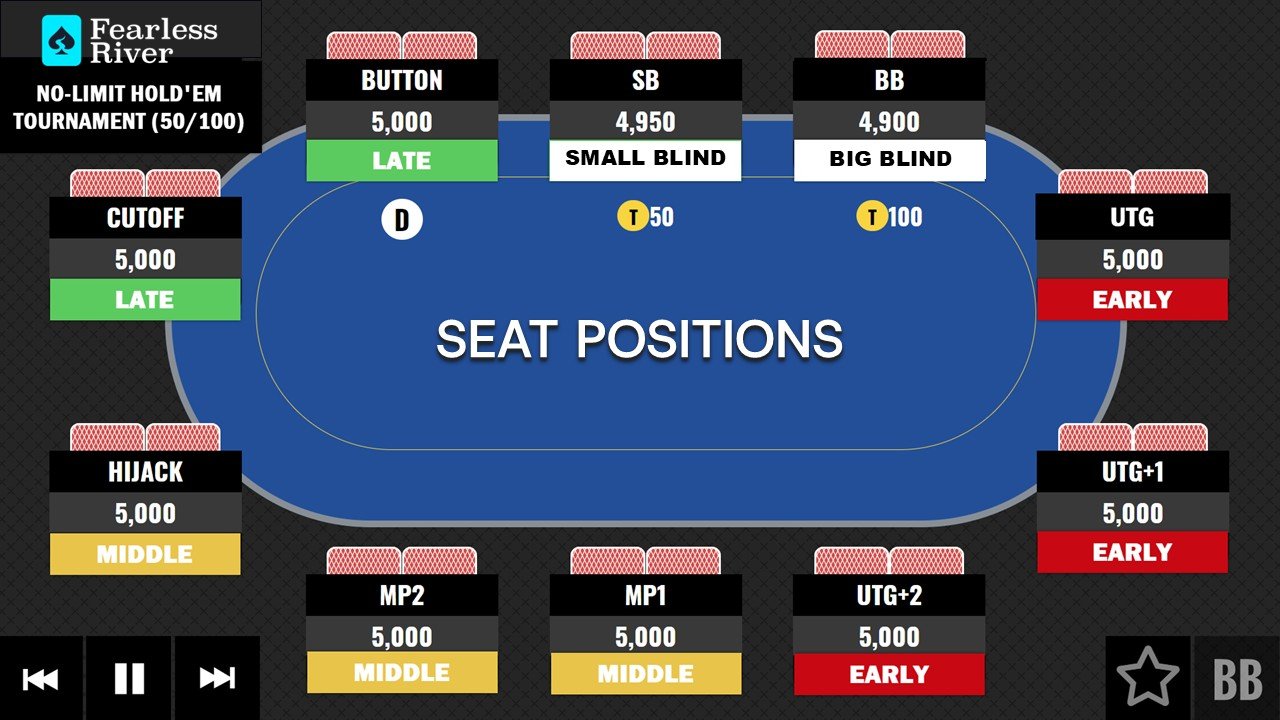
Fearless River seat position chart for a 10-handed No-Limit Hold'em tournament table showing early, middle, and late position

Position in poker means where you sit relative to the dealer button. The later you act in a hand, the more information you have when it is your turn. The player on the button acts last on every betting round after the flop, which makes it the best seat at the table.

Quick tips to remember:

  • Early Position = play fewer hands
  • Middle Position = play more hands
  • Late Position = play even more hands


Always count backwards from the button to figure out where you are sitting. Later into your study we'll show you which hands you should enter the pot with depending on your seat position.


What Comes Next: The 5 Keys of Poker

Once you know the rules and basic game flow, poker stops being a memory test and starts being a decision-making game. Most new players get overwhelmed with what to do next because they think every hand feels like a brand-new problem with no obvious answer.

That's not the case. Experienced players are not memorizing thousands of situations. They are filtering every decision through a small set of core factors. We call them the 5 Keys:

  1. Position: Why acting last is the single biggest advantage in poker.
  2. First-In Hand Ranges: Which hands to raise with from each seat and how to adjust.
  3. Board Texture: How different types of flops, turns, and rivers affect your next move.
  4. Number of Opponents: Why multiway pots (pots with more than 1 opponent) require completely different thinking.
  5. Effective Stack Size: When stack depth calls for aggression and when it calls for control.

Get these five concepts right and you have a repeatable process for almost every decision you will face, from your first hand preflop to a river bet.

The 5 Keys training is free. You get five strategy videos, the First-In Hand Range charts download, poker quizzes, and training hands. No credit card, and you can unsubscribe any time.


Pro Tip: To build mental muscle memory for these concepts in real time, focus on the 5 Keys even when you are not in the hand. Watch what gets shown down, and you will start seeing patterns immediately.


Five Mistakes Almost Every New Player Makes

  1. Playing too many hands. Most starting hands are not worth playing. Folding is not passive; it is a decision.
  2. Calling first-in instead of raising. If a hand is good enough to put chips in with, it is usually good enough to raise with. Calling gives your opponents cheap chances to outdraw you.
  3. Changing bet sizes based on hand strength. Raising to 600 with aces and 400 with nines makes you easy to read. Stay consistent.
  4. Chasing every draw. Not every flush or straight draw is worth paying for. The rank of your flush cards, the size of the pot and the size of the bet decide that, not hope.
  5. Judging decisions by results. A good decision can lose the pot, and a bad one can take it down. Results in a single hand tell you almost nothing. Focus on the process.


Build a Study Routine from Day One

Improving at poker is not about playing more hands. It is about reviewing the hands you already played. The simplest version costs nothing: when you face a tough decision, write it down. Pen and paper is fine to start. What matters is capturing the same details every time so you can spot patterns later.

Here is a simple checklist of 8 questions for tracking a hand:

  1. ☐ What was my seat position at the table?
  2. ☐ What were the seat positions of my opponents?
  3. ☐ What was my chip stack to start the hand?
  4. ☐ What were the chip stacks of my opponents to start the hand?
  5. ☐ What were my 2 cards, specific rank and suit?
  6. ☐ What were the community cards, specific rank and suit?
  7. ☐ What were the specific actions in the hand? Which player opened the betting?
  8. ☐ Did my opponents show down their hand, and if so, what were the specific cards?

When you are ready to move past pen and paper, the Fearless River Hand Input Tool (HIT) lets you enter hands from your phone, replay them, and share them with our pros for feedback.

No-Limit-Holdem-Poker-Software-Program

One rule when you review: focus on the range of hands your opponent could have had instead of putting them on a specific hand (like pocket jacks). Use the first-in hand range charts from the 5 Keys to guide you. Trying to put your opponent on a single hand is the fastest way to talk yourself into a bad decision.


Common Questions from New Players

Q: Do I need to memorize hand rankings before I play?
A: Yes, and it takes less time than you think. Hand rankings are the one thing that never change and you need instantly at the table. Download the free chart above and give it ten minutes.

Q: How much money do I need to start?
A: Start at the smallest stakes you can find, or play free games online while the rules sink in. There is no reason to risk money you care about while you are still learning the mechanics. Home games with your friends are also a great way to get started.

Q: Is poker mostly luck?
A: Over a single hand, luck decides a lot. Over the course of hundreds of hands, the quality of your decisions ultimately determines the outcome. That is the entire reason studying works and why you see the best players in the world constantly at the final table.

Q: Is Fearless River for beginners or experienced players?
A: Both. Our content is filterable by skill level: Foundation, Intermediate, and Advanced. You can train at the level that matches your game and skill level.

Q: Where should I start after this page?
A: The free 5 Keys training. It picks up exactly where this guide ends.


Ready to Keep Going?

Fearless-River-Instructors-Brian-Tony-Chewy-Gags

We built Fearless River to make improving at poker as simple as possible, on your time and your terms. Small, consistent effort over time is the thing that separates students of the game from everyone else. Not talent.

➧ Start free. The 5 Keys training gives you five strategy videos, First-In Hand Range charts, and poker quizzes to test what you have learned.

➧ Ready for the full library? A Fearless River membership gets you 550+ strategy videos from WSOP Bracelet winners and WPT Champions, the GTO Trainer, live monthly study sessions, and the Ask a Pro Discord where you get your hands reviewed directly from our pros.

Your first month is $5. No contracts. Cancel anytime.

No matter how you choose to use Fearless River, there is a path for you to learn, improve, and have fun on your own time and your own terms.

Good luck and good playing,
– Team Fearless River

Fearless River logo - Stacked

Find Your Flow. Train Smarter. Play Fearless.


Have questions?
Email our support team at [email protected] or click the 'Contact Us' button and they will be happy to help.

Are You Using the Fearless River Hand Input Tool (HIT)?

If yes, THANK YOU and congratulations on taking another step in improving your game! If not, let's change that today.

No-Limit-Holdem-Poker-Software-Program

So, what exactly is HIT?

The Hand Input Tool (HIT) is a Fearless River feature that allows members to capture, replay, and share real hands they've played and receive analysis and feedback from the Fearless River pros.

See below for info, hints, and the benefits of this powerful feature:


Getting Started:

Hit - Getting Started-reszd.png

Log in and access HIT from the top navigation bar or via the mobile menu. For more instructions, watch the "Show Me How It Works" video on the HIT Dashboard or review Episode 226: Hand Input Tool (HIT).

Recording your hand:
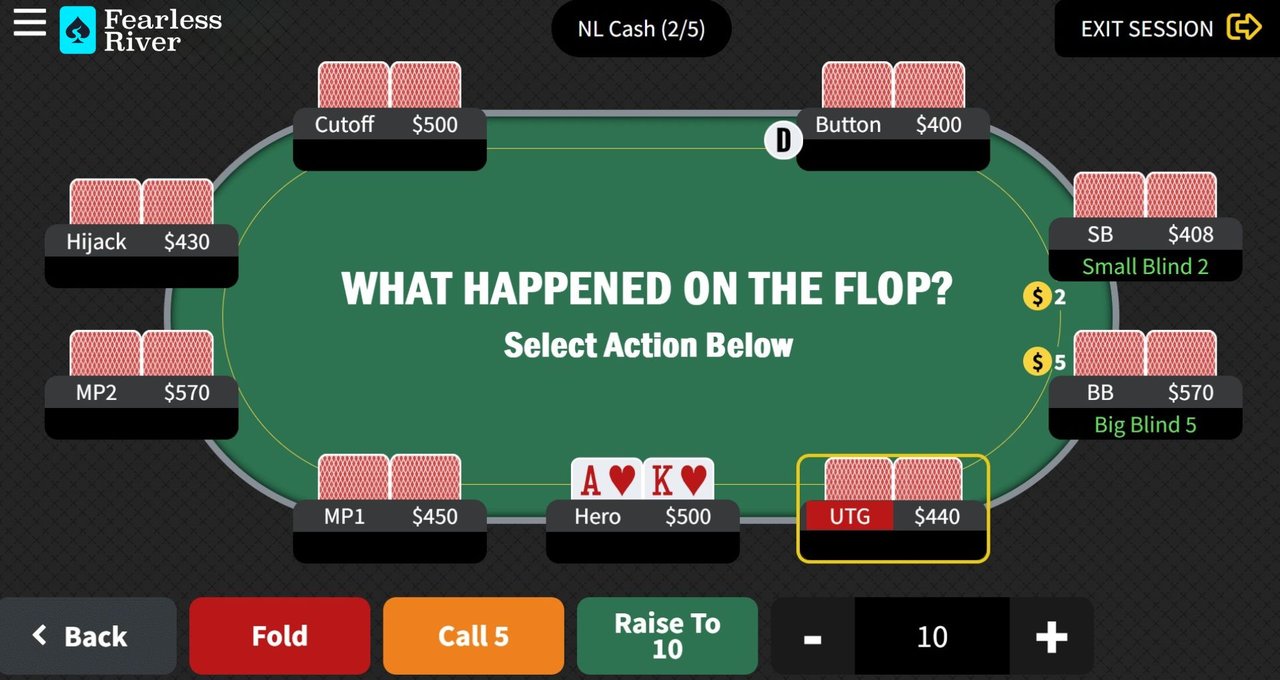
➧ To begin, click the red ENTER A HAND NOW button.
➧ Enter the game specifics:

  • Select Cash or Tournament
  • Enter the Blinds Amount
  • Select the type of Ante and enter the amount
  • Enter the number of Players Seated
  • Click the NEXT button to record the action


➧ Follow the onscreen prompts to record the hand information.
➧ Shortcuts when entering hole card information for quicker recording.

  • Type the first letter or number of the card value and suit versus clicking each option to select your card. Example:
    • Type "a" + "c" to select A♣ or type "2" + "d" to select 2♦
  • Use the +/- keys to increase/decrease values or click your cursor into the field box and manually type the value.


Helpful Hint: Click the EXIT SESSION button in the top right-hand corner of the screen to stop the hand at a specific point for analysis before getting to showdown.


Receiving Feedback:

Hit - Ask a Pro-reszd.png


Members can submit their recorded HIT hands to the Fearless River pros for analysis of their play and get answers to questions about a specific move or strategy using the Ask a Pro Discord channel.

Sending your hand in for feedback:

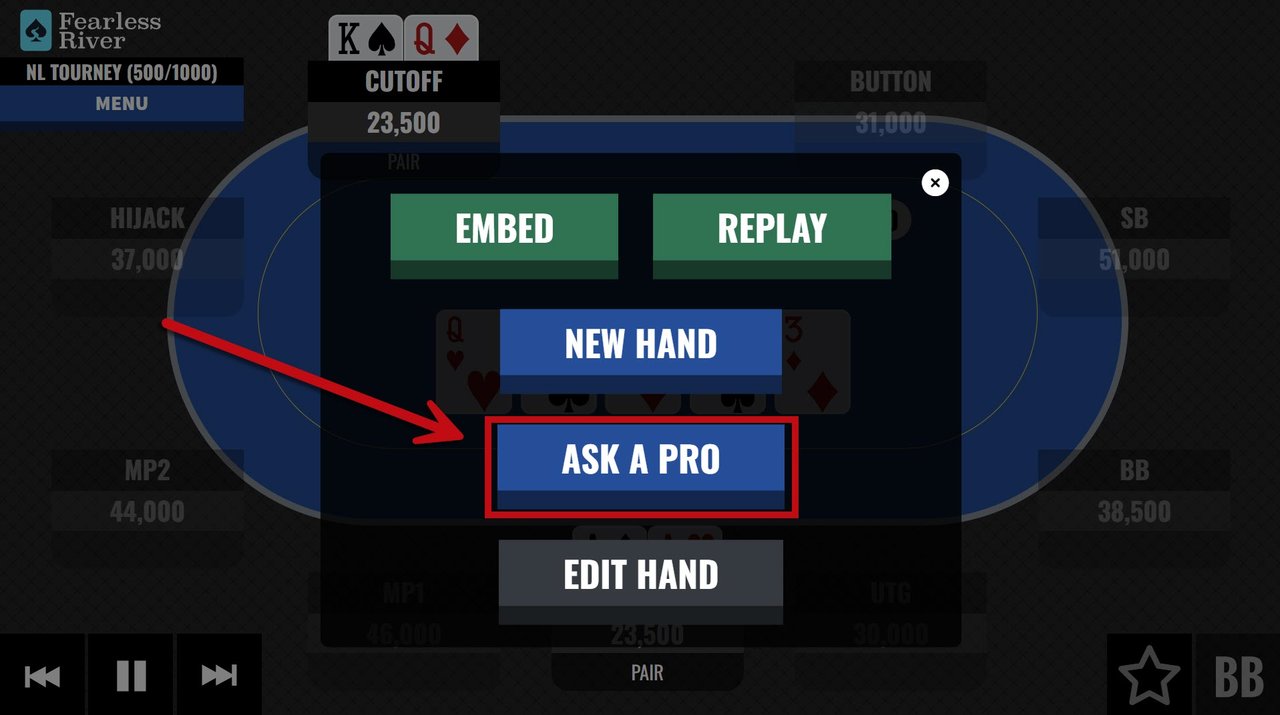
➧ Once finished recording your hand, the action will replay, and a pop-up will appear noting options for your hand.
➧ After replaying the hand, click the ASK A PRO button.
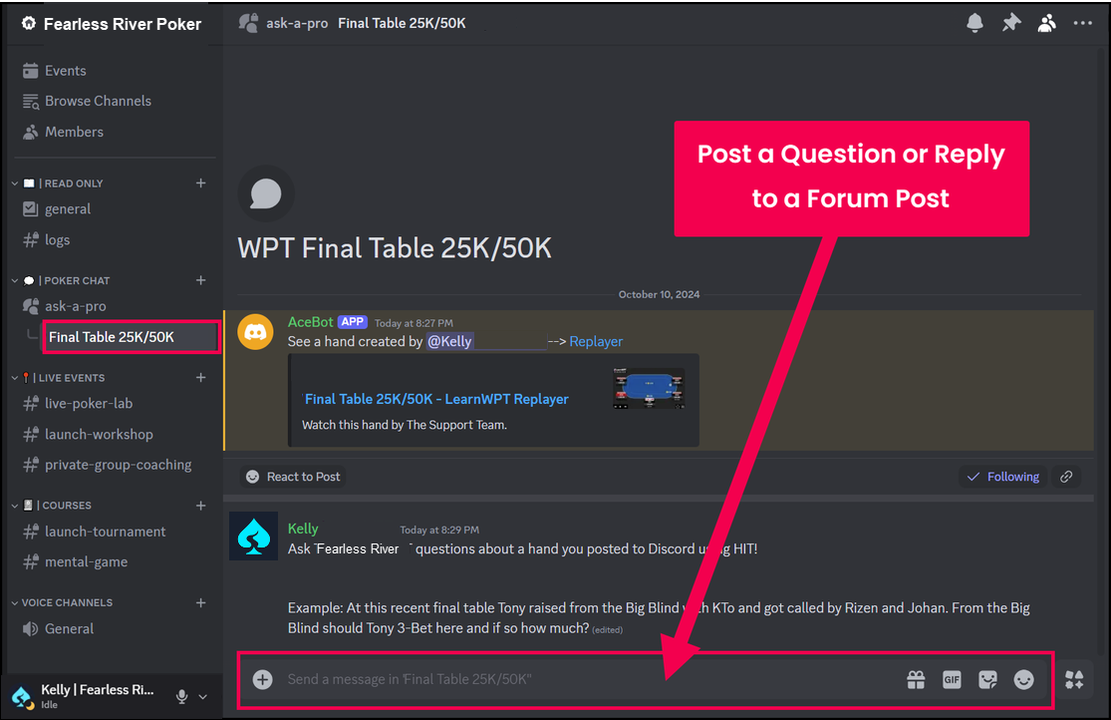
➧ You’ll automatically be directed to the #ask-a-pro Discord channel, and your HIT hand will be immediately posted.
➧ Type your question to Team Fearless River about the hand.

That's it! The Fearless River Pros will provide feedback shortly.

Don't have a Discord account? Click here to get started.

Discord - post forum channel


HIT Helpful Hints:

HIT - ellipsis.png


Our goal is to make HIT an easy-to-use and personal experience. Be sure to share with us any suggestions.

Did you know you can:

➧ Update the name of a hand by clicking the NL Cash or NL Tourney fields in the top center of the screen.
➧ Change the name/nickname of a player and their chip stack by clicking their position tile - PLAYER NAME and CHIP STACK fields.
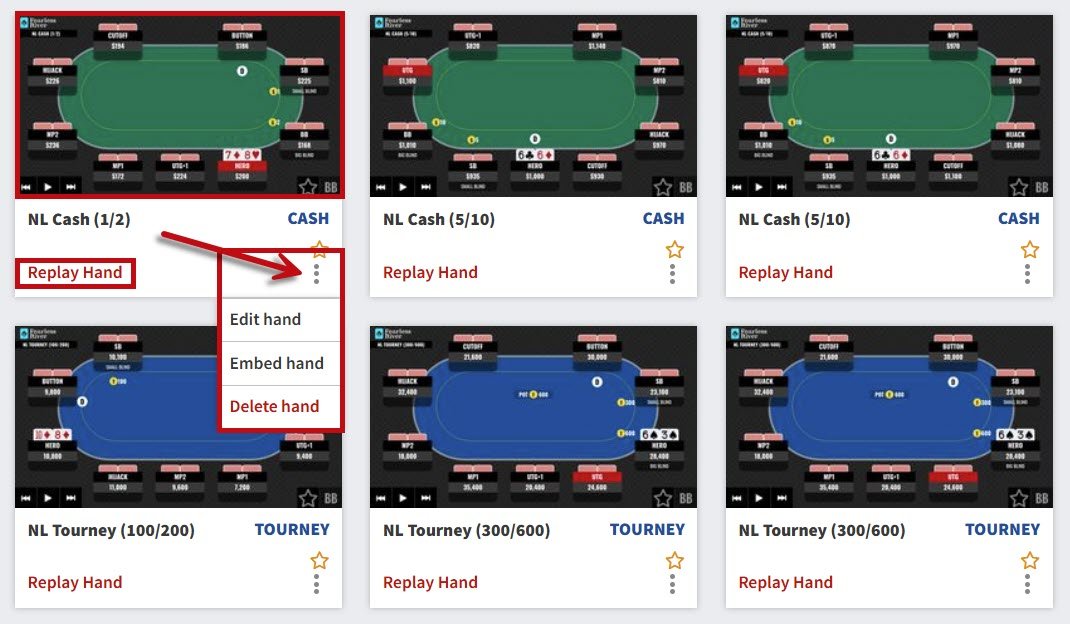
➧ Replay, delete, or edit hands you've saved from your HAND LIBRARY by clicking the thumbnail image or vertical ellipsis.
➧ Shortcuts when reviewing the replay of a hand for quick navigation.

  • Pause/Restart Action = Space Bar
  • Show Hole Cards = "H" Key
  • Move Action Forward/Backward = Right/Left Arrow Keys
  • Toggle Stacks Between Big Blinds/Chips = "B" Key
  • Toggle Between Player and Position Names = "A" Key


The habit of recording hands you've played, followed by analysis (and feedback), creates a positive feedback loop for improvement, which allows you to find (and fix) leaks faster while learning to make better decisions at the table.

We are excited to provide this invaluable tool for our members to help create that loop and to provide them with helpful feedback.

Thanks for being a part of Fearless River!


Fearless River logo - Stacked

Find Your Flow. Train Smarter. Play Fearless.


If you have any questions or need assistance contact our support team at [email protected].

Fearless River Poker Training Membership Tiers

We created Fearless River Poker Training to make it as easy as possible for anyone to improve their poker game, on their own time and their own terms. And we've made it easy to improve your No-Limit Texas Hold'em game with our Membership Tier Levels.

Choose the Membership Tier to best fit your budget, schedule, and skill level (upgrade or cancel at any time).

When upgrading your current Subscription Plan to a higher Membership Tier, a prorated credit from your existing plan will be applied to your new plan. You will never lose value by upgrading.


Choose the Plan That Fits Your Flow

Unlock everything inside Fearless River with one subscription.
Simple, flexible membership. Cancel anytime.

Membership-Tier-Silver

Every Plan Includes These Features

No matter which tier you choose, you'll always have access to:

  • Strategy Episodes: The entire on-demand library of 550+ videos
  • Ask A Pro Discord: Get hands reviewed and questions answered
  • Live Study Sessions: Real-time strategy sessions
  • Hand Input Tool (HIT): Record, save, and analyze played hands
  • Member Download Area: Charts, manuals, and guides to study
  • Practice Scenarios: Review decision points from real hands

Each tier below builds on this foundation with more GTO Trainer access, event savings, and exclusive features.

Fearless River SILVER Membership

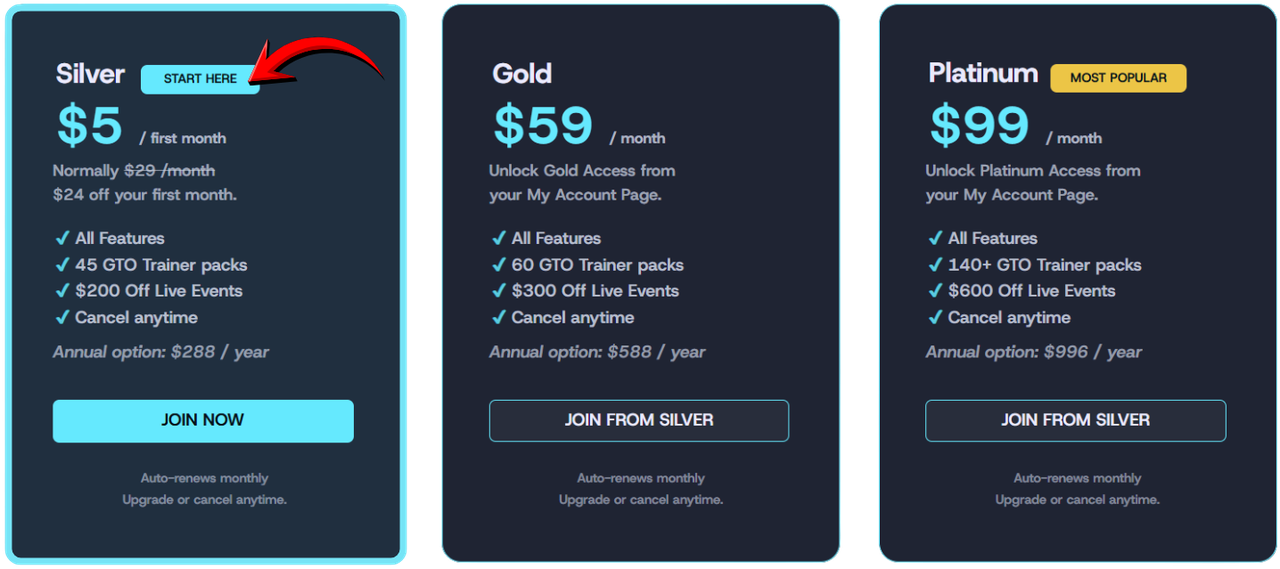
Start for $5 for your first 30 days, then $29/month (or $288/year).

The $5 First Month Membership helps new members fix nagging leaks and craft their own game while learning fundamental strategies. Filter for Foundations, Intermediate, or Advanced curriculum and tailor your training to the areas that need improving the most.

  • All Membership Features, plus:
  • 48 GTO Trainer Scenarios, covering Cash Game, Multi Table Tournament, Small Stakes, Final Table, and Heads Up spots

At the end of your $5 First Month Membership you will automatically upgrade and unlock full Silver membership benefits including discounts on Live Workshops and new in-depth strategy content.

New to Fearless River? Start at Silver for just $5.
Already a member? Upgrade anytime to Gold, Platinum, or a yearly plan from your My Acount page.


Fearless River GOLD Membership

$59/month or $588/year.

  • All Membership Features, plus:
  • 63 GTO Trainer Scenarios, covering Cash Game, Multi Table Tournament, Small Stakes, Final Table, and Heads Up spots (Yearly members get 3 bonus scenarios)
  • Preferred Pricing on Live Events:
    3-Day/2-Day Workshops: Save $500 (yearly members) or $200 (monthly members)

Already a member? This upgrades your current plan. New to Fearless River? Start at Silver for just $5.


Fearless River PLATINUM Membership

$99/month or $996/year.

  • All Membership Features, plus:
  • Unlimited access to all 140+ GTO Trainer Scenarios, covering Cash Game, Multi Table Tournament, Small Stakes, Final Table, and Heads Up spots
  • Platinum Exclusive: Dynamic Drilling Packs, train from multiple positions within a scenario
  • Preferred Pricing on Live Events:
    3-Day/2-Day Workshops: Save up to $1,000 (yearly members) or $600 (monthly members)
    Virtual Workshops: Save $400 (yearly members)
  • Bonus: Early access to new features and live training events

Already a member? This upgrades your current plan. New to Fearless River? Start at Silver for just $5.


About the Membership Features

We've made it easy for you to watch, train, discuss, study, and improve with these exclusive Fearless River Membership Features:

Site Features - Multiple Devices Mockup

GTO Trainer: Play solved GTO spots online and as often as you like while getting real-time feedback on your trouble spots. The GTO Trainer is laser focused on plugging your leaks and training you for peak performance by allowing you to choose the specific situations that give you the most trouble.


Strategy Episodes: Videos in short, easy to digest segments (usually 10-15 minutes) that focus on introducing and reinforcing specific aspects of the game plan. Sort Episodes by cash or tournament, concept, learning path, Instructor, last watched, and more.


Ask A Pro: Ask any of your poker questions and submit hands that you played to get rapid answers from your Instructors. The Fearless River Discord is a safe place to discuss concepts and strategy with your Instructors and fellow Members.


Live Study Sessions: The best way to improve your poker game is to step away from the table and spend time studying hands and discussing strategy. Join live sessions with your Instructors to dig into a specific concept or strategy each month for real-time discussion.


Hand Input Tool (HIT): Hand recording and analysis will make you a better and tougher poker player. Use HIT to record, save, share, and analyze played hands. You can also submit hands you've played for analysis from the Fearless River Instructors.


Member Download Area: View and download any of the hand range charts, manuals, and guides we’ve discussed in Strategy Episodes to study off the felt.


Practice Scenarios: Review and practice poker hand decision scenarios in one place. Pick cash or tournament hands, then see how your Instructors played it.


Preferred Pricing on Training Events: Members receive deep discounts for every Live and Digital Training Event, from single workshops to multi-day live events.


Meet the Fearless River Instructors

Our team of instructors is made up of WSOP bracelet winners, WPT champions, and seasoned professionals who've spent years studying, playing, and teaching the game at the highest level, and now bring that experience directly to you.

Fearless-River-Instructors-2026

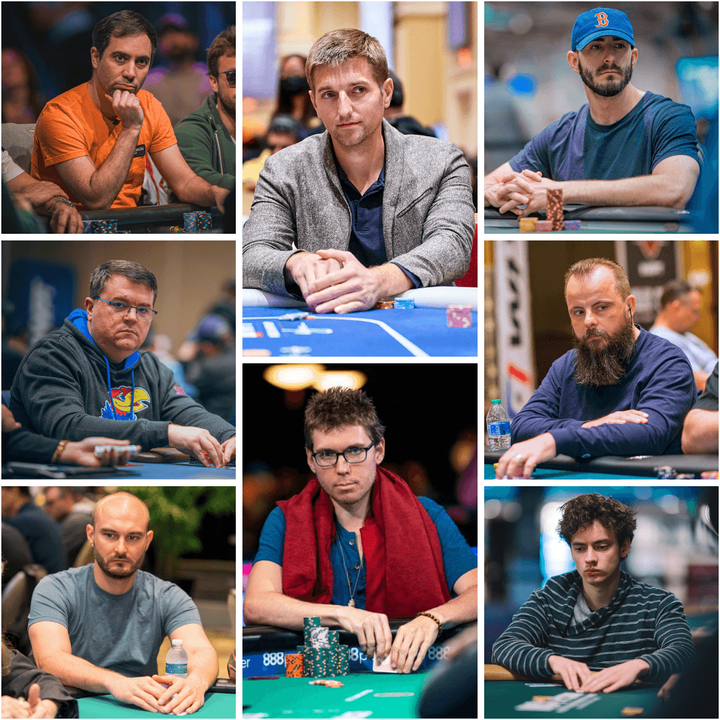
Brian Altman: 4x WPT Champion, WSOP Bracelet Winner, 5x WSOP Circuit Ring Winner, and the Season XVIII Player of the Year


Nick Binger: 2x WSOP Bracelet Winner, founder and lead Instructor for Fearless River, over 15 years coaching experience


Tony Dunst: 3x WSOP Bracelet Winner, WPT Champion, 3x WSOP Circuit Ring Winner, and Commentator for the World Poker Tour


Michael "Gags30" Gagliano: 4x WSOP Bracelet Winner, BetMGM Poker Ambassador, and 2026 WSOP Main Event finalist


Andrew "LuckyChewy" Lichtenberger: WSOP Bracelet Winner, WPT Alpha 8 Champion, and 9x PGT Champion


Eric "Rizen" Lynch: Acclaimed author with 3 major WSOP Final Tables and over 300 final tables across online and live events


Adrian Naggy: Fearless River COO and avid tournament grinder with over 15,000 tournaments played in the last decade


Johan Schultz-Pedersen: WSOP Bracelet Winner, talented GTO strategist, and rising star in the poker world


Jared Tendler: Acclaimed author, pioneer of Mental Game training, and the official Mental Game Coach of Fearless River

Have Questions about Fearless River Poker? Email our Support Team at [email protected] and we'll be happy to assist you.

We'll see you online,
Team Fearless River

Fearless River logo - Stacked

Find Your Flow. Train Smarter. Play Fearless.


Please note: If you choose to downgrade your subscription plan, your new plan's pricing will take effect on your renewal date. Features available to your current paid, active membership tier will be available until your renewal date.

Offers may not be combined. See our Terms for more details.

Poker Quiz! Facing a C-Bet After Flopping Trips, What Do You Do?

Flopped-Trips-JT-Facing-C-Bet-FR

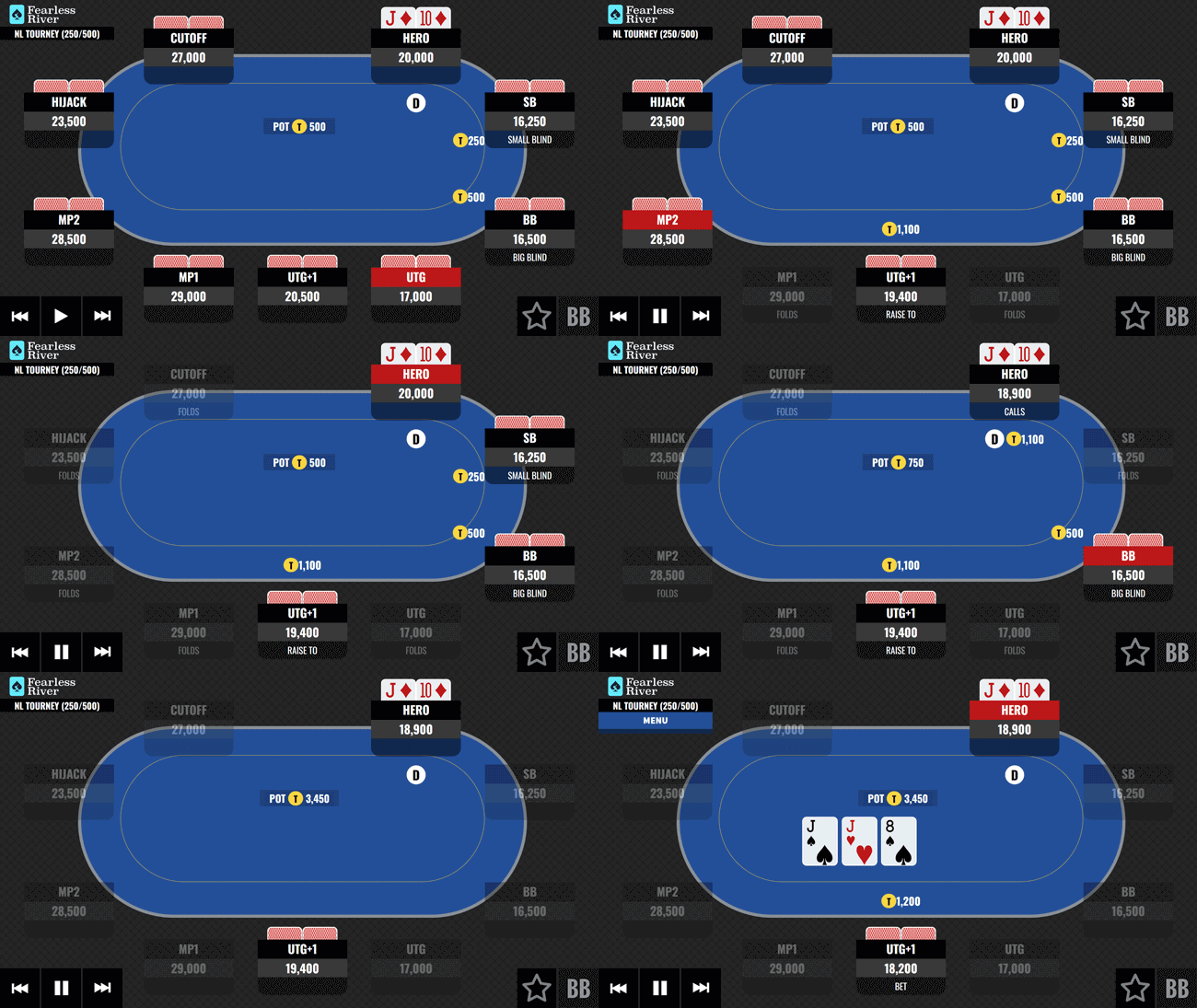
DECISION POINT: You’re playing a $1,500 regional tournament main event at a local card room that brings serious recreational players and pros. The play at your table has been aggressive with a lot of players firing multiple streets and few hands going to showdown. Blinds are 250/500 with a 500 big blind ante and you have a 20,000 chip stack. The opponent in UTG+1, who is an accomplished player, opens to 1,100 and everyone folds to you on the Button with J♦T♦. You call and the flop comes J♠J♥8♠. The early position opponent c-bets 1,200 and the action is on you. What's your move here?

PRO ANSWER: We're playing in a regional tournament at our local card room. It's a $1,500 main event that tends to draws in a lot of serious recreational players as well as pros from around the region. The action at our table has been a bit on the aggressive side, with lots of players capable of firing multiple barrels and few hands going to showdown.

The blinds are 250/500 with a 500 big blind ante, and we have 20,000 chips to start the hand. We are on the Button and are dealt J♦T♦. The UTG player folds and the opponent in UTG+1, who we recognize as an accomplished player and WSOP Bracelet winner, opens to 1,100 chips. Everyone else folds.

This is a great spot to call as part of an overall Button defense strategy. Our hand plays extremely well postflop with positional advantage, giving us a big edge at this stack depth against players who are capable of firing multiple barrels.

Both Blinds fold and the flop is J♠J♥8♠. The UTG+1 player comes out firing 1,200 chips, or just over one third of the pot. This is a flop where the early position raiser has a significant range advantage, and we can expect them to be betting nearly their entire range. We flopped a very strong hand and have a decision to make. Should we slow play our three of a kind or play it faster by raising now?

In this case, we are in position and against a single opponent. They should be continuation betting with a very wide range of hands, including plenty of overcard combinations that might not call a raise on the flop but could easily put more chips in the pot if they hit something like an ace or a king on the turn. UTG+1’s c-bet bluffing range could also easily continue bluffing on a lot of turn cards.

Many players immediately see the flush and straight draw cards on this board and become passive for fear of getting drawn out on. While that is the case, flush draws make up a very small portion of our opponent’s overall range, and we block a key straightening card by holding the Td in our hand. Additionally, if we raise it is difficult to get called by many worse hands. An early position raising range is unlikely to have many worse Jx combos than our JTs, and while UTG+1 does have some AA/KK/QQ hands, even those might proceed with caution when we raise the flop.

When we pause to consider the specific opponent, table tendencies, our position, the stack depth, and how both our ranges interact with this board, our best chance to win a big pot and maximize EV in this spot is to slow play and just call.

Calling is the best play.

How would you play it?
Share your answer in the comments!

Play Better Poker With Fearless River!

Whether you’re brand-new to poker training or are an experienced student, a membership to FearlessRiver.com is your chance to learn from world-class professional poker players in a friendly community using state-of-the-art tools.

Site Features - Multiple Devices Mockup

Join now to get started, and you'll immediately gain access to the Fearless River training features, including GTO Trainer packs, 550+ strategy videos, downloadable tools, Ask a Pro Discord, and more!

Have Questions about Fearless River? Send an email to our Support Team at [email protected] or click the CONTACT US button.
Poker Quiz! 3-Betting From the Small Blind With J♠J♣ ...

3-Betting Small Blind With JJ

DECISION POINT: You’re playing a daily tournament and late registration is still open. The blinds are 250/500 with a 500 big blind ante. A player in Middle Position raises first-in to 1,100 and it folds to you in the Small Blind with J♠J♣. You 3-bet to 4,000, the Big Blind folds, and the original raiser calls. The flop comes 9♥6♠6♣ and action is on you. What do you do here?

PRO ANSWER: We're playing in a daily tournament. Late registration is still open and the blinds are 250/500 with a 500 big blind ante. We are dealt J♠J♣ in the Small Blind and the action folds to MP2 who opens to 1,100 chips. Everyone else folds and action is on us.

Out of the Small Blind we prefer to reraise with a linear range, meaning that we will be reraising for value with hands that are ahead of our opponent’s range. Our opponent in Middle Position should be opening with around 25% of total hands as the first-in raiser.

Our jacks are well ahead of that range, so they would be a part of a linear 3-betting range. Typical 3-bet sizing will be around 3x the opening raise size, but since we will be out of position the remainder of the hand, we want to reraise a bit larger to make up for the positional disadvantage. We elect to make it 4,000 chips and our opponent calls.

The flop is 9♥6♠6♣ and action is on us. As the preflop 3-bettor we have a large range advantage on this flop and have all the big overpairs in our range. MP2’s range consists mostly of bigger suited cards and middle pairs, most of which don’t connect very well with this board. Since we have such a tremendous range advantage, it is ideal to c-bet with our entire range.

Typically, we utilize a smaller bet size when c-betting our entire range. However, this situation is unique. The stack to pot ratio (SPR) is just under two. With so much money in the pot in relation to our stack, some hands in our range start to really benefit from protection.

In this case, our really strong hands like AA/KK and semi-bluffs, such as AKo/AQo type hands, prefer to bet around 25% of the pot. Our more vulnerable hands, like TT/JJ and A9s, want to bet a larger sizing of around 50% of the pot in order to protect against many of the potential overcards that connect with MP2’s range.

Betting half of the pot is the best play.

How would you play it?
Share your answer in the comments section below!

Play Better Poker With Fearless River!

Whether you’re brand-new to poker training or are an experienced student, a membership to FearlessRiver.com is your chance to learn from world-class professional poker players in a friendly community using state-of-the-art tools.

Site Features - Multiple Devices Mockup

Join now to get started, and you'll immediately gain access to the Fearless River training features, including GTO Trainer packs, 550+ strategy videos, downloadable tools, Ask a Pro Discord, and more!

Have Questions about Fearless River? Send an email to our Support Team at [email protected] or click the CONTACT US button.
Poker Quiz! In Late Position With 7♥7♣ Vs the Big Blind...

In-Late-Position-With-77-Vs-the-Big-Blind-FR

DECISION POINT: You are in the early stages of a daily tournament and you don’t have any significant reads on your tablemates, with the exception that most have been showing down reasonable hands. The blinds are 200/400 with a 400 big blind ante and you have 20,000 chips to start the hand. The action folds to you in the Cutoff with 7♥7♣, you open to 1,000, and only the Big Blind calls. Your opponent checks the K♣5♥2♦ flop, you c-bet 900, and they call. On the 3♣ turn, the Big Blind leads out for 1,500. Action is on you, what do you do here?

PRO ANSWER: We are in the earlier stages of a daily tournament with blinds of 200/400 and a 400 big blind ante. Most of the players have been showing down reasonable hands when we’ve had the opportunity to see them, and we haven’t developed any significant reads to this point in the session.

With 20,000 chips to start the hand in the Cutoff and 7♥7♣ we make a standard raise to 1,000 chips, and everyone folds to the Big Blind who just calls. The flop is K♣5♥2♦ and the Big Blind checks to us. This is a board where the preflop raiser from the Cutoff will have a significant range advantage and we will frequently continuation bet with our entire range. In game we make the preferred choice and bet 900 into the 2,600 pot, and the Big Blind just calls.

The turn is the 3♣ and surprisingly, our opponent leads for 1,500. When an opponent takes a line where they lead into the aggressor on the turn, there are often one of several factors at play.

First, the Big Blind will often lead the turn when picking up additional equity, which in this case would mostly be flush draws but does include some Ax, 6x, and 4x hands.

Second, they could have turned two-pair or better with hands including A4, K3, 33, 53, and 32s, and are trying to build a pot fearing we may not fire again on this board texture. Lastly, this turn lead may be intended to to deny equity since we are betting such a wide range on the flop. Many of the 5x combos in the Big Blind’s range benefit greatly from generating folds from some of our random overcards such QJo that still have significant equity.

Given these assumptions, the Big Blind’s leading range likely consists of some draws, some bigger hands, and some medium-strength hands looking to clear out equity. Our pocket sevens are doing fairly well against that range. However, there is little reason to raise as our opponent is likely to fold medium-strength hands we dominate, continue with the hands that dominate us, and proceed with draws only if getting the correct price.

Calling is the best play.

How would you play it?
Share your answer in the comments below!


Improve Your Game Today!
Join Fearless River and Get:

Site Features - Multiple Devices Mockup

  • The GTO Trainer to play real solved hands and get instant feedback on YOUR leaks (over 4 BILLION solved spots!)
  • On-demand access to our full library of 550+ (and growing) in-depth Strategy Episodes from world-class players
  • All of your poker questions answered with the Ask a Pro feature
  • Analysis from Fearless River Pros using The Hand Input Tool
  • Downloadable Tools you can use at the table and away from it
  • Learn from a Team of world-class Professional Players


To join (just $5 your 1st month) click the JOIN NOW button and start improving your game!


Have questions?
Email us at [email protected].