Poker Quiz! Flopped Bottom Two Pair With 7♦3♦, Your Move?
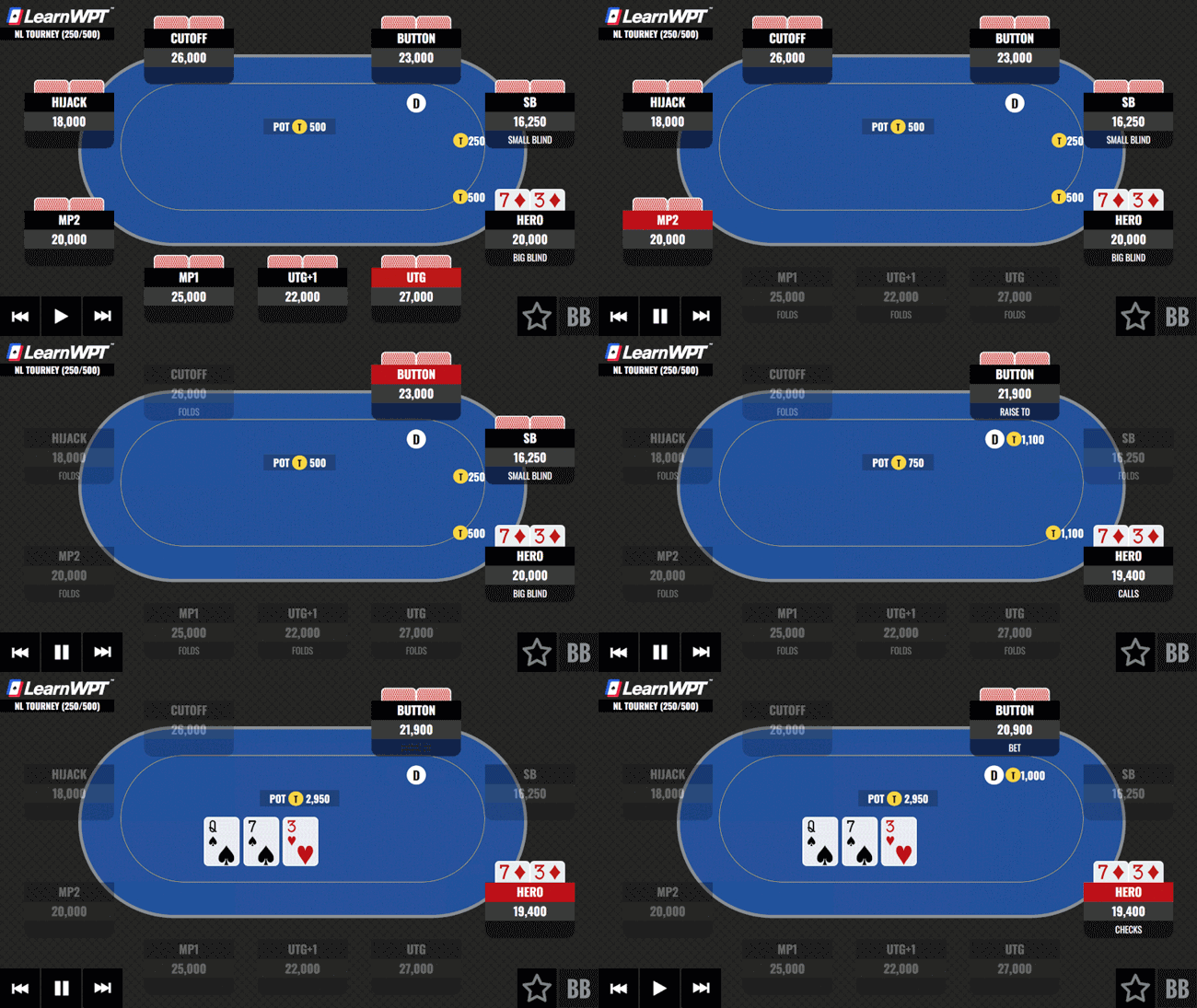
DECISION POINT: You are in the early stage of a live tournament with blinds at 250/500 and a 500 big blind ante. Most players are still close to the 20K starting stacks. Action folds to the Button who raises first-in to 1,100, the Small Blind folds, and you call from the Big Blind with 7♦3♦. The flop comes Q♠7♠3♥. You check, your opponent continuation bets 1,000 and action is back on you.
What do you do here?
PRO ANSWER: We are playing in the early levels of a live multi-table tournament. Each player started the tournament with 20,000 chips and most of the players at the table still have close to the starting stack. The blinds are 250/500 with a 500 big blind ante. We are dealt 7♦3♦ in the Big Blind. Everyone folds to the Button who raises to 1,100 chips. The Small Blind folds and action is on us.
Our hand, 73s, isn’t a particularly strong combination however in the Big Blind we are getting a tremendous price. Including the initial raise, the blinds, and the ante there are already 2,350 chips in the middle and it only costs us 600 more to call. We’re getting nearly 4 to 1 odds on a call, which means if we always fully realized our equity in this spot we would only need around 20% equity against the Button’s range to continue.
Taking that into consideration it’s important to note that we won’t always be able to realize our equity out of position and there are still 2 more streets of potential betting to be played. Suited hands realize their equity particularly well and the Button should have a very wide range. This means that even though we are out of position, we should be continuing with a range including any two suited cards as well as most playable offsuit hands against a Button open.
We decide to call and the flop is Q♠7♠3♥, giving us bottom 2-pair.
Continued below...

While there are some flops we could potentially lead on, this is a scenario where we should be checking 100% of our range to the preflop raiser. We check, and the Button bets 1,000 chips, or just over one third of the pot. One of the keys to playing good Big Blind defense is to make sure you have a robust check-raising range on the flop. If we look at solver output in this spot, the results show that we should be check-raising nearly 20% of hands.
This check-raising range includes a lot of bluffs and semi-bluffs, but also some real made hands. We are in a great spot to check-raise with 73s as we are very likely to have the best hand and would be willing to get all-in here if the Button raises.
Additionally 73s unblocks Qx combinations and flush draws in the Button’s range, which makes it more likely we can get some additional value when we take an aggressive action.
Calling here is still profitable, and may be preferable if we had specific read that our opponent was going to just keep firing future streets way too wide. In this hand we are against an unknown player so based on our default strategy check-raising will likely be the most profitable line.
Check-raising between 3,000 and 3,500 chips is the best play.
How would you play it?
Share your answer in the comments below!
Improve Your Game Today!
Join Fearless River and Get:
- The GTO Trainer to play real solved hands and get instant feedback on YOUR leaks (over 4 BILLION solved spots!)
- On-demand access to our full library of 550+ (and growing) in-depth Strategy Episodes from world-class players
- All of your poker questions answered with the Ask a Pro Feature
- Analysis from Fearless River Pros using The Hand Input Tool
- Downloadable Tools you can use at and away from the tables
- Learn from a Team of world-class Professional Players
To join (just $5 your 1st month) click the JOIN NOW button and start improving your game!
Have Questions? Email us at [email protected].