Poker Bankroll Management: A Complete Guide
When it comes to playing poker, there are many poker strategies and practices that can help improve your game. The more attention you pay to every aspect of your game that can be improved, the better your results can be in cash games and poker tournaments.
One of the key concepts in playing successful poker is bankroll management. In this guide, we'll give you solid guidelines for managing your bankroll, outline its tools and principles, and show you how to use it as a poker player.
What Is Poker Bankroll Management?
Poker bankroll management is a money management strategy based on statistical probability and skill level, and it's an essential part of playing poker for recreational and professional players alike. With bankroll management, you can reduce your risk of ruin by keeping your losses in check against your gains.
➧ What Is a Bankroll? Money set aside only for poker, separate from what you use for everyday life.
Having a dedicated bankroll offers a lot of advantages. If you play poker out of your everyday money, that can create a lot of problems, and you'll only go so far with your poker career if you keep playing that way. Having a dedicated bankroll offers many advantages.
Poker bankroll money is a little different from everyday money. Think of it as a tool you'll use to make more money and work your way up in stakes. When you separate your bankroll completely, you set it apart from the money you use for your mortgage, car or dinner out. Treat your bankroll as an investment in your poker career and growth.
When you keep a proper bankroll, you don't have to worry about the normal ups and downs that happen naturally because of variance. A proper bankroll can help you survive the inevitable downswings that come with playing poker over time.
➧ What Is Risk of Ruin? Your chance of losing your entire bankroll.
A good way to manage your bankroll is to physically separate it from your everyday money. Many card rooms and casinos offer safety deposit boxes, which are a good place to keep your poker bankroll. This keeps it away from your everyday money, and you'll feel safer not having to travel to and from the card room or casino with cash on you. If you play online, a separate bank account works the same way.
Watch the full lesson in Episode 5.
How Big Should Your Bankroll Be?
When playing poker, it's essential to always know the size of your bankroll. If you don't have a specific amount of money set aside for poker, how can you decide which games are worth playing?
Which games are worth playing with your available bankroll depends on whether you are a professional player or not. Professional players often have a target income and will choose the stakes that allow them to most reliably earn a specific hourly rate. Recreational players should set aside a percentage of their entertainment budget to invest in playing poker.
Although it may be tempting to jump into bigger games right away given the potential reward, it's much more enjoyable, and puts much less stress on your game, to stick to bankroll management rules.
Whether you are a top professional or new to the game, keeping track of your cash game sessions, tournament buy-ins and results is important to making good decisions with your poker bankroll.
How Long Until You Know Your Results?
After you've played several cash games and tournaments and have a good sample size to compare, it may seem like your game is ready to move up against tougher competition. So how can you make sure you're prepared?
Many players wonder how long it will take them to become better players, and how much time it takes to reach the long run when evaluating their ability at the table. There are several factors that go into playing better poker. However, improvement will mostly depend on how often you practice and how hard you work. If you practice every day, you'll likely make faster progress than someone who works on their game for only one hour a week. As long as you create a consistent study routine, you are on the right path to becoming a better poker player.
It takes time to reach the long run in poker, and that time is different for cash games and tournaments. For cash games, after around 20,000 hands, or roughly 700 hours of live play, you'll start to get a meaningful read on whether you are a winning, break-even or losing player.
In tournaments, variance is much higher, and it also depends on how big the fields are in the tournaments you play. After about 1,000 tournaments, you should have a good sense of what your skill level is and your profitability.
Bankroll Rules for Cash Games & Tournaments
Having a proper bankroll allows you to focus on decision-making at the table without the pressure of playing above your budget.
If you want to progress as a poker player, you'll have to start thinking long term instead of short term. Don't get overly emotional about a good or bad result in any single hand. Focus on improving your decision-making process. In addition to studying Fearless River Strategy Episodes, taking notes and discussing strategy with players you trust, bankroll management is one of the most effective ways to gain consistency in your game. Let's see how.
If you are just starting out in poker, it's important that your bankroll is healthy and big enough to allow for growth and learning.
Watch the full lesson in Episode 263.
You may see different guidelines for the right number of buy-ins to keep in your bankroll. To keep your risk of ruin low in cash games, budget at least 50 buy-ins for the level you are playing. For proper tournament bankroll management as a professional, you should never risk more than 1% of your bankroll on any given tournament. In other words, have at least 100 buy-ins for the tournament level you play.
Keep in mind these amounts are for pro players who can't replenish their bankroll and need to stay in the game to make a living. As a recreational player, you can be a little less strict, but you should still have at least 25 buy-ins for the level of cash games you are playing.
Bankroll Guidelines at a Glance
| Player Type | Cash Games | Tournaments |
|---|---|---|
| Professional | 50+ buy-ins | 100+ buy-ins |
| Recreational | 25+ buy-ins | 25-50 buy-ins |
Example: A $1/$2 Bankroll
Let's look at an example of how bankroll management breaks down for the recreational player. If you play $1/$2 no-limit cash games and usually buy in for $200, you want to keep at least 25 buy-ins of $200 in your bankroll. That means $5,000 set aside solely to play poker.
Example: A $1/$2 Bankroll
Typical buy-in: $200
Recreational (25 buy-ins): 25 x $200 = $5,000
Professional (50 buy-ins): 50 x $200 = $10,000
Maybe right now you can't set that much aside for poker, but you can work toward the goal of having an appropriate bankroll. That's why having a bankroll is so important: it can help your poker career or hobby become self-sustaining. You won't have to take money out of your paycheck or from anywhere else to play.
A 25 buy-in bankroll helps minimize your risk of ruin, otherwise known as your chance of going broke. The further you drop below 25 buy-ins, the higher your risk of ruin. In the same way, going above 25 buy-ins for the level you play reduces your risk of ruin even further.
When to Move Up, Move Down or Cash Out
Let the Numbers Decide
The best feature of bankroll management is that the number of buy-ins in your bankroll tells you when to move up or down in stakes, which takes the emotion and uncertainty out of one of poker's toughest decisions.
While it may seem discouraging, it's very typical to move up and down in stakes regularly to keep an appropriate bankroll.
This is why you shouldn't simply take money out of your bankroll whenever you feel like it. Ideally, your bankroll should be between 45 and 60 buy-ins before you even consider taking money out for everyday expenses or to treat yourself. A conservative bankroll strategy gives you the best chance to reach your goals and move up in levels.
To follow a more conservative strategy, split your profits each month: take a percentage out for life expenses and leave the rest to keep growing your bankroll. The typical split is 50-50. If you made $2,000, you'd take $1,000 out for yourself and leave $1,000 in your bankroll.
This is a key skill that separates amateurs from professionals. Many professional players with poor bankroll management skills are no longer able to make a living from poker. If you want to be successful over the long term, bankroll management is essential.
How Tilt Affects Your Bankroll
Another crucial skill that can help (or hurt) your ability to grow a bankroll is managing your emotions. When emotions guide us, it's often difficult to make clear decisions. Tilt is a big part of playing poker. It can happen when you're running bad, feel a sense of injustice or focus on bad luck, and many highly competitive people experience hate-losing tilt. Sometimes you'll tilt because you think you made a mistake, are overconfident, feel like you deserve to win or are motivated by revenge.
Tilt happens in everyone's game, but if you don't address it, it can have a dramatic effect on your ability to manage your bankroll.
Watch the full lesson in Episode 146.
What's the connection between tilt and bankroll management?
We've all likely experienced winner's tilt, otherwise known as overconfidence. When you start winning and it feels almost impossible to lose, you completely discount the possibility of making mistakes. Often this leads to studying less and not working as hard as before, while hyper-focusing on winning the next game you play.
When you go through a long winning stretch, it's easy to make poor bankroll decisions and move up in limits too quickly. You might buy into a tournament above your bankroll or skill level, or spend a lot more money outside the game than usual, which can lead to financial pressure later. Instead, use bankroll management to set limits when you could be emotionally at risk, and let your long-term goals guide you, not winner's tilt. Combined with consistent study, proper bankroll management gives your bankroll the best chance to grow and puts you in position to move up to bigger cash games and tournaments.
Poker bankroll management is a critical skill that lets you stay focused on executing your game plan, instead of worrying about the money at stake in any one tournament or cash game session.
Bankroll Management Tools
Bankroll tools can be handy in developing a routine and consistent process for managing your poker bankroll. Luckily, you don't need a pen and paper. There are many tools available, including mobile apps for Android and iOS and web-based tools on your computer.
➧ Bankroll management tools help you visualize your progress. Many apps include charts you can filter by game type, location and blinds. They make it easy to track how much you're making and investing, so you can build confidence and adjust quickly to the current state of your game.
➧ You can also track your bankroll in Google Sheets or Microsoft Excel. If you're creating your own tracking spreadsheet, make sure to include the following details:
- Date of the game or tournament
- Game type and stakes
- Total buy-ins (including rebuys and add-ons)
- Hours played
- Total amount won or lost
- Dealer tips
- Other expenses (meals, travel)
Poker can be a rewarding hobby, but there are pitfalls if you don't approach the game with a sound strategy for managing your money. Keeping a separate bankroll allows for better decision-making and perspective when you play. Proper poker bankroll management lets you treat your chips as a tool to invest, and frees you up to learn and grow by making objective decisions at the table.
How to Grow Your Bankroll
Now that we've walked through poker bankroll management for cash games and tournaments, let's review three tips for using your winnings to both grow your bankroll and reward yourself for your disciplined efforts.
How to Split Your Winnings
➧ 50% back into your bankroll. Whether you play professionally or recreationally, investing a healthy share of your winnings back into your bankroll helps secure your poker future.
➧ Up to 20% to enjoy. What else are you working for if you can't take some time to celebrate? Use it to have fun and treat yourself.
➧ Up to 30% towards savings and other goals. Put it toward other hobbies, investments or just the bank. Investing in projects you enjoy outside the game might motivate and inspire you to become an even better player.
Bankroll management strategies vary from player to player and depend on each person's financial situation. These guidelines are here to help you enjoy the game of No-Limit Texas Hold'em.
To learn more about poker bankroll management, get advice from pro players and work on every other part of your game, become a Fearless River student for just $5 your first month of membership.
Good luck and good playing,
Team Fearless River
Improve Your Game Today!
Join Fearless River and Get:
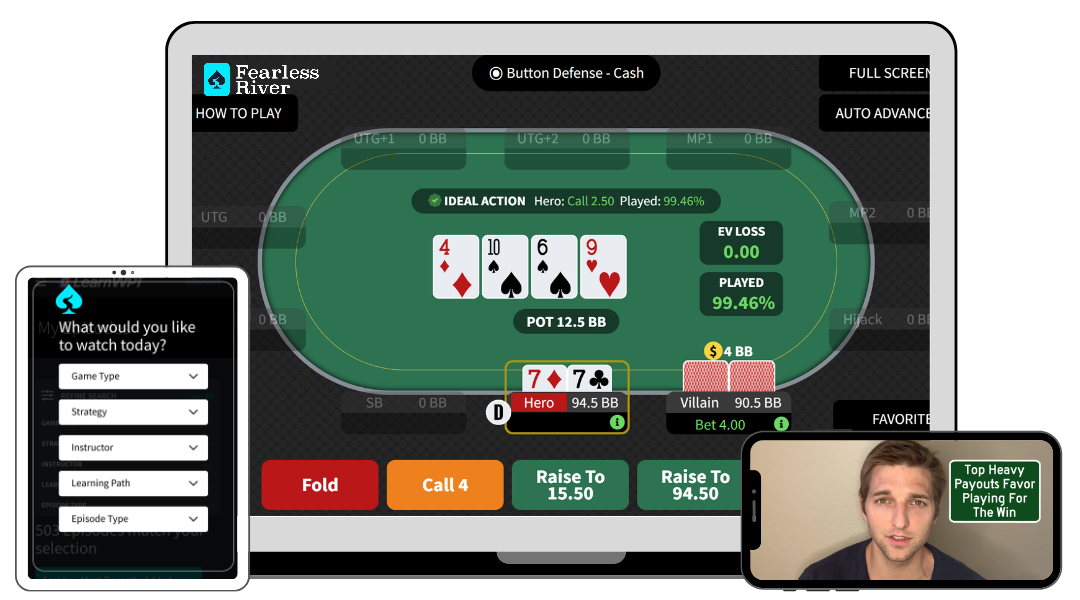
- The GTO Trainer to play real solved hands and get instant feedback on YOUR leaks (over 4 BILLION solved spots!)
- On-demand access to our full library of 550+ (and growing) in-depth Strategy Episodes from world-class players
- All of your poker questions answered with the Ask a Pro Feature
- Downloadable Tools you can use away from the tables
To join (just $5 your 1st month) click the button below and start improving your game!
Have Questions? Email us at [email protected].