Poker Quiz! Trip Aces on the Turn, What Do You Do Here?
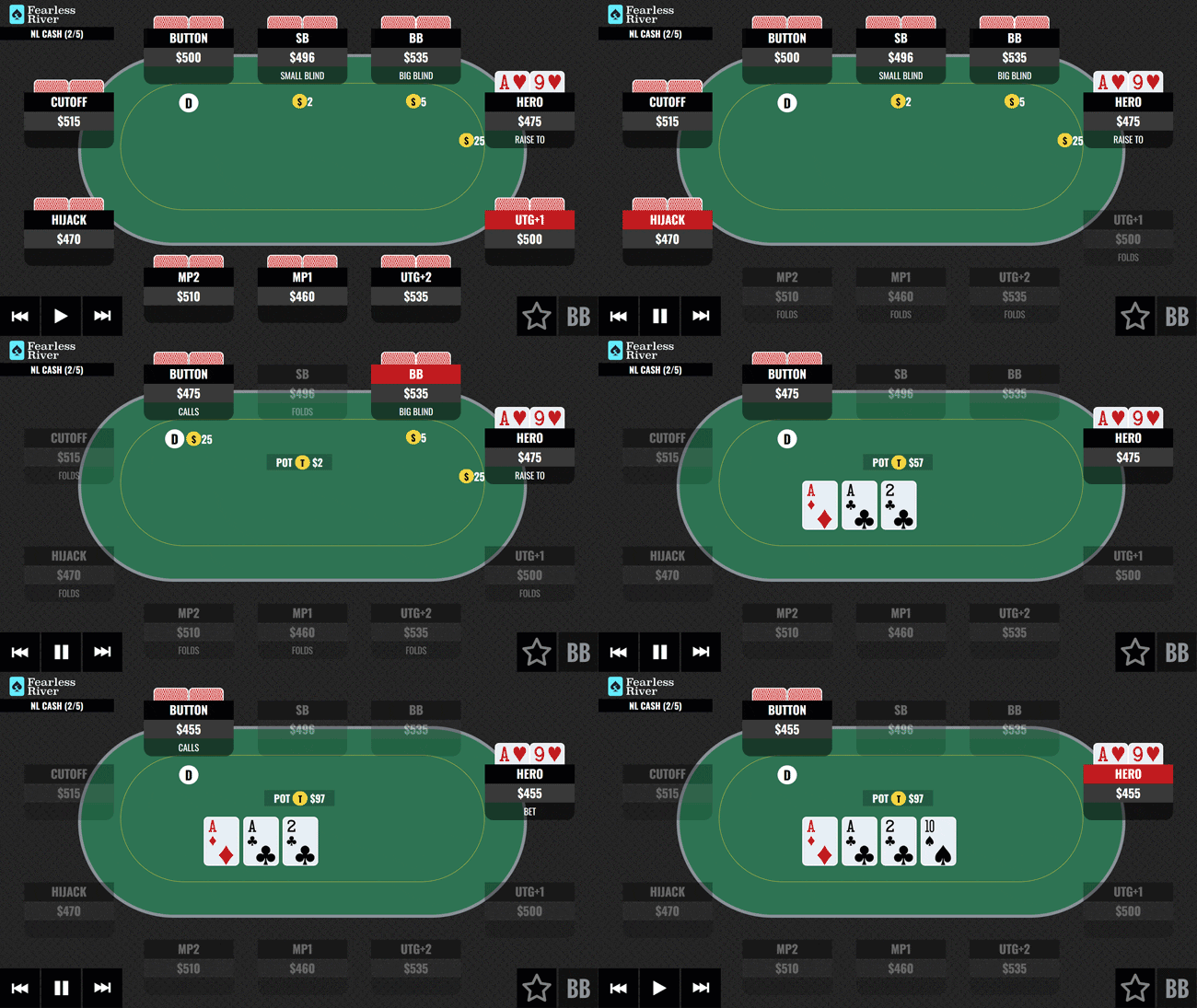
DECISION POINT: In a live $2/5 cash game with competent players you open to the standard raise size for this table of $25 from Early Position with A♥9♥. It folds around to the Button who flat calls and the Blinds fold. You c-bet $20 on the A♦A♣2♣ flop and get called. The turn is T♠ and action is on you. What do you do here?
PRO ANSWER: We are playing a live $2/$5 cash game with a standard opening raise size of $25. Everyone has around 100BBs and so far most of the players seem reasonably competent. We are dealt A♥9♥ Under the Gun and make a standard open to $25. Everyone folds to the Button who flat calls, and the Blinds fold.
The flop is A♦A♣2♣. This is a spot where we have an overwhelming range advantage as we have many more of the big Ax hands in our range and our opponent would likely reraise AK and AA preflop. We should be continuation betting with our entire range and we can do it using a sizing of around ⅓rd pot. We bet $20 and the Button calls. The turn is the T♠ and action is back on us.
This is a very good example of how relative hand strength and absolute hand strength can vary greatly in a specific poker situation. We have a very strong hand with three Aces, however given we opened 5BBs from UTG we are already representing a very strong hand.
We have one of the weakest combinations of exactly the type of hand our opponent is likely to put us on given these factors. Checking this flop will also be preferred with some of our JJ-KK hands so having some of our Ax hands in our checking range to protect the stronger combinations is an additional bonus.
Continued below ...

This decision can also be viewed as a way ahead/way behind situation. Given it’s likely our opponent will put us on a strong range of hands that often will contain an Ace, when we fire two barrels here and get action the Button likely will have a hand stronger than three Aces with A9, or has significant equity with a big draw such as KcQc or KcJc.
While it is tempting to pressure the drawing hands in our opponents range with a turn bet, these draws make up a very small portion of the Button’s overall range and have significant equity against our hand. Consequently, in order to price out the draws the bet sizing would be so large that only hands in the Button’s range that beat our trip aces will be calling.
While the initial temptation here is to continue betting our trip aces for value, the relative strength of our hand is actually not that strong. Our holding benefits from keeping the Button’s range wide and inducing some bluffs from hands that might have floated on the flop while still being able to control the pot when we’re behind.
If we were against an extremely loose calling station we could continue to bet, however against the majority of opponents checking is best.
Checking is the best play.
How would you play it?
Share your answer in the comments below!
Improve Your Game Today!
Join Fearless River and Get:
- The GTO Trainer to play real solved hands and get instant feedback on YOUR leaks (over 4 BILLION solved spots!)
- On-demand access to our full library of 550+ (and growing) in-depth Strategy Episodes from world-class players
- All of your poker questions answered with the Ask a Pro feature
- Analysis from Fearless River Pros using The Hand Input Tool
- Downloadable Tools you can use at the table and away from it
- Learn from a Team of world-class Professional Players
To join (just $5 your 1st month) click the JOIN NOW button and start improving your game!
Have questions? Email us at [email protected].