You're Out of Position With A♦T♦ Vs a Pro at the WSOP...
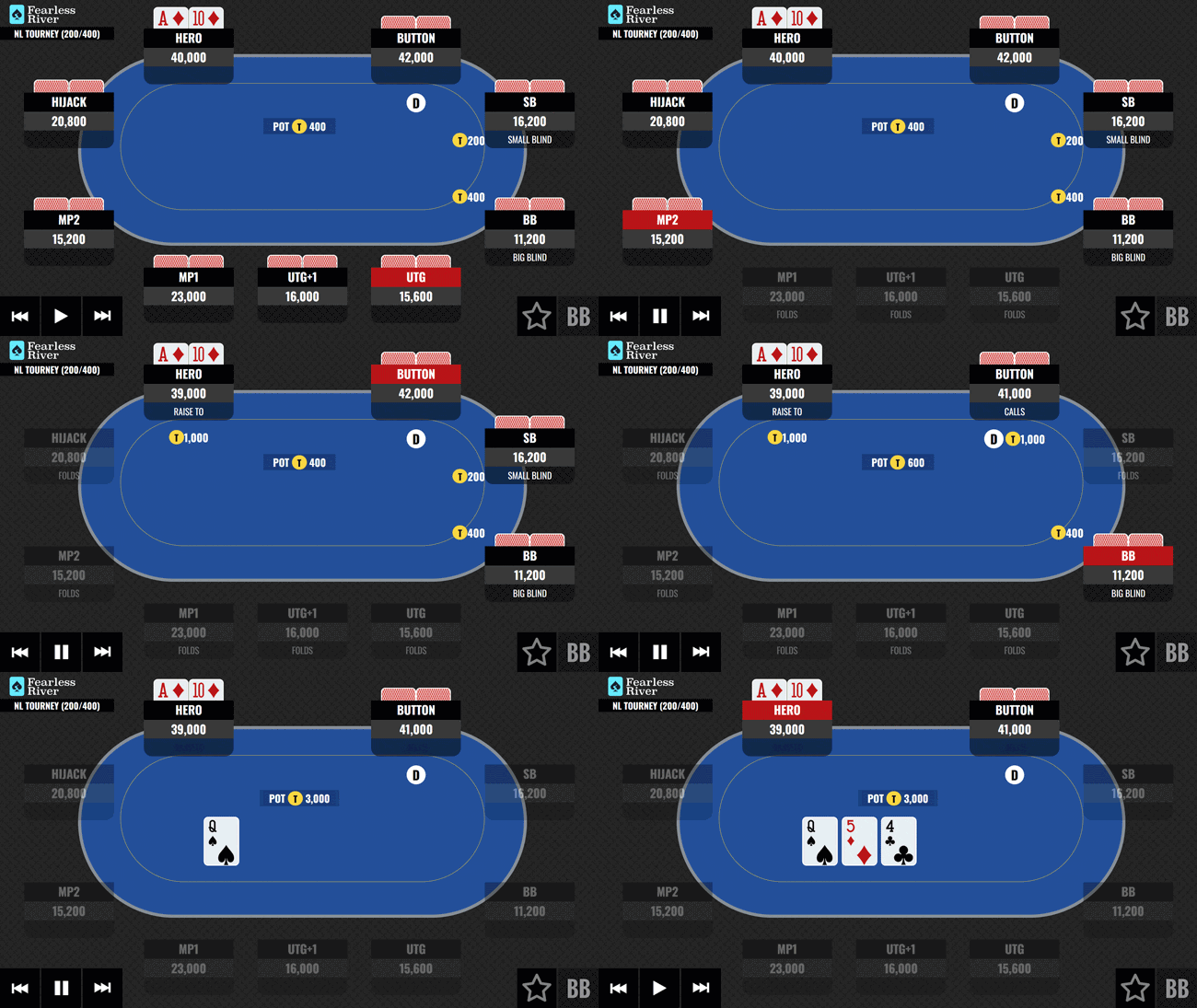
DECISION POINT: You're in the early stages of a World Series of Poker multi-day tournament with late registration and reentry still open. The blinds are 200/400 with a 400 big blind ante. Most players have around 50 big blinds, and you’ve worked your stack up to 100BBs. Action folds to you in the Cutoff with A♦T♦ and you make a standard raise to 1,000. The Button, who is an accomplished Pro and has a 105BB stack, calls. The flop comes Q♠5♦4♣ and action is on you. What do you do here?
PRO ANSWER: We're playing a multi-day event at the World Series of Poker. The tournament is in level 2 with late registration still open and players are allowed to reenter until the end of level 8. Most players have around 50 big blinds, but we’ve managed to work our stack up to 100BBs. The Button is a very studied professional poker player. The blinds are 200/400 with a 400 big blind ante and we are dealt A♦T♦ in the Cutoff. The action folds to us and we make a standard raise to 1,000. The Button decides to call and both Blinds fold. The flop is Q♠5♦4♣ and we are first to act.
The primary driver of continuation betting frequency on the flop is range advantage. Many players incorrectly believe that being the preflop raiser gives them a range advantage on dry boards like this one. Position is a key factor to consider in c-betting spots. Had we raised in Early Position instead of the Cutoff, we certainly would have a range advantage against the Button on this board. However, in this specific situation, we have a wide uncapped range and our opponent has a significantly narrower range that is capped and condensed.
Reviewing this spot in a solver as a part of post-hand analysis, we see that the Button defends with less than half as many hand combinations as we raise with from the Cutoff (215 vs. 450) and has a slight range advantage (51% vs. 49%) on the flop before any action takes place.
Continued below ...

This dynamic occurs most frequently in Cutoff open vs Button call and Small Blind vs Big Blind scenarios. When facing skilled and aggressive players who are capable of utilizing their position appropriately in these spots, we should check the flop quite frequently. In fact, based on the solver results, the Cutoff checks with the entire range around 85% of the time. While the Cutoff is often taking a passive line on the flop, it’s crucial to note that checking here doesn’t mean giving up. We should be checking some of our big hands to protect our checking range and add check-raises with some strong value hands and bluffs such as A2s/A3s on this particular board. Check-calling on the flop also makes up a portion of our strategy, particularly against smaller bet sizes.
If our opponent on the Button were a more passive recreational player in this spot, the strategy would change significantly. There would be more merit to betting because a passive opponent is like to call preflop with a much wider range, negating the range advantage a more narrow and condensed range has on this board. Recreational opponents are also far less likely to float and raise the flop with the appropriate tendencies to discourage us from continuation betting.
Against tougher players it’s very important to recognize these spots as high-frequency checks, or we will quickly bleed chips to good players who utilize position well.
Checking is the best play.
How would you play it?
Share your answer in the comments below!
Will YOU Be Our Next Bracelet Winner?
Our students consistently crush the summer poker season, bringing home massive scores and achieving their poker dreams.
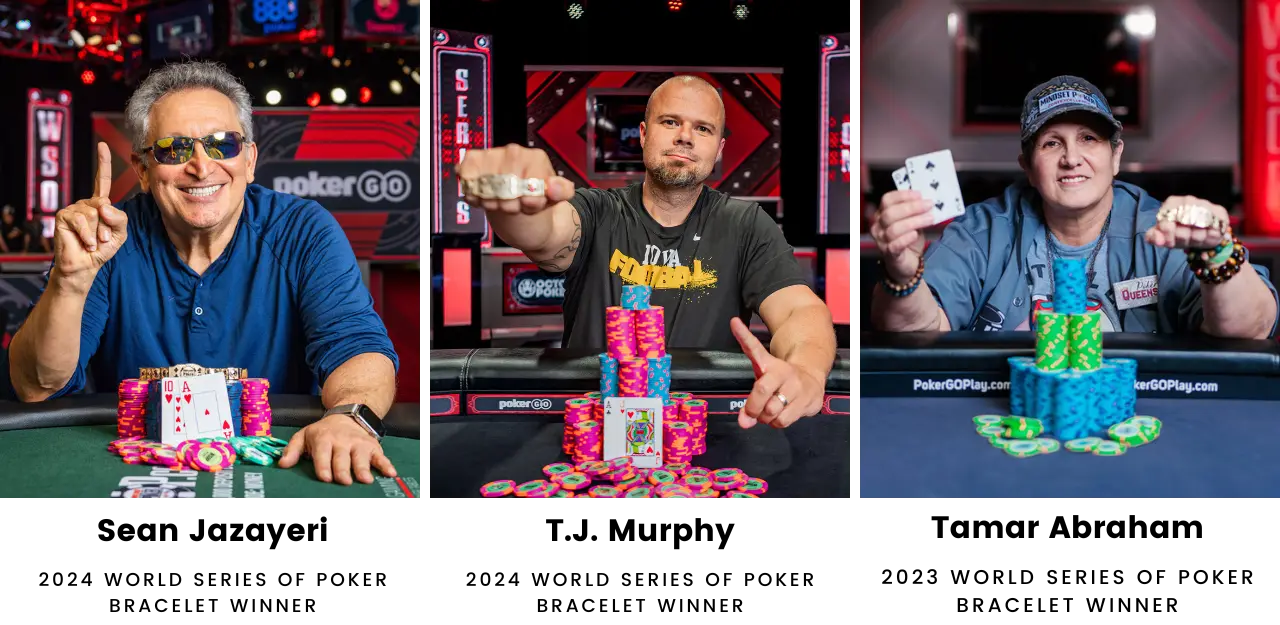
In fact, in just the past few years alone during the summer in Vegas Fearless River Students have achieved:
🥇 4 WSOP BRACELETS
🏆 6 WSOP Final Tables
💪 1 Around Town Win
👏 9 Around Town Final Tables
💰 Over $1.7 Million in Cashes
Ready to be our next success story?
Become a FearlessRiver.com Member now for just $5 your 1st month and start preparing for your best summer yet.
Have Questions about Fearless River? Send an email to our Support Team at [email protected] or click the CONTACT US button.
Poker Quiz! Turned a Straight on a Highly Coordinated Board ...
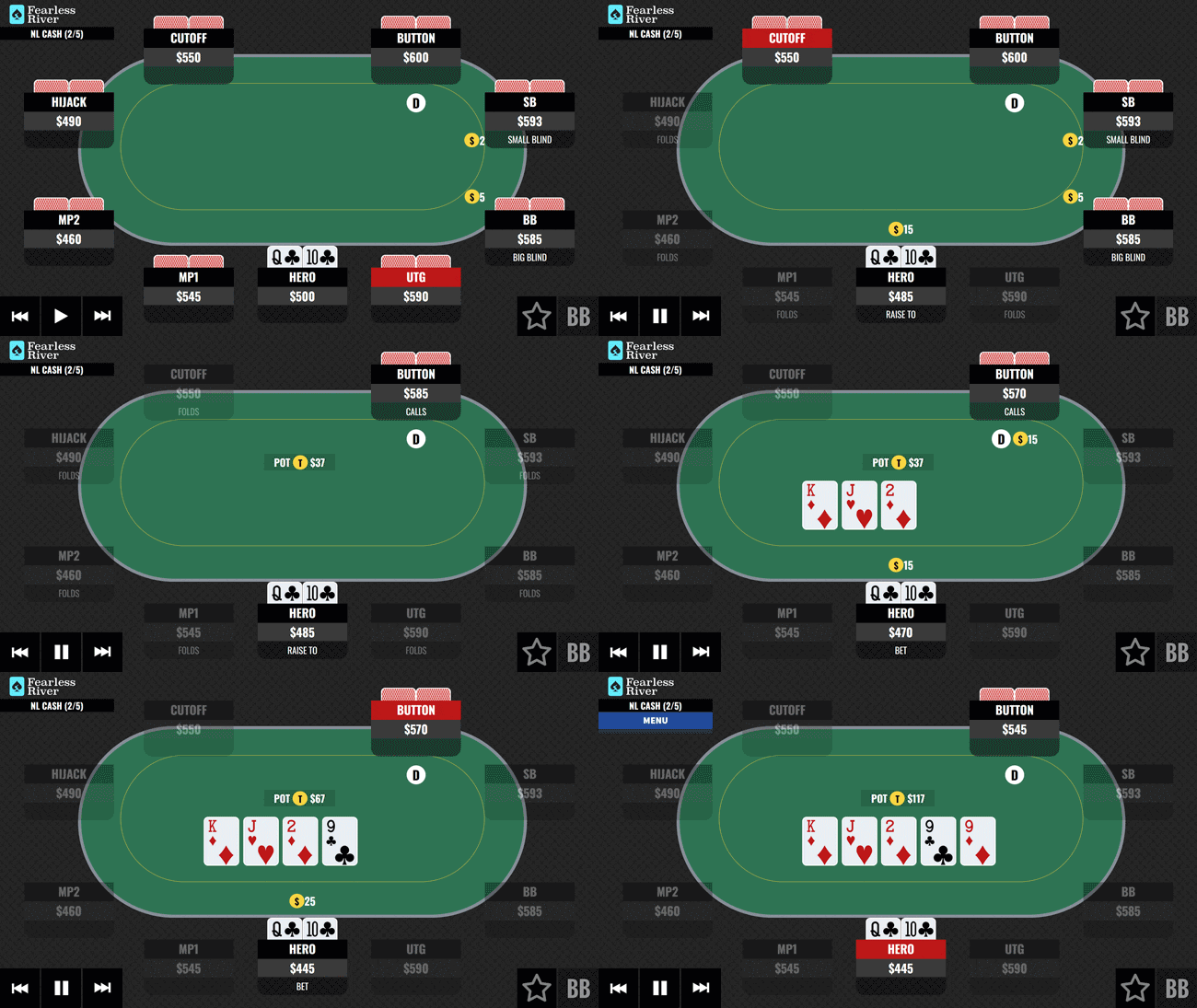
DECISION POINT: You’re in a live $2/$5 cash game that recently started. In early position you raise to $15 with Q♣T♣ and only the Button calls. You continuation bet $15 on the K♦J♥2♦ flop and get called. On the 9♣ turn you bet $25 and your opponent calls. The river is 9♦ and action is on you. What do you do here?
Vote and see how your answer compares to other players 👇
PRO ANSWER: We are playing in a $2/$5 game at our local casino. The game has recently started, and we don’t have any significant reads on our opponents. We are dealt Q♣T♣ UTG+1 and the UTG player folds. QTs is well within our first-in hand range in early position, so we make a standard open to $15. Everyone folds to the Button who flat calls, and both Blinds fold.
The flop is K♦J♥2♦ and we have an open-ended straight draw. On this flop the early position raiser has a significant range advantage and wants to bet frequently. Since we want to continuation bet our entire range, a smaller size is preferred. We bet $15 and the Button calls.
The turn is the 9♣ and we hit our straight draw. Our opponent called an early position raise preflop from the Button, which should represent a fairly condensed range consisting mostly of middle pairs, some suited broadway hands, and some suited Ax hands. We can assume that hands that continued on the flop connected with the board in some way, so the Button’s likely range on the turn is composed of flush draws, Kx/Jx/TT/T9s and QTs.
One big mistake many players make is becoming fixated on pricing out draws whenever they have a strong hand with draws present on the board. While that is a factor, we also need to be concerned about maximizing value against our opponent’s most likely range. Hands like KTs or QJs are unlikely to call a really big bet but are likely to continue against a half pot sized bet while drawing extremely thin. We elect to bet $25 and the Button calls.
The river is the 9♦. This completes the flush draw that was on the flop, and there are some hands like J9s that made a full house. Often players make the error of instantly going into check and call mode fearing the worst. By taking a check/call line we would still lose to all our opponent’s flushes, however we would also miss out on value from many Kx and 9x hands that would likely call a half-pot bet but will check behind if we check.
Missing value spots, especially out of position on the river, is one of the more common cash game leaks. Attempting to extract $60 more value in this spot by betting rather than checking and calling a similar sized bet, even though we will need to fold to a raise with some frequency, is a big way to increase your hourly rate. There are times where we may have opponent specific information that may make checking to induce bluffs in this situation more profitable, but against an unknown opponent, this is a great spot to go for a thin value bet.
Betting around half the pot ($60) is the best play.
How would you play it?
Share your answer in the comments below!
Your Opponents Are Making Mistakes.
Are You Capitalizing?

Join the Fearless River Exploit the Field Live Workshop on Saturday, May 23rd. In one full day of live, interactive training you'll get a complete framework for identifying the most common errors your opponents make and exactly how to exploit them.
Seating is limited. Registration Closes May 22nd.
Have questions about this event? Email us a [email protected].
Poker Quiz! Q♠Q♦ on a Draw-Heavy Turn, What Do You Do?
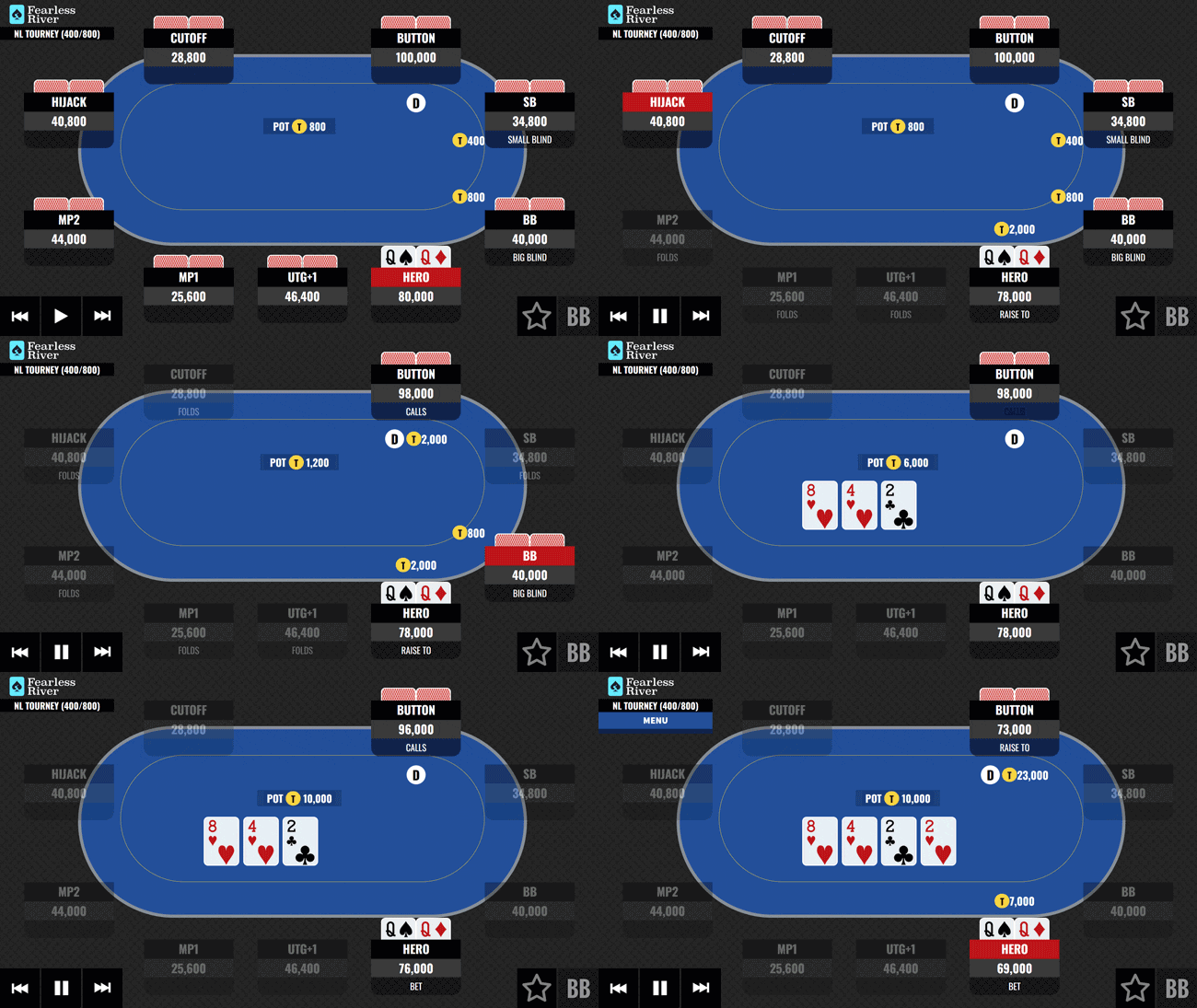
DECISION POINT: You’re playing in a weekend tournament at your local casino, and the reentry period just ended. The blinds are 400/800 with a 800 big blind ante. You are second in chips at your table with an 80,000 (100BBs) chip stack. From Under the Gun you make the standard open and raise to 2,000 with Q♠Q♦ and only the Button, who has you covered, calls. The flop is 8♥4♥2♣. You continuation bet 2,000 and get called. You bet 7,000 on the 2♥ turn and your opponent raises to 23,000. What do you do here?
Vote and see how your answer compares to other players 👇
PRO ANSWER: We are playing in a weekend tournament at our local casino. The reentry period just ended, and the blinds are 400/800 with an 800 big blind ante. We have built up an 80,000 chip stack during the reentry period, which covers the entire table except for the Button, who has 100,000 chips. We are dealt Q♠Q♦ UTG and make a standard raise to 2,000 chips. Everyone folds to the Button who just calls. Both Blinds fold, and we’re off to a flop of 8♥4♥2♣.
Most players will throw out a continuation bet here without a second thought, but it’s important to always be evaluating situations. Range advantage is the primary driver of betting frequency, and we do have a significant range advantage over our opponent in this spot. However, we have an SPR of 13 and an overpair that does not contain a heart. Our opponent will make this call preflop on the Button with a range that is weighted heavily toward suited hands and includes a lot of pocket pairs/suited connectors that connect well with this board.
If we look at this spot in a solver, pocket queens mix between betting and checking, which shows just how tough it can be to play overpairs on boards like this against a skilled Button and with deep stacks. In this situation, we do decide to make a continuation bet of 2,000, and our opponent just calls.
The turn is the 2♥. Now the obvious draw is completed, but given the small bet on the flop, our opponent still has many 8x hands in their range as well as a lot of pocket pairs. If we check and fold to a turn bet against that range, we are giving up our hand with far too much equity. Pocket queens without a heart benefit a fair amount from protection against a lot of our opponent’s range that will have around 11 outs against a vulnerable hand that has strong equity. Based on how these ranges interact on this board, our hand favors going a bit on the larger side with a turn second barrel.
We bet 7,000 and the Button raises to 23,000. Many players struggle with what to do with a big overpair in this situation.
If we step back and evaluate this spot logically, would our opponent ever do this with a worse hand for value? It is unlikely, which means our queens are basically a bluff catcher. Is our opponent bluffing often enough to make calling profitable?
If we consider the Button's actions on each street, there aren’t a lot of hands that make logical bluffs. Our opponent’s range is composed of strong made hands or hands with some showdown value that would likely prefer calling to raising.
Even though we started with the third-best hand in poker preflop, our pocket queens become simply a bluff catcher in a spot where our opponent doesn’t have a lot of bluffs.
Folding is the best play.
How would you play it?
Share your answer in the comments below!
Will YOU Be Our Next Bracelet Winner?
Our students consistently crush the summer poker season, bringing home massive scores and achieving their poker dreams.
In fact, in just the past few years alone during the summer in Vegas Fearless River Students have achieved:
🥇 4 WSOP BRACELETS
🏆 6 WSOP Final Tables
💪 1 Around Town Win
👏 9 Around Town Final Tables
💰 Over $1.7 Million in Cashes
Ready to be our next success story?
Become a FearlessRiver.com Member now for just $5 your 1st month and start preparing for your best summer yet.
Have Questions about Fearless River? Send an email to our Support Team at [email protected] or click the CONTACT US button.
Poker Quiz! J♠J♣ on the Button Facing a Raise and Reraise ...
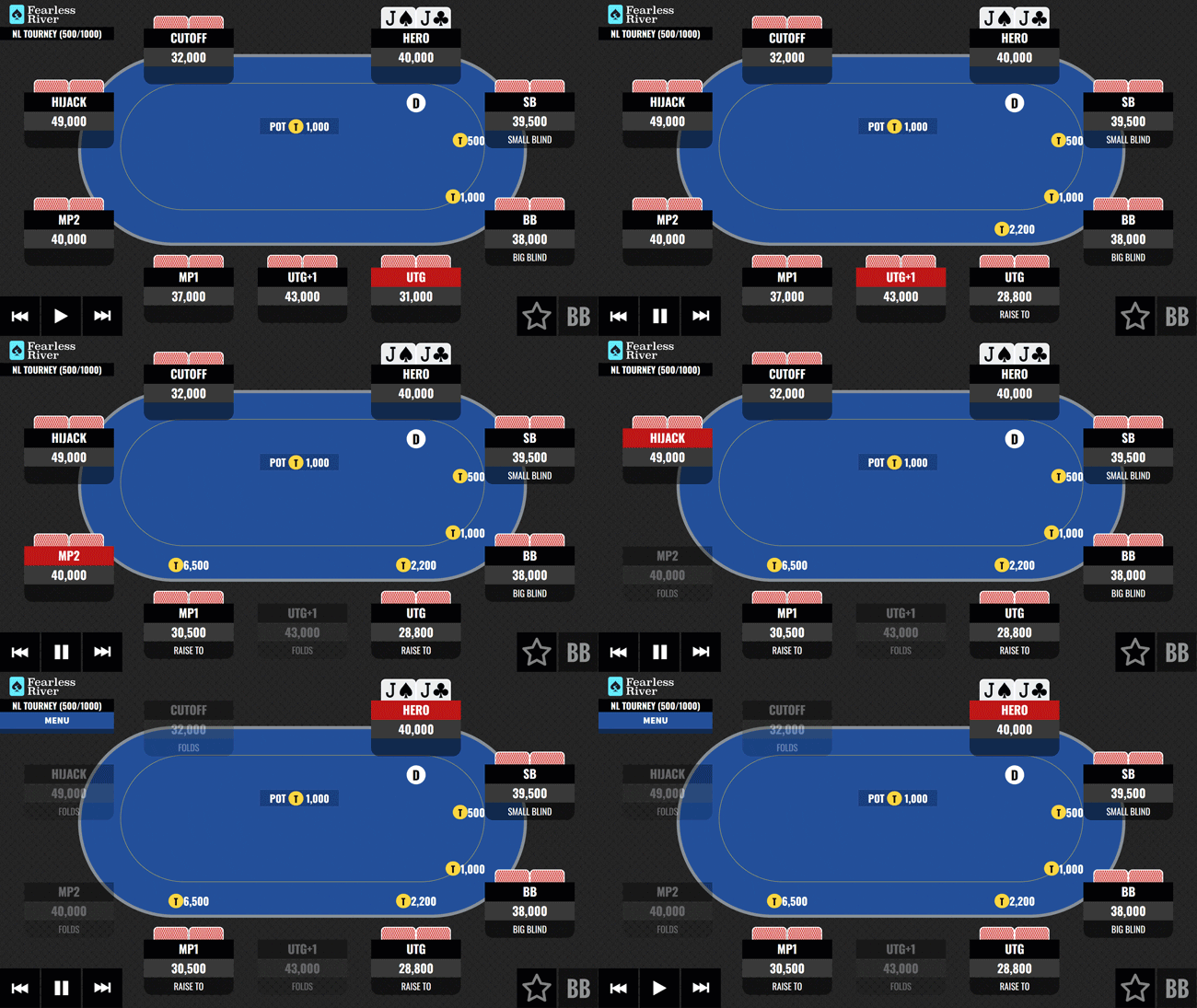
DECISION POINT: You’re playing in a two-day regional tournament and have noticed your tablemates are using appropriate ranges based on hands seen at showdown. The blinds are 500/1,000 with a 1,000 big blind ante. The UTG player raises to 2,200 and MP1 reraises to 6,500. Action folds to you on the Button with J♠J♣. What do you do here?
PRO ANSWER: We are playing in a two-day regional event with a reasonable structure. The blinds are 500/1,000 with a 1,000 big blind ante. So far, we’ve seen solid hands at showdown from every player at the table and can assume we are up against competent opponents.
We are dealt J♠J♣ on the Button and the UTG player raises to 2,200 chips. Following a fold from UTG+1, the player in the MP1 seat reraises to 6,500 chips and everyone else folds to us. This is a spot where many players make the mistake of thinking about their hand’s absolute value instead of their hand’s relative value in the specific situation. Pocket jacks is one of the top 5 starting hands in poker, and we are going to want to continue in some fashion preflop in the majority of situations.
In this scenario, however, the initial raise came from an early position player followed by a reraise from MP1 with 40 big blind effective stacks. In this spot, MP1 should be raising fewer than 5% of total hands. To give an idea of what this looks like, MP1’s reraising range should only include hands such as TT+/AKs/AQo+ along with a few bluffs for balance. A true GTO 3-betting range for MP1 versus UTG open would include 88-QQ all mixing with some frequency, where pocket pairs 88-JJ are doing more calling than raising. Combine MP1’s narrow range with the fact that any action preflop will very quickly become pot committing for us, and our hand doesn’t look near as nice.
If we had some sort of information that our opponents were on the more aggressive side with their preflop ranges, we might be able to continue exploitatively. In longer events that are well-structured, players will often be even more passive than optimal ranges would suggest, which would make continuing here with pocket jacks even more problematic.
It can be incredibly frustrating to be dealt a top 5 starting hand in No-Limit Hold’em and have to fold preflop facing multiple raises. When the action suggests that one of your opponents is likely holding something that is stronger, finding folds and preserving your stack for more favorable situations is a huge edge.
Folding is the best play.
How would you play it?
Share your answer in the comments below!
Will YOU Be Our Next Bracelet Winner?
Our students consistently crush the summer poker season, bringing home massive scores and achieving their poker dreams.
In fact, in just the past few years alone during the summer in Vegas Fearless River Students have achieved:
🥇 4 WSOP BRACELETS
🏆 6 WSOP Final Tables
💪 1 Around Town Win
👏 9 Around Town Final Tables
💰 Over $1.7 Million in Cashes
Ready to be our next success story?
Become a FearlessRiver.com Member now for just $5 your 1st month and start preparing for your best summer yet.
Have Questions about Fearless River? Send an email to our Support Team at [email protected] or click the CONTACT US button.
Poker Quiz! Pocket Sevens in Late Position Vs the Big Blind...
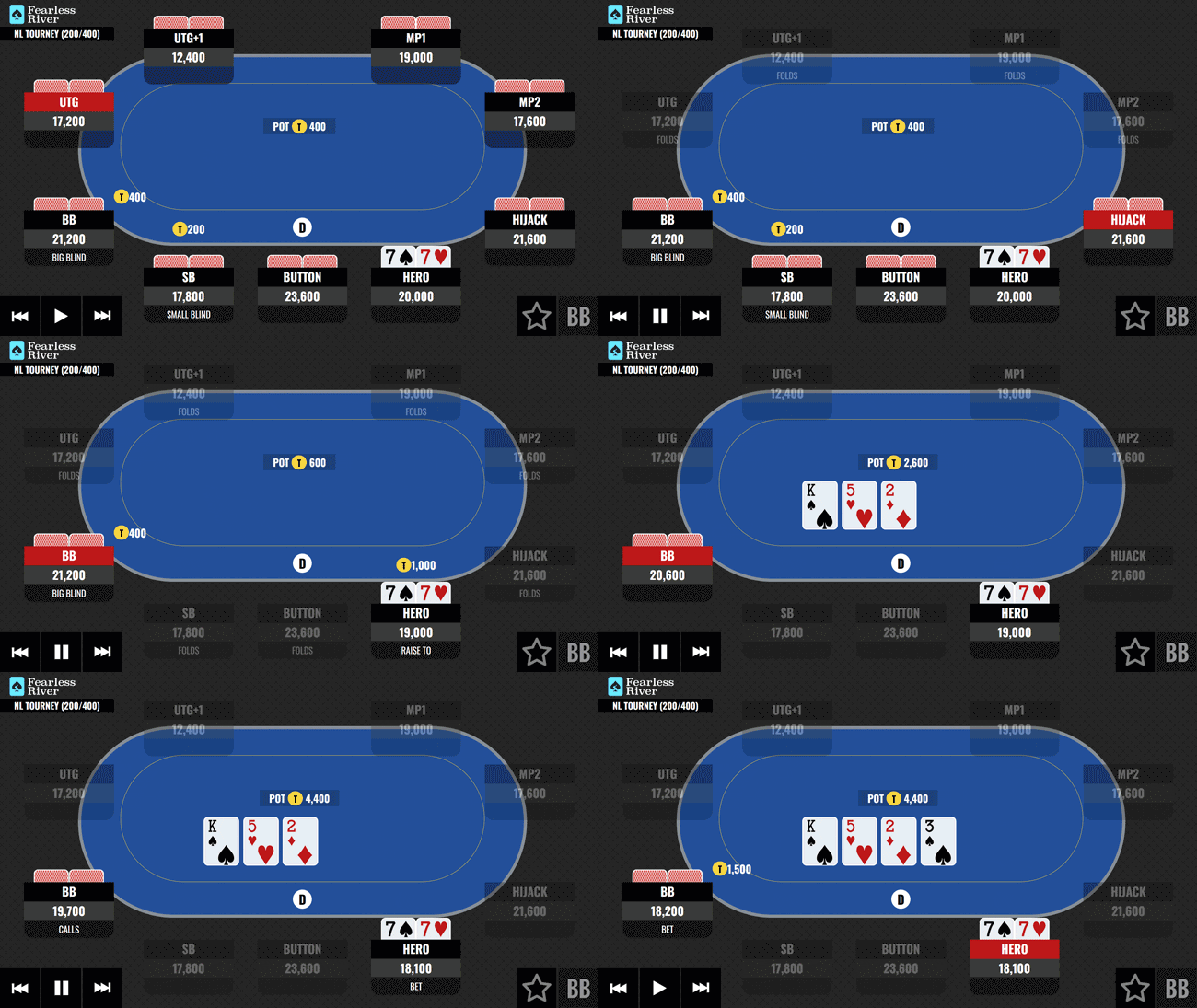
DECISION POINT: You're in the early stages of a daily tournament with no significant reads on your tablemates, with the exception that they mostly have been showing down reasonable hands. The blinds are 200/400 with a 400 big blind ante and you have 20,000 chips to start the hand. The action folds to you in the Cutoff with 7♠7♥, you open to 1,000, and only the Big Blind calls. The flop comes K♠5♥2♦. Your opponent checks, you c-bet 900, and they call. On the 3♠ turn the Big Blind leads out for 1,500 and action is on you. What do you do here?
PRO ANSWER: We are in the earlier stages of a daily tournament with blinds of 200/400 and a 400 big blind ante. Most of the players have been showing down reasonable hands when we’ve had the opportunity to see them, and we otherwise haven’t developed any significant reads to this point in the session.
With 20,000 chips to start the hand in the Cutoff and holding 7♠7♥ we make a standard raise to 1,000 chips, and everyone folds to the Big Blind who just calls. The flop is K♠5♥2♦ and the Big Blind checks to us. This is a board where the preflop raiser from the Cutoff will have a significant range advantage and we will frequently continuation bet with our entire range. In game we make the preferred choice and bet 900 into the 2,600 pot, and the Big Blind just calls.
The turn is the 3♠ and surprisingly, our opponent leads for 1,500. When an opponent takes a line where they lead into the aggressor on the turn, there is often one of several factors at play.
First, the Big Blind will often lead the turn when picking up additional equity, which in this case would mostly be flush draws but does include some Ax, 6x, and 4x hands.
Second, they could have turned two-pair or better with hands including A4, K3, 33, 53, and 32s, and are trying to build a pot fearing we may not fire again on this board texture. Lastly, this turn lead may be intended to deny equity since we are betting such a wide range on the flop. Many of the 5x combos in the Big Blind’s range benefit greatly from generating folds from some of our random overcards, such QJo, that still have significant equity.
Given these assumptions, the Big Blind’s leading range likely consists of some draws, some bigger hands, and some medium-strength hands looking to clear out equity. Our pocket sevens are doing fairly well against that range. However, there is little reason to raise as our opponent is likely to fold medium-strength hands we dominate, continue with the hands that dominate us, and proceed with draws only if getting the correct price.
Calling is the best play.
How would you play it?
Share your answer in the comments!
Will YOU Be Our Next Bracelet Winner?
Our students consistently crush the summer poker season, bringing home massive scores and achieving their poker dreams.
In fact, in just the past few years alone during the summer in Vegas Fearless River Students have achieved:
🥇 4 WSOP BRACELETS
🏆 6 WSOP Final Tables
💪 1 Around Town Win
👏 9 Around Town Final Tables
💰 Over $1.7 Million in Cashes
Ready to be our next success story?
Become a FearlessRiver.com Member now for just $5 your 1st month and start preparing for your best summer yet.
Have Questions about Fearless River? Send an email to our Support Team at [email protected] or click the CONTACT US button.
Poker Quiz! 9♥9♣ Facing a Flop Donk Bet, What's Your Move?
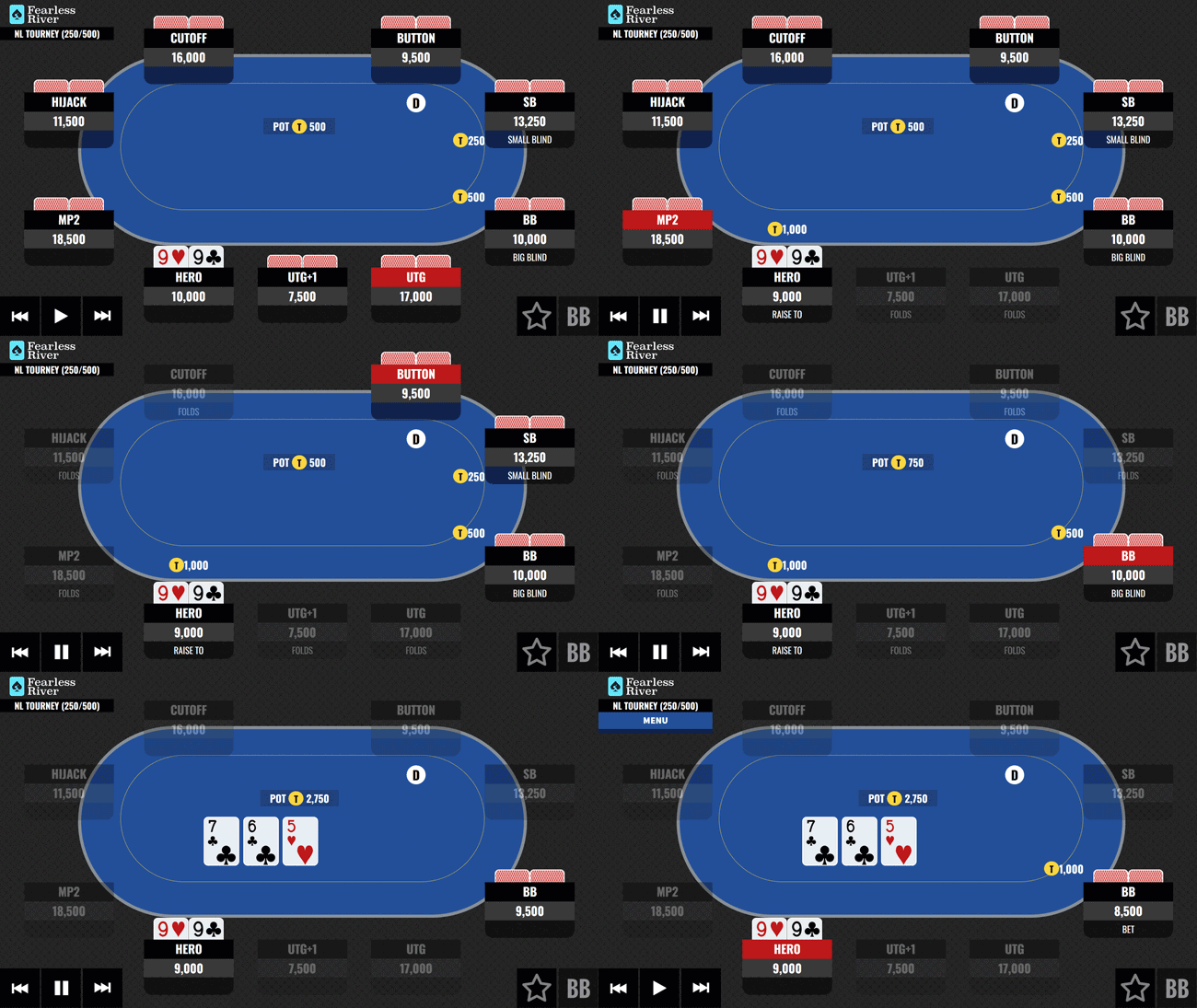
DECISION POINT: You have late registered for a daily tournament with a fast structure. The blinds are 250/500 with a 500 big blind ante. It folds to you in MP1 with 9♥9♣ and you raise first-in to 1,000. Action folds to the Big Blind who just calls. The flop comes 7♣6♣5♥ and your opponent bets 1,000. Action is on you. What do you do here?
PRO ANSWER: We have just entered a daily tournament with a fast structure and are jumping in a few levels after the start. The blinds are 250/500 with a 500 big blind ante. We are dealt 9♥9♣ in MP1 with our 10,000 starting stack. Everyone folds to us, and since pocket nines are a part of our first-in hand range from this position, we open to 1,000 chips. Everyone folds except the Big Blind, who just calls.
The flop is 7♣6♣5♥ and our opponent leads for 1,000 chips. Unlike our recent decision from a cash game session, this is a spot where a good opponent should be doing some leading based on theory. This board does connect well with a Big Blind defense calling range, but they have many hands that benefit from protection, and this is a board we won’t be expected to continuation bet often.
The Big Blind’s range should include a lot of 1-pair hands, especially those that have some sort of straight and/or flush draw to provide some backup equity. They will also lead with some overcard combinations that include flush draws, both backdoor and direct, as well as some 2-pair hands for balance. When we look at this situation closely, the Big Blind should be leading with around 50% of their range on this board.
From our perspective, we have an overpair with an inside straight draw and a stack to pot ratio (SPR) of around 3. This is not a spot we would ever be looking to fold our hand, so the main question we have to ask is if we should just call or raise. When considering the potential leading range for the Big Blind as discussed above, we can assume:
- We are well ahead of most of their 1-pair hands
- We still have significant equity against many of their 2-pair hands
- Many of their overcards have significant equity against us
It is important to consider that if we were to raise now, many of their hands that we are well ahead of will call, while many of the overcard combos that have significant equity against us will fold (with the exception of direct flush draws using both hole cards). When our opponent will continue against aggression with hands such as 74s but folds hands such as JhTh or KcTh, that is a huge win for us.
Raising is the best play.
How would you play it?
Share your answer in the comments!
Play Better Poker With Fearless River!
Whether you’re brand-new to poker training or are an experienced student, a membership to FearlessRiver.com is your chance to learn from world-class professional poker players in a friendly community using state-of-the-art tools.
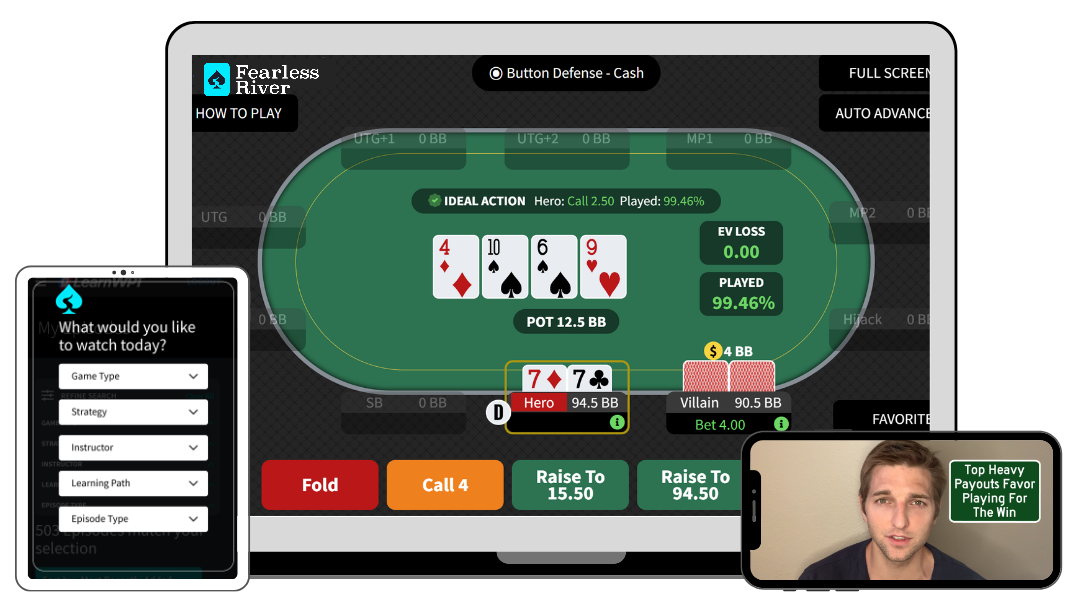
Join now to get started, and you'll immediately gain access to the Fearless River training features, including GTO Trainer packs, 550+ strategy videos, downloadable tools, Ask a Pro Discord, and more!
Have Questions about Fearless River? Send an email to our Support Team at [email protected] or click the CONTACT US button.
Poker Quiz! Facing a C-Bet After Flopping Trips, What Do You Do?
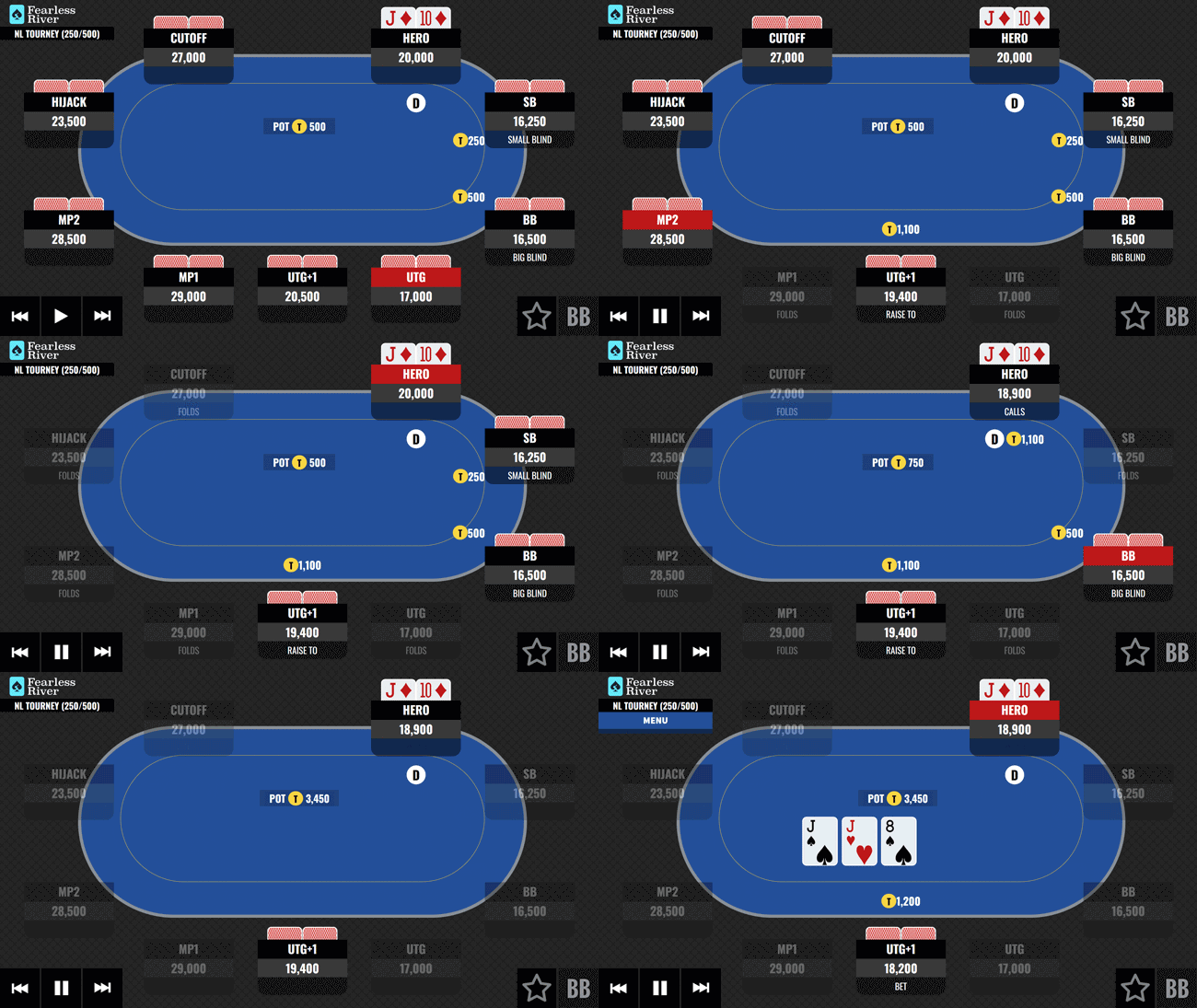
DECISION POINT: You’re playing a $1,500 regional tournament main event at a local card room that brings serious recreational players and pros. The play at your table has been aggressive with a lot of players firing multiple streets and few hands going to showdown. Blinds are 250/500 with a 500 big blind ante and you have a 20,000 chip stack. The opponent in UTG+1, who is an accomplished player, opens to 1,100 and everyone folds to you on the Button with J♦T♦. You call and the flop comes J♠J♥8♠. The early position opponent c-bets 1,200 and the action is on you. What's your move here?
PRO ANSWER: We're playing in a regional tournament at our local card room. It's a $1,500 main event that tends to draws in a lot of serious recreational players as well as pros from around the region. The action at our table has been a bit on the aggressive side, with lots of players capable of firing multiple barrels and few hands going to showdown.
The blinds are 250/500 with a 500 big blind ante, and we have 20,000 chips to start the hand. We are on the Button and are dealt J♦T♦. The UTG player folds and the opponent in UTG+1, who we recognize as an accomplished player and WSOP Bracelet winner, opens to 1,100 chips. Everyone else folds.
This is a great spot to call as part of an overall Button defense strategy. Our hand plays extremely well postflop with positional advantage, giving us a big edge at this stack depth against players who are capable of firing multiple barrels.
Both Blinds fold and the flop is J♠J♥8♠. The UTG+1 player comes out firing 1,200 chips, or just over one third of the pot. This is a flop where the early position raiser has a significant range advantage, and we can expect them to be betting nearly their entire range. We flopped a very strong hand and have a decision to make. Should we slow play our three of a kind or play it faster by raising now?
In this case, we are in position and against a single opponent. They should be continuation betting with a very wide range of hands, including plenty of overcard combinations that might not call a raise on the flop but could easily put more chips in the pot if they hit something like an ace or a king on the turn. UTG+1’s c-bet bluffing range could also easily continue bluffing on a lot of turn cards.
Many players immediately see the flush and straight draw cards on this board and become passive for fear of getting drawn out on. While that is the case, flush draws make up a very small portion of our opponent’s overall range, and we block a key straightening card by holding the Td in our hand. Additionally, if we raise it is difficult to get called by many worse hands. An early position raising range is unlikely to have many worse Jx combos than our JTs, and while UTG+1 does have some AA/KK/QQ hands, even those might proceed with caution when we raise the flop.
When we pause to consider the specific opponent, table tendencies, our position, the stack depth, and how both our ranges interact with this board, our best chance to win a big pot and maximize EV in this spot is to slow play and just call.
Calling is the best play.
How would you play it?
Share your answer in the comments!
Play Better Poker With Fearless River!
Whether you’re brand-new to poker training or are an experienced student, a membership to FearlessRiver.com is your chance to learn from world-class professional poker players in a friendly community using state-of-the-art tools.
Join now to get started, and you'll immediately gain access to the Fearless River training features, including GTO Trainer packs, 550+ strategy videos, downloadable tools, Ask a Pro Discord, and more!
Have Questions about Fearless River? Send an email to our Support Team at [email protected] or click the CONTACT US button.
Poker Quiz! 3-Betting From the Small Blind With J♠J♣ ...
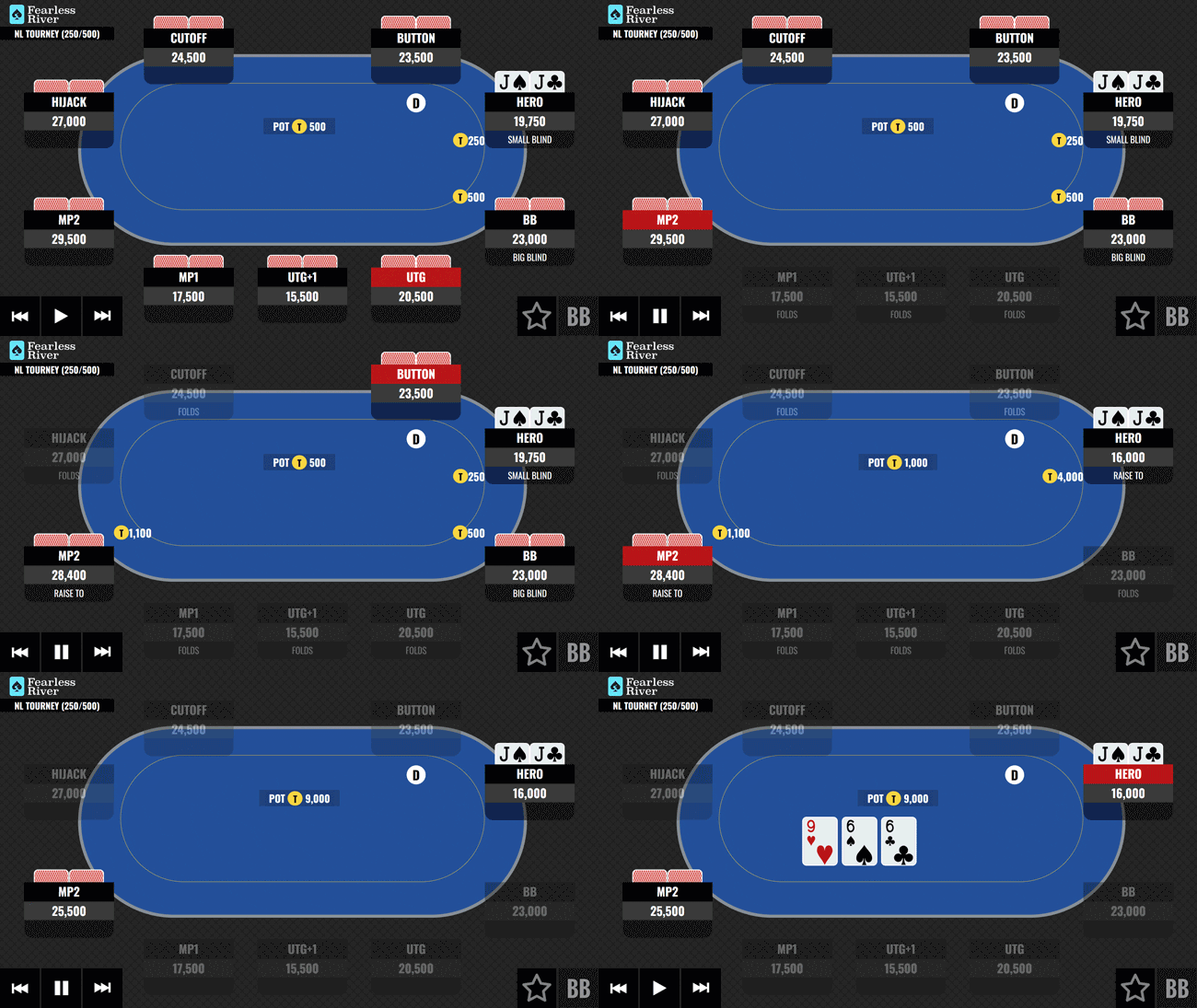
DECISION POINT: You’re playing a daily tournament and late registration is still open. The blinds are 250/500 with a 500 big blind ante. A player in Middle Position raises first-in to 1,100 and it folds to you in the Small Blind with J♠J♣. You 3-bet to 4,000, the Big Blind folds, and the original raiser calls. The flop comes 9♥6♠6♣ and action is on you. What do you do here?
PRO ANSWER: We're playing in a daily tournament. Late registration is still open and the blinds are 250/500 with a 500 big blind ante. We are dealt J♠J♣ in the Small Blind and the action folds to MP2 who opens to 1,100 chips. Everyone else folds and action is on us.
Out of the Small Blind we prefer to reraise with a linear range, meaning that we will be reraising for value with hands that are ahead of our opponent’s range. Our opponent in Middle Position should be opening with around 25% of total hands as the first-in raiser.
Our jacks are well ahead of that range, so they would be a part of a linear 3-betting range. Typical 3-bet sizing will be around 3x the opening raise size, but since we will be out of position the remainder of the hand, we want to reraise a bit larger to make up for the positional disadvantage. We elect to make it 4,000 chips and our opponent calls.
The flop is 9♥6♠6♣ and action is on us. As the preflop 3-bettor we have a large range advantage on this flop and have all the big overpairs in our range. MP2’s range consists mostly of bigger suited cards and middle pairs, most of which don’t connect very well with this board. Since we have such a tremendous range advantage, it is ideal to c-bet with our entire range.
Typically, we utilize a smaller bet size when c-betting our entire range. However, this situation is unique. The stack to pot ratio (SPR) is just under two. With so much money in the pot in relation to our stack, some hands in our range start to really benefit from protection.
In this case, our really strong hands like AA/KK and semi-bluffs, such as AKo/AQo type hands, prefer to bet around 25% of the pot. Our more vulnerable hands, like TT/JJ and A9s, want to bet a larger sizing of around 50% of the pot in order to protect against many of the potential overcards that connect with MP2’s range.
Betting half of the pot is the best play.
How would you play it?
Share your answer in the comments section below!
Play Better Poker With Fearless River!
Whether you’re brand-new to poker training or are an experienced student, a membership to FearlessRiver.com is your chance to learn from world-class professional poker players in a friendly community using state-of-the-art tools.
Join now to get started, and you'll immediately gain access to the Fearless River training features, including GTO Trainer packs, 550+ strategy videos, downloadable tools, Ask a Pro Discord, and more!
Have Questions about Fearless River? Send an email to our Support Team at [email protected] or click the CONTACT US button.
Poker Quiz! In Late Position With 7♥7♣ Vs the Big Blind...
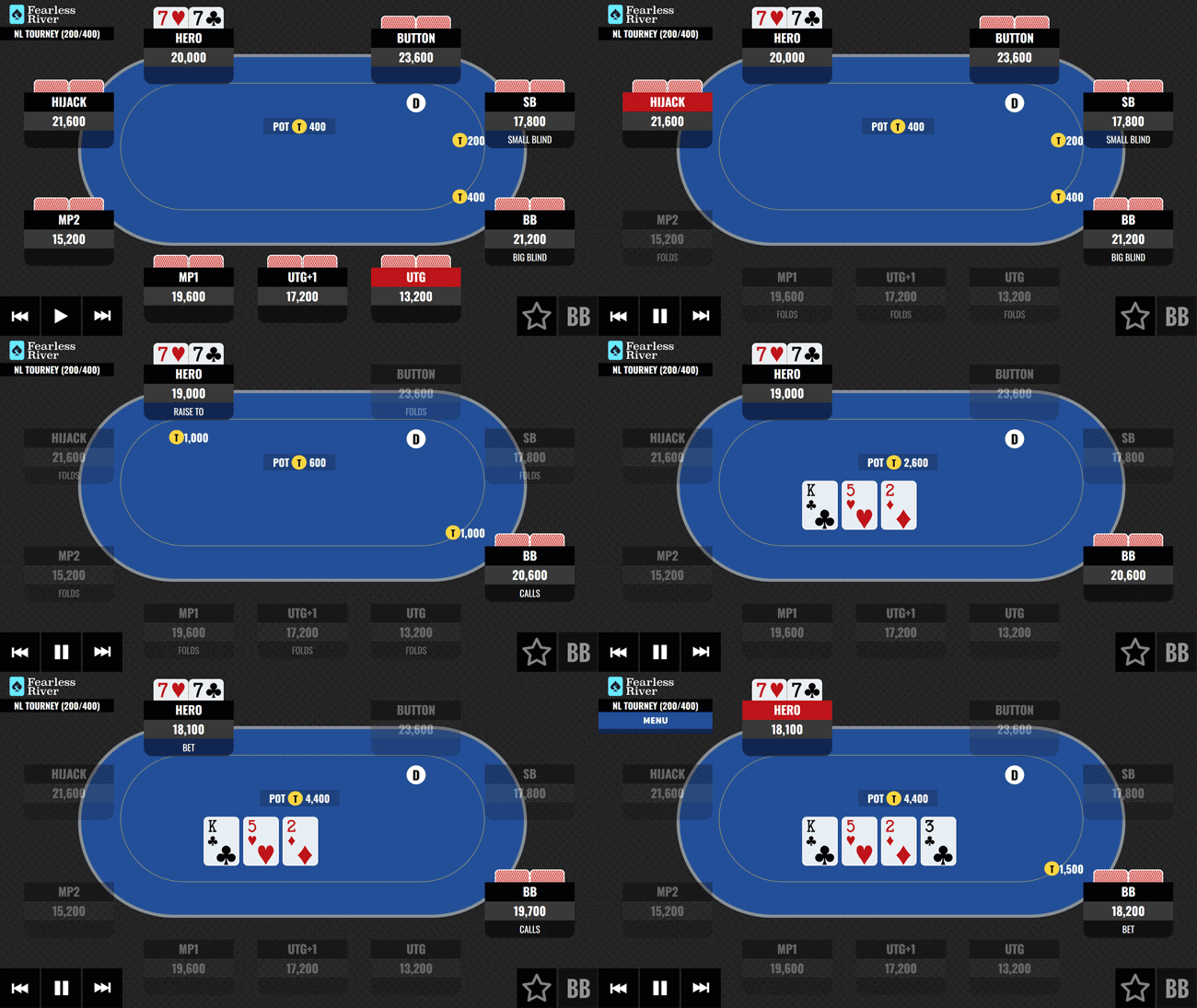
DECISION POINT: You are in the early stages of a daily tournament and you don’t have any significant reads on your tablemates, with the exception that most have been showing down reasonable hands. The blinds are 200/400 with a 400 big blind ante and you have 20,000 chips to start the hand. The action folds to you in the Cutoff with 7♥7♣, you open to 1,000, and only the Big Blind calls. Your opponent checks the K♣5♥2♦ flop, you c-bet 900, and they call. On the 3♣ turn, the Big Blind leads out for 1,500. Action is on you, what do you do here?
PRO ANSWER: We are in the earlier stages of a daily tournament with blinds of 200/400 and a 400 big blind ante. Most of the players have been showing down reasonable hands when we’ve had the opportunity to see them, and we haven’t developed any significant reads to this point in the session.
With 20,000 chips to start the hand in the Cutoff and 7♥7♣ we make a standard raise to 1,000 chips, and everyone folds to the Big Blind who just calls. The flop is K♣5♥2♦ and the Big Blind checks to us. This is a board where the preflop raiser from the Cutoff will have a significant range advantage and we will frequently continuation bet with our entire range. In game we make the preferred choice and bet 900 into the 2,600 pot, and the Big Blind just calls.
The turn is the 3♣ and surprisingly, our opponent leads for 1,500. When an opponent takes a line where they lead into the aggressor on the turn, there are often one of several factors at play.
First, the Big Blind will often lead the turn when picking up additional equity, which in this case would mostly be flush draws but does include some Ax, 6x, and 4x hands.
Second, they could have turned two-pair or better with hands including A4, K3, 33, 53, and 32s, and are trying to build a pot fearing we may not fire again on this board texture. Lastly, this turn lead may be intended to to deny equity since we are betting such a wide range on the flop. Many of the 5x combos in the Big Blind’s range benefit greatly from generating folds from some of our random overcards such QJo that still have significant equity.
Given these assumptions, the Big Blind’s leading range likely consists of some draws, some bigger hands, and some medium-strength hands looking to clear out equity. Our pocket sevens are doing fairly well against that range. However, there is little reason to raise as our opponent is likely to fold medium-strength hands we dominate, continue with the hands that dominate us, and proceed with draws only if getting the correct price.
Calling is the best play.
How would you play it?
Share your answer in the comments below!
Improve Your Game Today!
Join Fearless River and Get:
- The GTO Trainer to play real solved hands and get instant feedback on YOUR leaks (over 4 BILLION solved spots!)
- On-demand access to our full library of 550+ (and growing) in-depth Strategy Episodes from world-class players
- All of your poker questions answered with the Ask a Pro Feature
- Analysis from Fearless River Pros using The Hand Input Tool
- Downloadable Tools you can use at and away from the tables
- Learn from a Team of world-class Professional Players
To join (just $5 your 1st month) click the JOIN NOW button and start improving your game!
Have Questions? Email us at [email protected].
Poker Quiz! At the WSOP With A♠T♠ vs a Pro, What Do You Do?
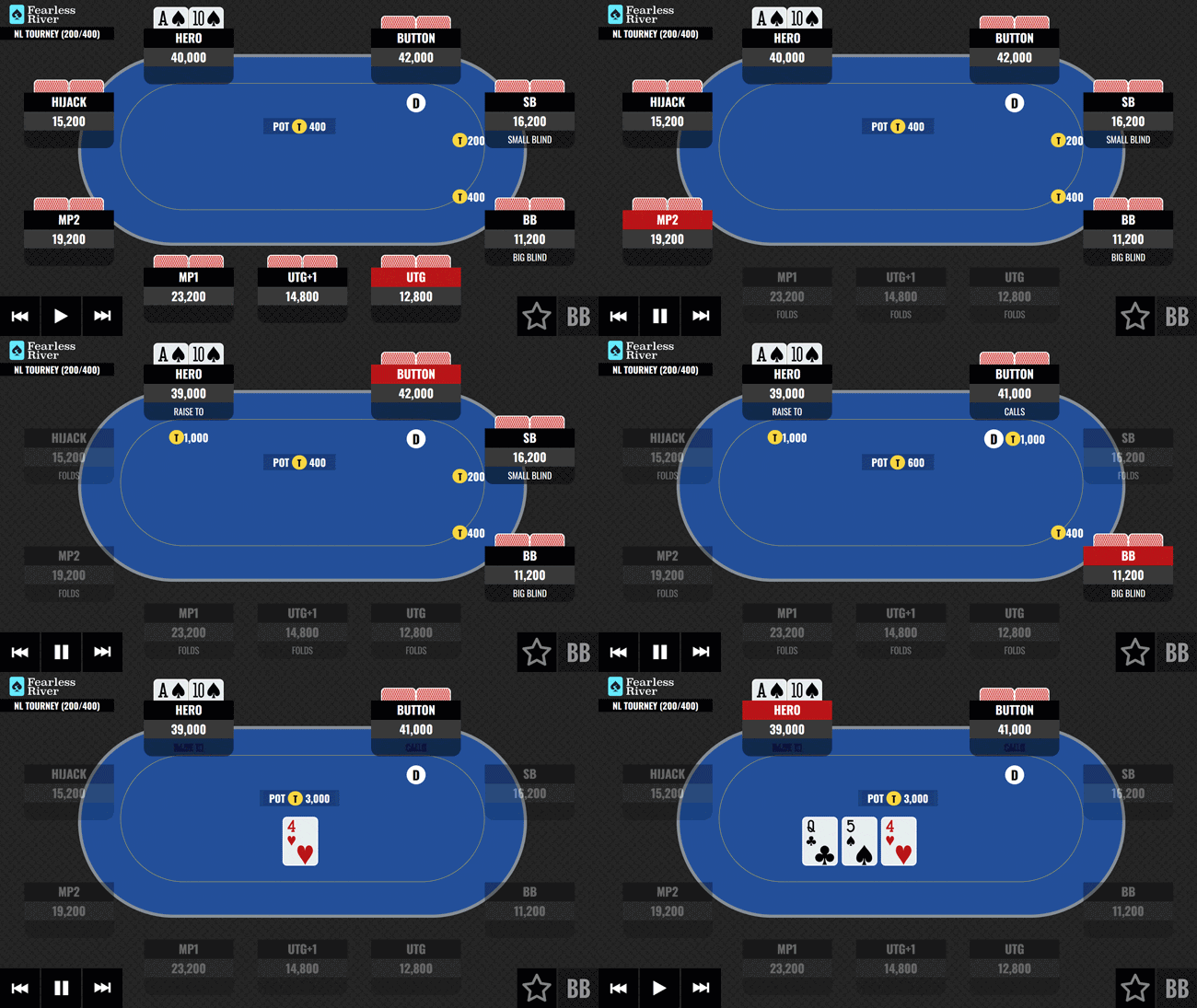
DECISION POINT: You are in the early stages of a multi-day tournament at the World Series of Poker with late registration and reentry still available. Most players have around 50 big blinds but you’ve worked your stack up to 100BBs. The action folds around to you in the Cutoff with A♠T♠ and you make a standard raise to 1,000. The Button, who is an accomplished Pro and has a 105BB stack, calls and the Blinds fold. The flop comes Q♣5♠4♥ and action is on you.
What do you do here?
PRO ANSWER: We are playing a multi-day event at the World Series of Poker. The tournament is in the early stages with late registration still open and players are allowed to reenter. Most players have around 50 big blinds but we’ve managed to work our stack up to 100BBs. The Button is a very studied Pro. The blinds are 200/400 with a 400 big blind ante and we are dealt A♠T♠ in the Cutoff. The action folds to us and we make a standard raise to 1,000. The Button decides to call and both Blinds fold. The flop is Q♣5♠4♥ and we are first to act.
The primary driver of continuation betting frequency on the flop is range advantage. Many players make the mistake of assuming that just because we are the preflop raiser, we have a range advantage on dry boards such as this one. Position is a key factor to consider in c-betting spots, and had we raised in Early Position instead of the Cutoff we certainly would have a range advantage on this board. However, in this specific situation we have a wide uncapped range and our opponent has a significantly narrower range that is capped and condensed.
Reviewing this spot in a solver after the hand we see that the Button actually defends with less than half as many hand combinations as we raise with from the Cutoff (215 vs 450) and has a slight range advantage (51% vs 49%) on the flop before any action takes place.
This happens most frequently in Cutoff opens vs Button call and Small Blind vs Big Blind scenarios. When facing skilled and aggressive players in these situations who are capable of utilizing their position appropriately, we should check the flop quite frequently. In fact, based on the solver results the Cutoff checks with the entire range around 85% of the time. It’s very important to note that checking here doesn’t mean giving up. We should be checking some of our big hands to protect our checking range and add some check-raising with some strong value hands and bluffs such A2s/A3s on this particular board. Check-calling on the flop also makes up a portion of our strategy, particularly against smaller bet sizes.
If our opponent on the Button was a more passive recreational player in this spot the strategy would change significantly. There would be more merit to betting because a passive opponent would likely be calling preflop with a much wider range, negating the range advantage a more narrow and condensed range has on this board, and they would be far less likely to float and raise the flop with the appropriate tendencies to discourage us from continuation betting.
Against tougher players it’s very important to recognize these spots as high frequency checks or we will quickly bleed chips to good players who utilize position well.
Checking is the best play.
How would you play it?
Share your answer in the comments below!
Will YOU Be Our Next Bracelet Winner?
Our students consistently crush the summer poker season, bringing home massive scores and achieving their poker dreams.
In fact, in just the past few years alone during the summer in Vegas Fearless River Students have achieved:
🥇 4 WSOP BRACELETS
🏆 6 WSOP Final Tables
💪 1 Around Town Win
👏 9 Around Town Final Tables
💰 Over $1.7 Million in Cashes
Ready to be our next success story?
Become a FearlessRiver.com Member now for just $5 your 1st month and start preparing for your best summer yet.
Have Questions about Fearless River? Send an email to our Support Team at [email protected] or click the CONTACT US button.